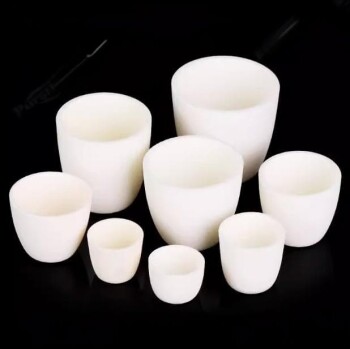
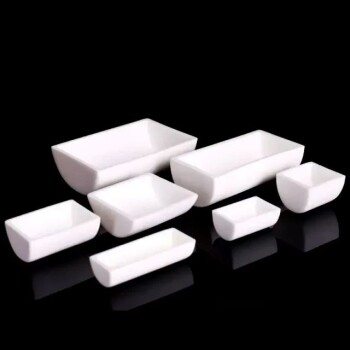
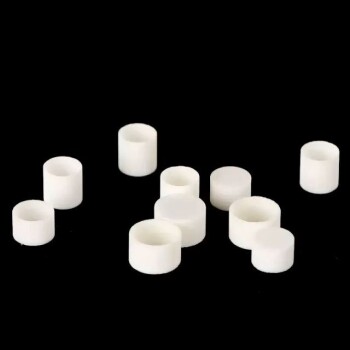
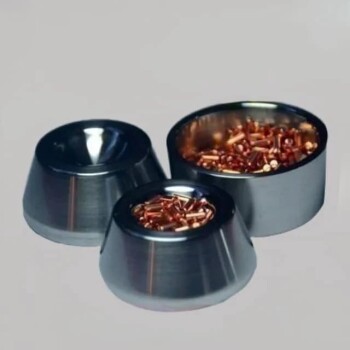
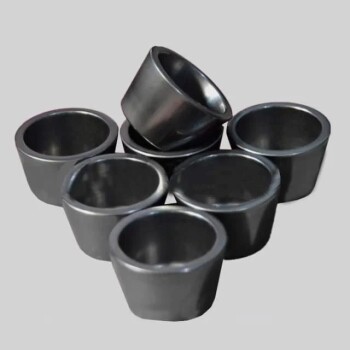
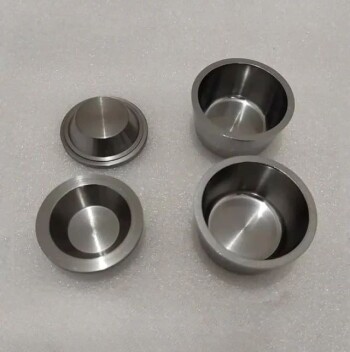
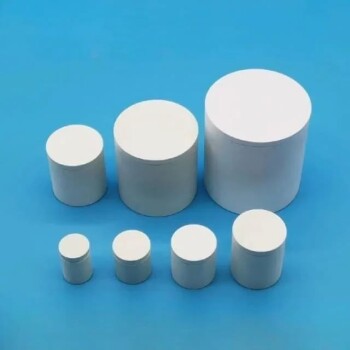
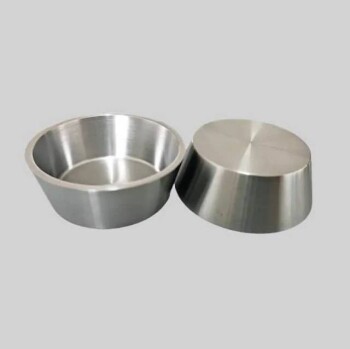
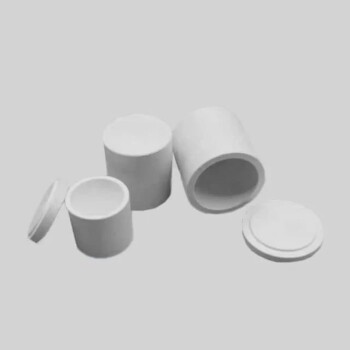
The necessity of using an alumina (corundum) crucible stems from its ability to maintain structural integrity and chemical neutrality under extreme conditions. When annealing loose ceramic powders, these crucibles can withstand temperatures of 1500°C without deforming or softening. Most importantly, they prevent the vessel itself from contaminating the sample, ensuring that the powder's properties are defined solely by your experimental parameters.
High-temperature annealing requires total experimental isolation. Alumina crucibles ensure that the final characteristics of your powder are the result of the heat treatment process alone, rather than an unwanted reaction with the container wall.
The Critical Role of Thermal Stability
Withstanding Extreme Heat
Loose ceramic powders often require processing at temperatures that would compromise standard laboratory vessels. An alumina crucible is a high-purity refractory container designed to survive these environments.
It maintains its shape and rigidity at temperatures as high as 1500°C. This prevents the physical collapse of the vessel, which could lead to the loss of the sample or damage to the furnace.
Ensuring Chemical Purity and Accuracy
Preventing Secondary Reactions
The primary danger during high-temperature annealing is the interaction between the sample and the vessel. Alumina exhibits excellent chemical inertness, acting as a neutral barrier during the heating process.
This is vital when working with reactive materials, such as silicon nitride, alumina powders, or lithium salts. The crucible refuses to engage in secondary chemical reactions with these precursors, eliminating a common source of experimental error.
Maintaining Stoichiometry
In solid-state synthesis, the ratio of elements (stoichiometry) determines the material's final performance. A reactive crucible can leach elements into the powder or absorb components from it.
By preventing the introduction of impurities, alumina ensures the synthesized ceramic powder maintains its strict stoichiometric ratio. This results in a final product that is chemically pure and consistent with the intended design.
The Risks of Material Contamination
Phase Evaluation Integrity
If a crucible reacts with the sample, it alters the chemical composition, leading to incorrect data regarding phase changes. This makes it impossible to distinguish between the effects of the heat treatment and the effects of contamination.
Using alumina ensures that phase evaluations depend solely on the initial composition and the heat treatment profile. This isolation is the only way to validate that your thermal annealing process is working as intended.
Making the Right Choice for Your Goal
To ensure the validity of your high-temperature experiments, consider the following specific requirements:
- If your primary focus is Phase Analysis: Use alumina to ensure observed structural changes are driven purely by temperature, not by foreign contaminants from the vessel.
- If your primary focus is Material Synthesis: Rely on alumina to prevent reaction with precursors like lithium salts, ensuring your final powder retains high purity and precise stoichiometry.
By selecting the correct refractory vessel, you eliminate variables and secure the reliability of your data.
Summary Table:
| Feature | Alumina (Corundum) Crucible Benefit | Impact on Ceramic Powder |
|---|---|---|
| Thermal Resistance | Withstands up to 1500°C without deformation | Prevents sample loss and furnace damage |
| Chemical Inertness | High purity, non-reactive refractory properties | Eliminates secondary reactions and impurities |
| Structural Integrity | Rigid shape under extreme heat | Ensures physical isolation of the sample |
| Purity Control | Prevents leaching or absorption of elements | Maintains strict stoichiometric ratios |
| Data Validity | Neutral barrier during phase changes | Ensures phase evaluations depend solely on heat profile |
Elevate Your Research Precision with KINTEK's High-Performance Labware
Don't let crucible contamination compromise your material synthesis. KINTEK specializes in premium laboratory equipment and consumables designed for the most demanding thermal processes. Our high-purity alumina (corundum) and ceramic crucibles provide the chemical inertness and thermal stability required for consistent, high-yield results in high-temperature annealing.
Whether you are performing solid-state synthesis or phase analysis, we offer a comprehensive range of muffle and tube furnaces, high-temperature reactors, and crucibles tailored to your specific research needs.
Ready to secure the reliability of your data? Contact KINTEK today to discover how our high-temperature solutions can enhance your laboratory's efficiency and accuracy!
References
- Daryn B. Borgekov, Dmitriy I. Shlimas. Synthesis and Characterization of the Properties of (1−x)Si3N4-xAl2O3 Ceramics with Variation of the Components. DOI: 10.3390/ma16051961
This article is also based on technical information from Kintek Solution Knowledge Base .
Related Products
- Arc-Shaped Alumina Ceramic Crucible High Temperature Resistant for Engineering Advanced Fine Ceramics
- Alumina Al2O3 Ceramic Crucible Semicircle Boat with Lid for Engineering Advanced Fine Ceramics
- Engineering Advanced Fine Ceramics Alumina Al2O3 Crucible With Lid Cylindrical Laboratory Crucible
- Engineering Advanced Fine Ceramics Alumina Crucibles (Al2O3) for Thermal Analysis TGA DTA
- Engineering Advanced Fine Alumina Al2O3 Ceramic Crucible for Laboratory Muffle Furnace
People Also Ask
- Why Use Alumina Crucibles & Powder Burial for NaSICON? Ensure Phase Purity and Prevent Elemental Volatilization
- What is the primary purpose of using alumina crucibles for LLTO ceramics? Optimize Your High-Temperature Sintering
- Why are alumina crucibles and mother powder essential for LATP sintering? Optimize Your Solid Electrolyte Performance
- Why are high-purity alumina crucibles used for liquid lead corrosion experiments? Ensure Data Accuracy at 550°C
- Primary considerations for choosing alumina crucibles and quartz tubes in indium intercalation: Ensure Material Purity