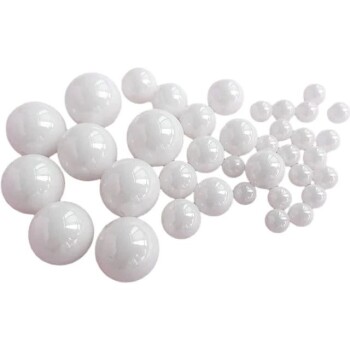
The use of high-strength stainless steel components is strictly necessary to generate high-impact kinetic energy while maintaining material purity. During the milling of CrFeCuMnNi alloys, hardened steel jars and balls provide the specific mass and hardness required to break atomic bonds and refine the powder without introducing excessive contaminants from the equipment itself.
Successful mechanical alloying of high-entropy alloys requires a delicate balance of extreme force and material purity. High-strength stainless steel provides the critical mass needed to fracture atomic bonds, while its wear resistance prevents the grinding medium itself from destroying the integrity of the final powder.
The Physics of Mechanical Alloying
Generating Kinetic Energy
The synthesis of high-entropy alloys (HEAs) is not merely a mixing process; it is a high-energy collision process.
Hardened stainless steel balls provide the essential mass required to generate enormous kinetic energy. When rotated at high speeds, the density of these balls translates into significant impact force, which is the primary driver of the alloying mechanism.
Breaking Atomic Bonds
To create a CrFeCuMnNi alloy, elements must be combined at the atomic level.
The kinetic energy generated by the steel media is essential for breaking the atomic bonds between the elemental powders. This fracture allows for the necessary diffusion and structural rearrangement required to achieve true mechanical alloying.
Refining and Homogenization
The milling process involves extended cycles of dry and wet grinding.
Through continuous mechanical impact, the high-strength media refines the particle size and ensures the mixture is chemically homogeneous. This creates a high-quality pre-alloyed powder that is structurally ready for subsequent sintering processes.
The Role of Wear Resistance
Minimizing Impurity Contamination
One of the greatest risks in mechanical milling is "cross-contamination" from the milling tools.
If the grinding balls or jars are softer than the alloy material, they will degrade rapidly, shedding debris into your powder. High-strength stainless steel acts as a barrier against this degradation, significantly reducing the amount of foreign material introduced into the alloy.
Withstanding Extended Processing
The preparation of HEA powders is an aggressive, time-consuming process.
Standard steel would deteriorate quickly under the repetitive stress of high-speed impact. The hardening treatment applied to high-strength components ensures they retain their structural integrity throughout the lengthy dry and wet grinding phases.
Understanding the Trade-offs
The Reality of "Minimized" Contamination
It is critical to distinguish between minimized contamination and zero contamination.
While high-strength steel drastically reduces wear, it does not eliminate it entirely. Over extended milling periods, trace amounts of iron (Fe) from the steel media may still leach into the CrFeCuMnNi mixture. Because Iron is already a constituent element of this specific alloy, this contamination is often less detrimental than it would be in non-ferrous alloys, but it still alters the final stoichiometric ratio.
Making the Right Choice for Your Goal
To ensure the quality of your CrFeCuMnNi alloy, consider the following operational priorities:
- If your primary focus is synthesis efficiency: maximize the rotational speed to fully leverage the mass of the hardened steel balls, ensuring sufficient energy is transferred to break atomic bonds.
- If your primary focus is compositional accuracy: Regularly inspect the weight of your milling balls before and after cycles to calculate exactly how much iron has been lost from the media and added to your alloy.
Select your equipment hardness not just for durability, but as a critical variable in the chemical purity of your final material.
Summary Table:
| Feature | Requirement for CrFeCuMnNi Alloying | Role of High-Strength Stainless Steel |
|---|---|---|
| Kinetic Energy | High force to break atomic bonds | Provides necessary mass and density for impact |
| Material Purity | Low contamination from tools | Wear-resistant surface prevents debris shedding |
| Particle Size | Uniform refinement and homogenization | Enables aggressive dry/wet grinding cycles |
| Durability | Ability to withstand long milling times | Hardened structure resists structural fatigue |
Elevate Your Material Research with KINTEK
Precision in high-entropy alloy synthesis starts with the right tools. KINTEK specializes in premium laboratory equipment, offering high-performance crushing and milling systems featuring high-strength stainless steel jars and balls designed for the rigorous demands of mechanical alloying.
Whether you are refining CrFeCuMnNi alloys or developing new HEAs, our comprehensive range—including high-temperature furnaces, hydraulic presses, and specialized milling media—ensures your powders achieve maximum homogeneity with minimal contamination.
Ready to optimize your milling process? Contact us today to discover how KINTEK's advanced solutions can enhance your lab's efficiency and material integrity.
References
- S. Sivasankaran, Abdel-baset H. Mekky. Influence of Oxide Dispersions (Al2O3, TiO2, and Y2O3) in CrFeCuMnNi High-Entropy Alloy on Microstructural Changes and Corrosion Resistance. DOI: 10.3390/cryst13040605
This article is also based on technical information from Kintek Solution Knowledge Base .
Related Products
- Laboratory Jar Mill with Agate Grinding Jar and Balls
- Laboratory Jar Ball Mill with Alumina Zirconia Grinding Jar and Balls
- Laboratory Ball Mill Jar Mill with Metal Alloy Grinding Jar and Balls
- Laboratory Single Horizontal Jar Mill
- Laboratory Four-Body Horizontal Jar Mill
People Also Ask
- What are the different types of laboratory mills? Choose the Right Grinder for Your Sample Material
- What is use for grinding in the laboratory? Select the Right Mill for Accurate Sample Prep
- What laboratory apparatus is used for grinding? Match the Right Mill to Your Sample Material
- What is the function of a laboratory grinding mill? Achieve Precise Sample Preparation for Accurate Results
- Why are agate milling jars and balls used for Mo-La2O3 powder mixing? Ensure High-Purity Material Dispersion