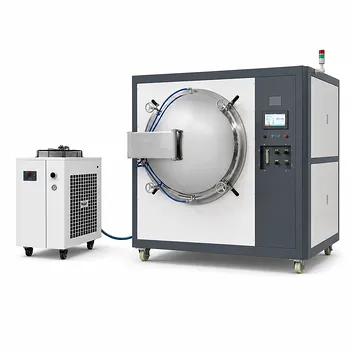
The primary function of the vacuum environment in a vacuum hot pressing furnace is to eliminate the presence of oxygen and volatile gases during the high-temperature processing of A356 aluminum alloy. Because aluminum alloys are highly reactive, this environment prevents the formation of oxide films that act as barriers to particle bonding, while simultaneously extracting trapped gases to ensure maximum material density.
Sintering A356 composites without a vacuum is fundamentally compromised; the vacuum is required to strip away oxide layers and adsorbed gases, enabling the atomic diffusion necessary for a structurally sound, high-density material.
The Barrier of Oxidation
Combating Aluminum's Reactivity
A356 aluminum alloy is inherently susceptible to rapid oxidation, especially when exposed to the elevated temperatures required for sintering.
Without a vacuum, oxygen in the atmosphere reacts immediately with the aluminum matrix.
This reaction creates hard, stable oxide films on the surface of the powder particles.
Eliminating Interfacial Barriers
These oxide films are detrimental because they physically separate the metal particles.
If these films remain intact, they prevent the matrix particles from fusing together.
The vacuum environment ensures these films do not form or grow, allowing for direct metal-to-metal contact.
Enhancing Density and Bonding
Removing Adsorbed Volatiles
Metal powders naturally trap air and moisture within their porous structures and on their surfaces.
A vacuum system, often pulling pressures as low as 0.1 Pa or even lower, actively degasses the material before the sintering structure closes up.
This extraction prevents gas pockets from becoming trapped inside the final composite, which would otherwise result in internal porosity and weakness.
Facilitating Diffusion Bonding
Once the surfaces are clean and oxide-free, the high temperature and pressure promote atomic diffusion.
Atoms can move freely across particle boundaries, merging the separate powders into a unified solid.
This process significantly increases the final density of the material and improves mechanical properties like hardness and interfacial strength.
Understanding the Trade-offs
The Risk of Element Sublimation
While a high vacuum is crucial for cleanliness, it introduces a physical risk regarding vapor pressure.
When external pressure drops below a material's vapor pressure at a specific temperature, elements within the alloy can sublimate (evaporate) directly from the solid state.
Balancing Composition Integrity
A356 is an alloy containing specific ratios of Silicon and Magnesium.
If the vacuum is too deep relative to the sintering temperature, you risk losing these critical alloying elements through evaporation.
Therefore, the vacuum level must be carefully calculated to remove impurities without altering the chemical composition of the workpiece.
Making the Right Choice for Your Goal
To achieve the best results with A356 matrix composites, you must balance purification with composition control.
- If your primary focus is maximum density: Prioritize a high-vacuum degassing stage before reaching peak temperature to extract all volatiles while the pores are still open.
- If your primary focus is alloy composition stability: Monitor the vapor pressure of volatile elements (like Magnesium) and adjust the vacuum level to prevent element loss during the holding phase.
Mastering the vacuum environment transforms A356 powder from a loose aggregate into a high-performance, fully dense composite.
Summary Table:
| Feature | Impact on A356 Aluminum Matrix Composites |
|---|---|
| Oxidation Control | Prevents oxide films to allow direct metal-to-metal bonding. |
| Degassing | Extracts trapped air and moisture to eliminate internal porosity. |
| Atomic Diffusion | Facilitates particle fusion at high temperatures and pressures. |
| Vapor Pressure Management | Balanced vacuum levels prevent loss of key elements like Magnesium. |
Elevate Your Material Research with KINTEK Precision
Achieving the perfect balance of vacuum level and temperature is critical for high-performance A356 composites. KINTEK specializes in advanced laboratory equipment, offering high-precision vacuum hot pressing furnaces, muffle furnaces, and high-pressure reactors designed to meet the rigorous demands of material science.
Whether you are working on sintering, crushing and milling, or battery research, our comprehensive portfolio—from hydraulic presses and isostatic systems to PTFE consumables and ceramics—ensures your lab has the tools for success.
Ready to optimize your sintering process? Contact us today to discuss our customized solutions for high-temperature and high-pressure applications.
Related Products
- Vacuum Hot Press Furnace Heated Vacuum Press Machine Tube Furnace
- 600T Vacuum Induction Hot Press Furnace for Heat Treat and Sintering
- Vacuum Hot Press Furnace Machine Heated Vacuum Press
- Vacuum Hot Press Furnace Machine for Lamination and Heating
- Vacuum Heat Treat and Pressure Sintering Furnace for High Temperature Applications
People Also Ask
- What advantages does a vacuum hot press furnace provide for LSLBO ceramic electrolytes? Achieve 94% Relative Density
- What role does a Vacuum Hot Press (VHP) furnace play in the densification of austenitic stainless steel 316 composites?
- What are the advantages of using a vacuum hot pressing furnace? Superior Densification for 2024Al/Gr/SiC Composites
- What are the advantages of a vacuum hot press furnace for LTPO solid electrolytes? Boost Density and Conductivity
- What core processing conditions does a vacuum hot press furnace provide? Achieve High-Density Cu-SiC/Diamond Composites