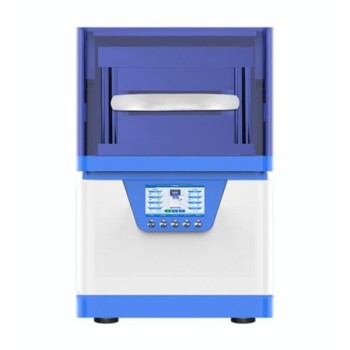
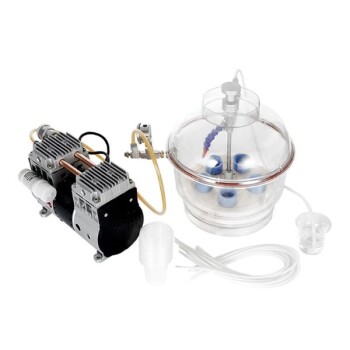
Vacuum Hot Pressing (VHP) is the preferred method for preparing Ruthenium powder materials primarily because it significantly lowers equipment and operational costs compared to Hot Isostatic Pressing (HIP) and Spark Plasma Sintering (SPS). While alternative methods exist, VHP provides a unique balance of operational simplicity and high controllability, allowing manufacturers to achieve high-density Ruthenium targets without the excessive financial burden or technical complexity of competing technologies.
VHP offers an optimal compromise between cost-efficiency and technical performance, utilizing the synergy of heat and mechanical pressure to achieve near-theoretical density through diffusion and creep mechanisms.
The Economic and Operational Rationale
Lower Capital and Running Costs
The most immediate advantage of VHP is economic. Advanced sintering technologies like HIP and SPS often require substantial initial capital investment and incur higher daily operational costs.
VHP equipment is generally less expensive to install and maintain. This cost-effectiveness makes it the logical choice for industrial production where keeping overhead low is as critical as the final material quality.
Operational Simplicity and Control
Beyond cost, VHP is favored for its high controllability. The process is less complex than HIP, which requires managing high-pressure gas containment, or SPS, which involves complex pulsed current parameters.
This simplicity reduces the margin for error during production. It allows operators to consistently replicate results, ensuring reliable quality control for Ruthenium target materials.
How VHP Achieves High Density
Synergy of Temperature and Pressure
VHP does not rely on temperature alone. It facilitates densification by simultaneously applying high temperatures (typically 1050°C to 1450°C) and mechanical pressure (such as 40 MPa) within a vacuum environment.
Reducing Activation Energy
The application of mechanical pressure significantly reduces the activation energy required for sintering. This allows the Ruthenium powder to densify at temperatures well below its melting point, preserving material integrity while saving energy.
Eliminating Porosity via Creep
The combination of heat and pressure induces plastic yield and creep in the powder particles. This mechanism effectively squeezes out pores and voids between particles.
Through this process, VHP can produce Ruthenium materials with a relative density of up to 99.7%. This near-theoretical density is essential for ensuring superior electrical transport properties and mechanical strength in the final application.
Understanding the Trade-offs
Geometry vs. Cost
While VHP is excellent for flat shapes like sputtering targets, it applies pressure uniaxially (from one direction). In contrast, HIP applies pressure from all sides (isostatically).
However, for Ruthenium targets which are typically flat discs or plates, the isostatic capabilities of HIP are often unnecessary. Therefore, VHP provides the required performance without the "over-engineering" and expense of HIP.
Speed vs. Simplicity
SPS is known for rapid heating rates, which can be faster than VHP. However, the operational complexity and cost of SPS equipment often outweigh the speed advantage for this specific application. VHP remains the "workhorse" solution that balances reasonable cycle times with lower complexity.
Making the Right Choice for Your Goal
When selecting a sintering method for Ruthenium, consider your specific constraints regarding budget, geometry, and performance.
- If your primary focus is Cost Efficiency: Choose VHP to minimize both initial equipment investment and ongoing operational expenses.
- If your primary focus is Process Control: Choose VHP for a simplified, highly controllable workflow that reduces the likelihood of operator error.
- If your primary focus is Material Density: Choose VHP to reliably achieve up to 99.7% density through proven diffusion and creep mechanisms.
VHP stands out as the pragmatic, high-performance standard for Ruthenium consolidation, delivering critical material properties without unnecessary complexity.
Summary Table:
| Feature | Vacuum Hot Pressing (VHP) | Hot Isostatic Pressing (HIP) | Spark Plasma Sintering (SPS) |
|---|---|---|---|
| Pressure Mode | Uniaxial (One Direction) | Isostatic (All Sides) | Uniaxial (One Direction) |
| Equipment Cost | Moderate | High | High |
| Complexity | Low to Moderate | High | High (Pulse Current) |
| Relative Density | Up to 99.7% | Near 100% | Near 100% |
| Best For | Flat Targets & Cost Efficiency | Complex Geometries | Ultra-Fast Processing |
Elevate Your Material Research with KINTEK
Maximize your laboratory's efficiency and budget with KINTEK’s industry-leading Vacuum Hot Pressing (VHP) systems. Whether you are developing Ruthenium sputtering targets or advanced ceramics, our precision-engineered hydraulic presses and high-temperature furnaces deliver near-theoretical density with unmatched controllability.
From muffle and vacuum furnaces to specialized crushing, milling, and sieving equipment, KINTEK provides the comprehensive tools needed for high-performance powder metallurgy. Don't compromise on quality or overspend on unnecessary complexity.
Ready to optimize your production workflow? Contact our technical experts today to find the perfect sintering solution for your specific application.
Related Products
- Vacuum Hot Press Furnace Machine Heated Vacuum Press
- Vacuum Hot Press Furnace Machine for Lamination and Heating
- Vacuum Hot Press Furnace Heated Vacuum Press Machine Tube Furnace
- 600T Vacuum Induction Hot Press Furnace for Heat Treat and Sintering
- Touchscreen Automatic Vacuum Heat Press
People Also Ask
- What advantages does a vacuum hot press furnace provide for LSLBO ceramic electrolytes? Achieve 94% Relative Density
- What role does a Vacuum Hot Press (VHP) furnace play in the densification of austenitic stainless steel 316 composites?
- What are the advantages of using a vacuum hot pressing furnace? Superior Densification for 2024Al/Gr/SiC Composites
- Why is it necessary to maintain a high-vacuum environment within a vacuum hot press furnace? Optimize Cu-SiC Sintering
- What core challenges does a vacuum hot press furnace address? Achieve Superior WCp/Cu FGM Structural Integrity