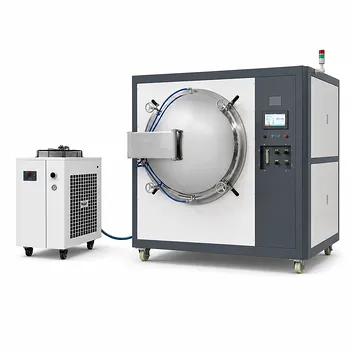
The pre-sintering drying phase is a critical quality control step that directly dictates the structural integrity of your final composite. Specifically, placing graphite molds loaded with diamond and aluminum mixed powders into a drying oven (typically at 120°C) is required to remove ethylene glycol dispersants and adsorbed moisture. Failing to perform this step leads to rapid gas expansion during the vacuum hot-press cycle, resulting in sample collapse, internal porosity, and a failure to achieve the required material density.
Core Takeaway The drying process is not merely about moisture control; it is a mechanism to eliminate volatile organic dispersants used during mixing. By volatilizing these substances at low temperatures before applying high heat and pressure, you prevent catastrophic gas expansion that would otherwise fracture the material or create permanent void defects.
The Mechanics of Defect Prevention
Eliminating Volatile Dispersants
During the initial mixing of diamond and aluminum powders, ethylene glycol is often added as a dispersant to ensure a uniform blend.
While essential for mixing, this organic compound becomes a liability during sintering. The drying oven treatment volatilizes the ethylene glycol at a controlled, low temperature, effectively extracting it from the powder mixture before the main heating cycle begins.
Managing Moisture Adsorption
Raw metal and ceramic powders have a tendency to adsorb moisture from the surrounding environment.
Even trace amounts of water trapped within the powder matrix can turn into steam during the heating phase. The drying process ensures that this moisture is driven off completely, leaving only the pure reactants (diamond and aluminum) inside the mold.
Consequences of Skipping the Drying Phase
The Risk of Rapid Gas Expansion
If the loaded mold enters the vacuum hot-press without drying, the trapped dispersants and moisture will vaporize rapidly as the temperature climbs.
Because the material is confined within a graphite mold under vacuum, this phase change triggers a sudden, violent expansion of gas. This internal pressure fights against the external pressure applied by the press, destabilizing the powder structure.
Structural Collapse and Porosity
The immediate result of this gas expansion is often sample collapse. The structural framework of the powder body gives way under the stress of the escaping gas.
Even if the sample retains its general shape, the trapped gas creates pores (voids) within the matrix. This directly compromises the density of the final diamond/aluminum composite, rendering it weaker and less effective for its intended application.
The Role of the Graphite Mold
A Confined High-Pressure Environment
Graphite molds are designed to transmit significant uniaxial pressure (e.g., 30 MPa) to the powder to force particle contact and densification.
Because the mold acts as a rigid shaping container, there is very little room for error regarding internal volume changes. If gas is evolving inside the mold while the press is trying to compact the powder, the opposing forces effectively prevent the material from consolidating into a dense solid.
Ensuring Uniform Sintering
Graphite is chosen for its high thermal conductivity, which ensures heat is transferred uniformly to the powder.
However, if volatiles are present, they can create pockets of insulation or disruption within the powder bed. Removing these volatiles ensures that the heat transfer remains uniform and the sintering kinetics proceed as predicted.
Understanding the Trade-offs
Temperature Precision vs. Speed
You might be tempted to accelerate the process by increasing the drying oven temperature.
This is a pitfall. The temperature must be kept relatively low (around 120°C) to allow volatiles to escape gradually. If the temperature is too high, the evaporation may become too vigorous, disturbing the particle arrangement and potentially creating the very defects you are trying to avoid.
Process Time vs. Yield
Including a drying step adds time to the overall manufacturing cycle.
However, this time cost is negligible compared to the cost of a failed sintering run. The trade-off overwhelmingly favors the drying step; skipping it to save a few hours will almost certainly result in a wasted batch of expensive diamond and aluminum raw materials.
Making the Right Choice for Your Goal
When preparing your diamond/aluminum composites, apply the drying step based on your specific quality metrics:
- If your primary focus is Maximum Density: Ensure the drying cycle is long enough to fully volatilize the ethylene glycol, as even trace residues will form micropores.
- If your primary focus is Structural Integrity: Strictly adhere to the low-temperature limit (120°C) to prevent rapid evaporation from cracking the green body before sintering.
Ultimate density is achieved not just by the pressure applied during sintering, but by the purity of the powder environment established during drying.
Summary Table:
| Stage | Purpose | Key Mechanism | Consequence of Skipping |
|---|---|---|---|
| Drying (120°C) | Remove Volatiles | Volatilizes ethylene glycol & moisture | Rapid gas expansion and sample collapse |
| Vacuum Hot-Press | Densification | Applies uniaxial pressure (30 MPa) | High internal porosity and low material density |
| Graphite Mold | Containment | Ensures uniform heat & pressure | Structural failure due to trapped gas pressure |
Maximize Your Material Density with KINTEK Precision
Don't let avoidable defects compromise your high-performance composites. At KINTEK, we provide the advanced vacuum hot-press sintering systems, crushing and milling systems, and precision drying ovens required to ensure your diamond-aluminum mixtures achieve theoretical density and flawless structural integrity.
Whether you are performing complex battery research or developing advanced industrial materials, our comprehensive range of graphite molds, high-temperature furnaces, and hydraulic presses is engineered for excellence.
Ready to elevate your laboratory results? Contact our technical experts today to find the perfect equipment solution for your specific application needs!
Related Products
- 600T Vacuum Induction Hot Press Furnace for Heat Treat and Sintering
- Vacuum Heat Treat and Pressure Sintering Furnace for High Temperature Applications
- Vacuum Heat Treat and Sintering Furnace with 9MPa Air Pressure
- Vacuum Hot Press Furnace Machine Heated Vacuum Press
- Vacuum Hot Press Furnace Machine for Lamination and Heating
People Also Ask
- What role does an induction vacuum hot pressing furnace play in sintering? Achieve 98% Density in Carbide Blocks
- What advantages does a vacuum hot press furnace provide for LSLBO ceramic electrolytes? Achieve 94% Relative Density
- What role does a Vacuum Hot Press (VHP) furnace play in the densification of austenitic stainless steel 316 composites?
- What role does mechanical pressure play during the vacuum diffusion bonding of tungsten and copper? Keys to Solid Bonding
- What are the advantages of a vacuum hot press furnace for W-50%Cu? Achieve 99.6% Density at Lower Temperatures