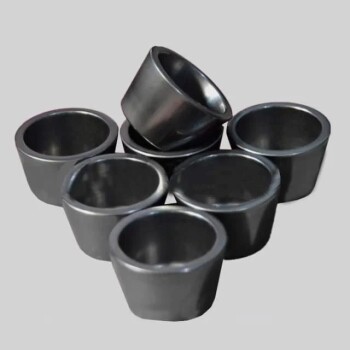
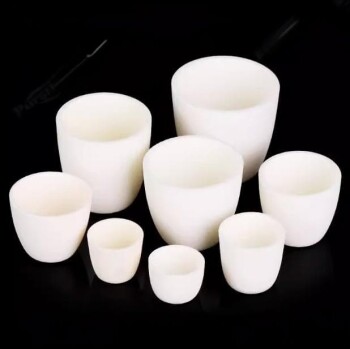
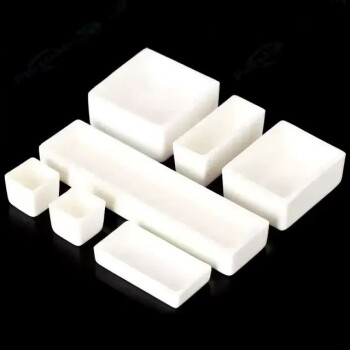
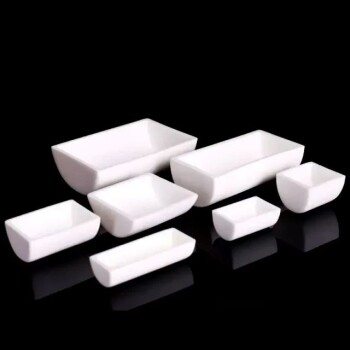
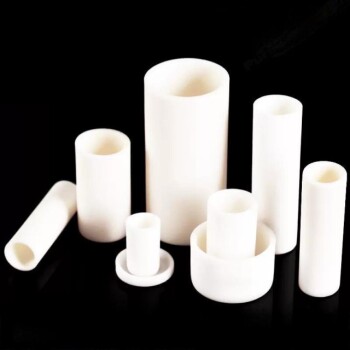
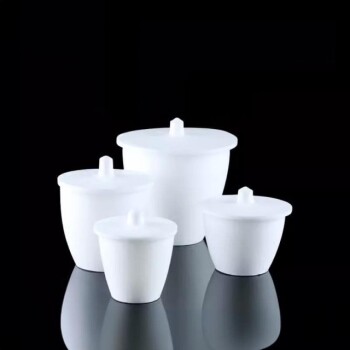
High-purity ceramic crucibles are mandatory for the thermal analysis of epoxy resins because they provide the essential chemical inertness and thermal stability required to isolate the sample's true behavior. By resisting reaction with the resin or its breakdown products—even at extreme temperatures—these containers ensure that the data collected originates solely from the polymer matrix.
The use of high-purity ceramics eliminates experimental artifacts caused by container degradation or chemical interference. This guarantees that thermal stability assessments reflect the true properties of the epoxy resin, rather than impurities introduced by the testing environment.
Preserving Data Integrity at High Temperatures
To understand the necessity of high-purity ceramics, one must look at the hostile environment created during thermal decomposition analysis.
Exceptional Chemical Inertness
The primary function of the crucible is to act as a neutral vessel.
High-purity ceramics are engineered to be chemically inert. They do not react with epoxy resins or the complex byproducts generated as the resin breaks down.
Without this inertness, the container could chemically interact with the sample, altering the decomposition path and invalidating the results.
Withstanding Extreme Thermal Stress
Thermal decomposition analysis pushes materials to their limits.
High-purity ceramics offer exceptional thermal stability, capable of withstanding simulated decomposition temperatures that can reach up to 3000 K.
This stability ensures the crucible maintains its structural integrity and does not degrade, melt, or off-gas, even when subjected to heat far exceeding standard operating conditions.
Eliminating Experimental Artifacts
The goal of thermogravimetric analysis is to measure the properties of the sample, not the container.
Isolating Component Signals
When epoxy resins degrade, they release specific volatiles such as water, hydrogen, and hydrocarbon radicals.
High-purity crucibles ensure that these detected elements originate solely from the resin matrix.
If a lower-quality crucible were used, impurities from the container itself could leach into the sample, creating "ghost" signals that confuse the analysis of the resin’s thermal stability.
Ensuring Accurate Mass Loss Data
Precise measurement of mass loss is the cornerstone of thermal analysis.
Any chemical interaction between the sample and the container introduces experimental artifacts, such as artificial weight changes or skewed molecular weight distribution data.
By preventing these interactions, high-quality ceramics allow for the precise evaluation of degradation paths and char-forming mechanisms.
Understanding the Trade-offs
While high-purity ceramics are the standard, it is critical to understand the risks associated with material selection.
The Risk of Lower Purity
Not all ceramic crucibles provide the same level of protection.
Using crucibles with lower purity levels introduces a risk of contamination, where trace elements in the ceramic react with the sample at elevated temperatures.
Material Compatibility Limits
Even within high-quality ceramics, compatibility matters.
For example, while Alumina crucibles are excellent for many applications up to 850 °C, one must ensure the specific ceramic material chosen does not react with specific additives, such as flame retardants or phosphides, within the resin.
Making the Right Choice for Your Goal
Selecting the correct crucible is a strategic decision based on the specific data you need to capture.
- If your primary focus is analyzing degradation byproducts: Prioritize ultra-high purity to ensure detected radicals (water, hydrogen) are exclusively from the resin.
- If your primary focus is measuring mass loss and residue: Ensure the crucible has verified thermal stability well beyond your maximum test temperature to prevent container-induced weight artifacts.
Ultimately, the reliability of your thermal analysis data is only as strong as the inertness of the container you choose.
Summary Table:
| Feature | Benefit for Epoxy Thermal Analysis |
|---|---|
| Chemical Inertness | Prevents reactions between the resin/byproducts and the container, ensuring pure sample data. |
| Thermal Stability | Withstands temperatures up to 3000 K without melting, degrading, or off-gassing. |
| Contamination Control | Eliminates 'ghost signals' from impurities, isolating volatiles like water and hydrocarbon radicals. |
| Precision Mass Loss | Ensures weight change measurements reflect only the polymer matrix degradation. |
Elevate Your Thermal Analysis with KINTEK
Don't let container interference compromise your research. KINTEK specializes in high-performance laboratory equipment and consumables, offering a premium range of high-purity ceramic crucibles and thermal analysis tools designed for the most demanding environments. Whether you are conducting TGA, DSC, or high-temperature material synthesis, our products—from muffle and tube furnaces to advanced ceramics—provide the precision you need.
Ready to achieve superior data integrity? Contact KINTEK experts today to find the perfect high-purity solutions for your laboratory's needs!
References
- Wei-Feng Sun, Zhong Chen. A Reactive Molecular Dynamics Study on Crosslinked Epoxy Resin Decomposition under High Electric Field and Thermal Aging Conditions. DOI: 10.3390/polym15030765
This article is also based on technical information from Kintek Solution Knowledge Base .
Related Products
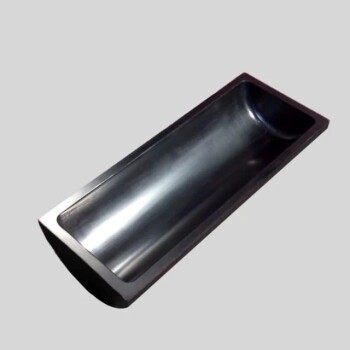
- High Purity Pure Graphite Crucible for Evaporation
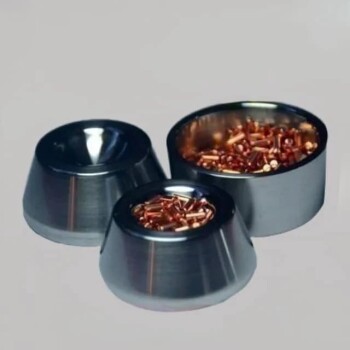
- High Purity Pure Graphite Crucible for Electron Beam Evaporation
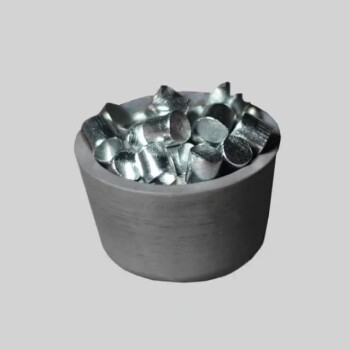
- Arc-Shaped Alumina Ceramic Crucible High Temperature Resistant for Engineering Advanced Fine Ceramics
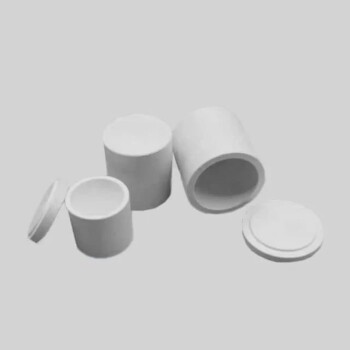
- Engineering Advanced Fine Alumina Al2O3 Ceramic Crucible for Laboratory Muffle Furnace
- Alumina Al2O3 Ceramic Crucible Semicircle Boat with Lid for Engineering Advanced Fine Ceramics
People Also Ask
- Why are high-purity graphite crucibles preferred for sulfide solid electrolytes? Achieve Superior Material Purity
- Why is a high-purity graphite crucible required for Chromel-TaC composites? Ensure Peak Purity at 1400°C
- What role do high-purity graphite crucibles play in molten salt corrosion research? Ensure Reactor-Grade Precision
- Why are high-purity graphite crucibles used for magnesium distillation? Ensure 3N8 Purity & Thermal Stability
- Why is a high-purity graphite crucible ideal for nitrogen-doped graphene at 1500 °C? Maximize Purity and Stability