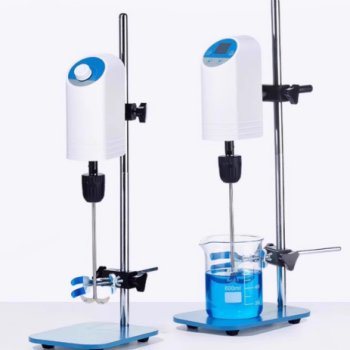
Precise stirring mechanisms are essential for controlling particle genesis. Reaction vessels must feature advanced homogenization capabilities to ensure high consistency in local concentration and temperature during chemical co-precipitation. This mechanical control is the only way to guarantee the narrow particle size distribution required for effective magnetic iron oxide nanoparticles.
The quality of magnetic nanoparticles is determined by the uniformity of their synthesis environment. Efficient stirring prevents local supersaturation and agglomeration, directly enabling the superparamagnetic properties required for high-performance applications.
The Connection Between Mixing and Magnetism
Defining Superparamagnetic Properties
The utility of iron oxide nanoparticles relies heavily on their superparamagnetic properties. This behavior allows the particles to respond strongly to magnetic fields without retaining magnetism once the field is removed.
The Role of Particle Size
To achieve superparamagnetism, particles must remain extremely small. The specific size and the distribution of that size across the batch are the defining factors of the material's magnetic responsiveness.
Consistency is Key
If the manufacturing process produces particles of varying sizes, the magnetic performance becomes unpredictable. Therefore, the reaction vessel must maintain a perfectly uniform environment to ensure every particle grows at the same rate.
Controlling the Chemical Environment
Managing Local Concentration
During chemical co-precipitation, reagents are mixed to form the solid nanoparticles. Without precise stirring, local concentration gradients occur.
Preventing Supersaturation Spikes
Inefficient mixing leads to "hot spots" where the concentration of reactants is too high, known as local supersaturation. These spikes trigger rapid, uncontrolled precipitation in specific areas of the vessel.
Ensuring Temperature Uniformity
Chemical reactions are sensitive to heat. Effective homogenizers distribute heat evenly, ensuring there are no temperature variances that could alter the crystal growth rate in different parts of the tank.
The Risks of Inadequate Homogenization
The Danger of Agglomeration
When local supersaturation occurs due to poor mixing, particles tend to stick together. This process, known as agglomeration, fuses individual nanoparticles into larger, irregular clusters.
Impact on Size Distribution
Agglomeration destroys the uniformity of the batch. Instead of a narrow, consistent particle size, you end up with a wide distribution of sizes that degrades the material's quality.
Loss of Responsiveness
Clumped, irregular particles do not exhibit the same sharp magnetic response as discrete, uniform nanoparticles. The failure to homogenize effectively renders the final product less effective for its intended application.
Optimizing Your Synthesis Protocol
To ensure the production of high-quality magnetic iron oxide nanoparticles, consider these operational priorities:
- If your primary focus is Consistency: Prioritize vessels with high-shear homogenization to eliminate local concentration gradients and prevent supersaturation spikes.
- If your primary focus is Magnetic Performance: Ensure your stirring mechanism creates uniform temperature distribution to maintain the narrow particle size required for maximum responsiveness.
Control the mixing environment to strictly control the material properties.
Summary Table:
| Factor | Impact on Nanoparticle Quality | Role of Precise Stirring/Homogenization |
|---|---|---|
| Local Concentration | Prevents supersaturation spikes and uncontrolled growth | Ensures even reagent distribution throughout the vessel |
| Temperature | Maintains consistent crystal growth rates | Eliminates thermal gradients for uniform batch reaction |
| Particle Size | Determines superparamagnetic properties | Guarantees a narrow size distribution for high performance |
| Agglomeration | Leads to irregular clusters and loss of responsiveness | High-shear mixing prevents particles from fusing together |
Elevate Your Nanomaterial Synthesis with KINTEK Precision
Achieving the perfect superparamagnetic response requires uncompromising control over your chemical environment. KINTEK specializes in advanced laboratory solutions designed to meet the rigorous demands of magnetic nanoparticle research. From high-shear homogenizers and shakers that eliminate concentration gradients to high-pressure reactors and autoclaves that ensure thermal stability, our equipment provides the consistency your breakthrough deserves.
Whether you are focusing on battery research, magnetic resonance imaging, or targeted drug delivery, KINTEK offers a comprehensive range of crushing and milling systems, PTFE-lined vessels, and cooling solutions to optimize your synthesis protocol.
Ready to achieve superior particle uniformity? Contact KINTEK today to discover how our high-performance laboratory equipment can refine your production process.
References
- Tetiana Dontsova, Ihor Astrelin. Metaloxide Nanomaterials and Nanocomposites of Ecological Purpose. DOI: 10.1155/2019/5942194
This article is also based on technical information from Kintek Solution Knowledge Base .
Related Products
- Custom PTFE Teflon Parts Manufacturer for Magnetic Stirring Bar
- Laboratory Small Constant Temperature Heated Magnetic Stirrer Heater and Stirrer
- Engineering Advanced Fine Ceramics Alumina Crucibles (Al2O3) for Thermal Analysis TGA DTA
- High Performance Laboratory Stirrers for Diverse Applications
- High Purity Pure Graphite Crucible for Evaporation
People Also Ask
- What is the function of a magnetic stirrer during the alkaline etching of nano-silicon carbide? Essential Mixing Guide
- Why is a powerful magnetic stirrer essential during photocatalytic degradation? Ensure Accurate Catalyst Performance
- What is the function of a magnetic stirrer in simulating industrial sulfolane environments? Master Fluid Dynamics
- What is the function of a magnetic stirrer in MgAl-LDH coprecipitation? Ensure Uniformity and Precision
- What is the function of a magnetic stirrer in co-precipitation? Ensure Homogeneity in Doped ZnO Synthesis