Knowledge Vacuum Furnace Why would you want to anneal your metal? Restore Ductility and Improve Machinability
Author avatar

Tech Team · Kintek Solution

Updated 3 months ago

Why would you want to anneal your metal? Restore Ductility and Improve Machinability


In short, you anneal metal to reverse the effects of work hardening. This heat treatment process makes a material softer, more ductile, and easier to shape. It works by relieving internal stresses and refining the metal's internal crystal structure, which reduces its hardness and makes it significantly less brittle.

Annealing is not just about softening metal; it's a strategic process for restoring a material's workability. Think of it as a "reset button" that allows you to undo the brittleness caused by manufacturing processes, enabling further work or preparing the metal for its final application.
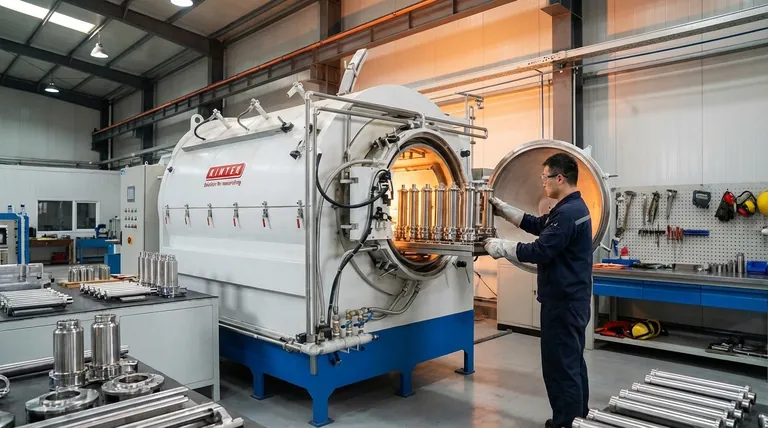
Why would you want to anneal your metal? Restore Ductility and Improve Machinability

The Core Purpose: Reversing Work Hardening

To understand annealing, you must first understand the problem it solves: work hardening.

What is Work Hardening?

When you bend, hammer, roll, or otherwise deform a metal at room temperature (a process called "cold working"), you are creating a vast number of defects, or dislocations, in its internal crystal structure.

These dislocations get tangled and impede each other's movement. This makes the metal stronger and harder, but it also makes it more brittle and prone to cracking under further stress.

How Annealing Acts as a "Reset"

Annealing applies controlled heat to the metal, allowing its atoms to vibrate and rearrange themselves into a more orderly, low-defect crystal lattice.

This process, known as recrystallization, effectively "untangles" the dislocations. The result is a reduction in internal stress and a return to a softer, more ductile state.

Key Benefits of a Properly Annealed Metal

By resetting the metal's microstructure, annealing provides several distinct advantages for manufacturing and performance.

Enhanced Ductility and Formability

The primary benefit is a dramatic increase in ductility, which is the ability to deform without fracturing. An annealed metal can be bent, stamped, or drawn into complex shapes without cracking.

This is critical in multi-stage manufacturing, where annealing is performed between cold working steps to allow for additional forming.

Improved Machinability

Hard, brittle metals are difficult to machine. They cause excessive wear on cutting tools, can lead to poor surface finishes, and may chip unpredictably.

By reducing hardness, annealing makes the material easier to cut, drill, and shape, leading to a more efficient and precise machining process.

Relief of Internal Stresses

Processes like welding, grinding, and heavy machining can introduce significant internal stresses into a part. These locked-in stresses can cause the part to warp or distort over time, or even crack during subsequent heat treatments.

Annealing provides a controlled way to release these stresses, ensuring the dimensional stability of the finished component.

Refined Electrical Properties

For some metals, particularly copper, the uniform crystal structure created by annealing improves electrical conductivity. A more orderly lattice presents fewer obstacles to the flow of electrons.

Understanding the Trade-offs and Considerations

Annealing is a powerful tool, but it involves critical trade-offs and requires careful process control.

The Obvious Trade-off: Loss of Strength

The entire point of annealing is to reduce hardness and increase ductility. This means you will lose the strength and hardness gained from work hardening. This must be factored into the design and manufacturing sequence.

The Risk of Oxidation

Heating metal in the presence of oxygen will cause a layer of oxide, or scale, to form on its surface. This is often undesirable.

To prevent this, industrial annealing is typically performed in a controlled, inert atmosphere, often using nitrogen or other specialized gas mixtures.

The Need for Process Control

Annealing is not simply a matter of heating metal. The temperature, soak time, and cooling rate are all critical parameters that must be precisely controlled for the specific alloy.

Improper control can lead to incomplete annealing or undesirable grain growth, which can negatively impact the final mechanical properties of the material.

When to Choose Annealing

Applying this knowledge depends entirely on your specific manufacturing goal.

  • If your primary focus is further cold working: Use annealing to restore ductility between forming stages, which prevents the material from cracking as you continue to shape it.
  • If your primary focus is better machinability: Anneal raw stock before machining to reduce tool wear, increase cutting speeds, and achieve a superior surface finish.
  • If your primary focus is dimensional stability: Anneal components after welding or aggressive machining to relieve internal stresses and prevent warping in the final product.
  • If your primary focus is optimizing electrical properties: Anneal metals like copper or aluminum to refine the grain structure, thereby maximizing their conductivity.

Ultimately, annealing is a fundamental tool that gives you precise control over a metal's mechanical and physical properties.

Summary Table:

Benefit Key Outcome
Enhanced Ductility Allows for further shaping without cracking
Improved Machinability Reduces tool wear and improves surface finish
Stress Relief Prevents warping and ensures dimensional stability
Refined Electrical Properties Increases conductivity in metals like copper

Ready to optimize your metal's properties with precise annealing?

KINTEK specializes in the lab equipment and consumables needed for controlled heat treatment processes. Whether you're working with raw stock or complex components, our solutions help you achieve the perfect balance of ductility, strength, and stability.

Let our experts help you enhance your manufacturing process. Contact us today to discuss your specific annealing needs!

Visual Guide
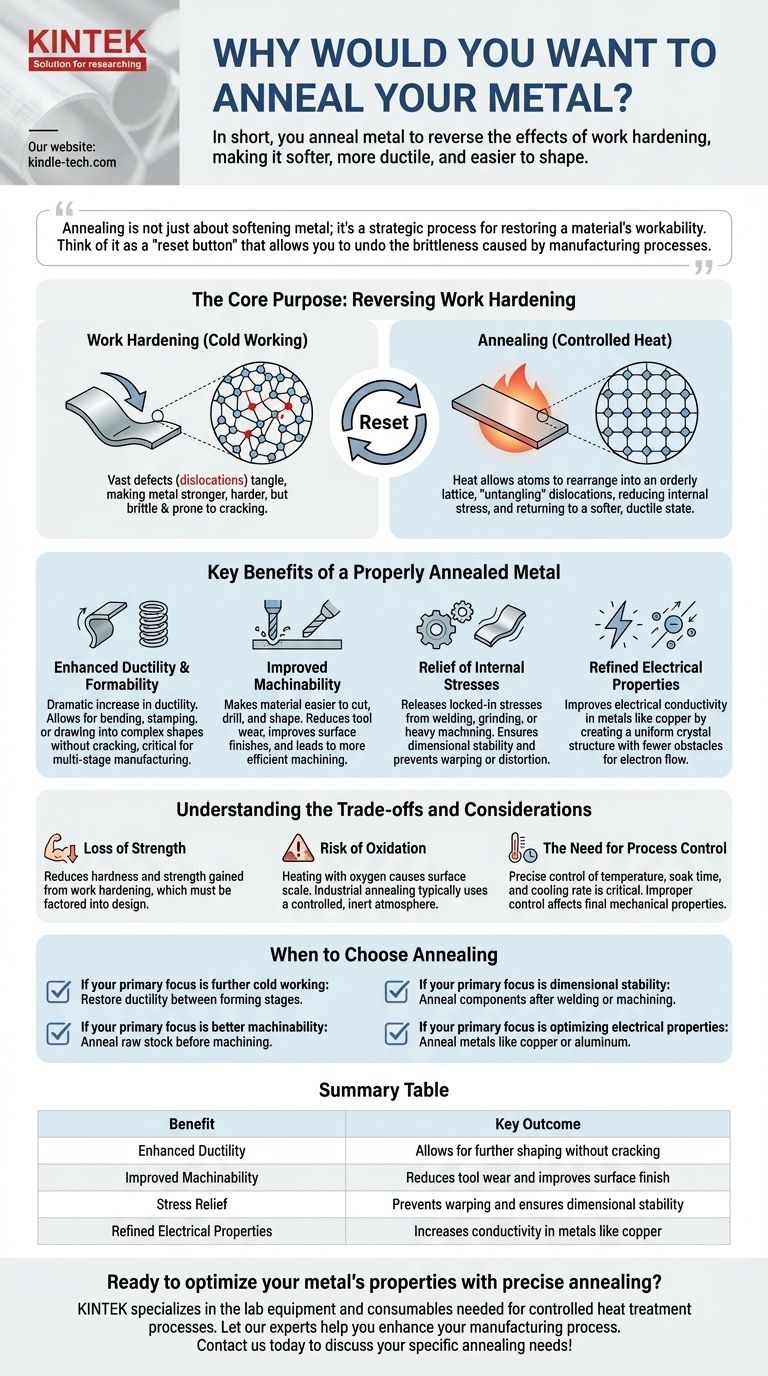
Why would you want to anneal your metal? Restore Ductility and Improve Machinability Visual Guide

Related Products

People Also Ask

Related Products

Controlled Nitrogen Inert Hydrogen Atmosphere Furnace

Controlled Nitrogen Inert Hydrogen Atmosphere Furnace

KT-AH Hydrogen atmosphere furnace - induction gas furnace for sintering/annealing with built-in safety features, dual housing design, and energy-saving efficiency. Ideal for lab and industrial use.

2200 ℃ Tungsten Vacuum Heat Treat and Sintering Furnace

2200 ℃ Tungsten Vacuum Heat Treat and Sintering Furnace

Experience the ultimate refractory metal furnace with our Tungsten vacuum furnace. Capable of reaching 2200℃, perfect for sintering advanced ceramics and refractory metals. Order now for high-quality results.

Vacuum Heat Treat Furnace with Ceramic Fiber Liner

Vacuum Heat Treat Furnace with Ceramic Fiber Liner

Vacuum furnace with polycrystalline ceramic fiber insulation liner for excellent heat insulation and uniform temperature field. Choose from 1200℃ or 1700℃ max. working temperature with high vacuum performance and precise temperature control.

Non Consumable Vacuum Arc Induction Melting Furnace

Non Consumable Vacuum Arc Induction Melting Furnace

Explore the benefits of Non-Consumable Vacuum Arc Furnace with high melting point electrodes. Small, easy to operate & eco-friendly. Ideal for laboratory research on refractory metals & carbides.

High Temperature Muffle Oven Furnace for Laboratory Debinding and Pre Sintering

High Temperature Muffle Oven Furnace for Laboratory Debinding and Pre Sintering

KT-MD High temperature debinding and pre-sintering furnace for ceramic materials with various molding processes. Ideal for electronic components such as MLCC and NFC.

Mesh belt controlled atmosphere furnace

Mesh belt controlled atmosphere furnace

Discover our KT-MB mesh belt sintering furnace - perfect for high-temperature sintering of electronic components & glass insulators. Available for open air or controlled atmosphere environments.

Laboratory Muffle Oven Furnace Bottom Lifting Muffle Furnace

Laboratory Muffle Oven Furnace Bottom Lifting Muffle Furnace

Efficiently produce batches with excellent temperature uniformity using our Bottom Lifting Furnace. Features two electric lifting stages and advanced temperature control up to 1600℃.

Ultra-High Temperature Graphite Vacuum Graphitization Furnace

Ultra-High Temperature Graphite Vacuum Graphitization Furnace

The ultra-high temperature graphitization furnace utilizes medium frequency induction heating in a vacuum or inert gas environment. The induction coil generates an alternating magnetic field, inducing eddy currents in the graphite crucible, which heats up and radiates heat to the workpiece, bringing it to the desired temperature. This furnace is primarily used for graphitization and sintering of carbon materials, carbon fiber materials, and other composite materials.

Horizontal High Temperature Graphite Vacuum Graphitization Furnace

Horizontal High Temperature Graphite Vacuum Graphitization Furnace

Horizontal Graphitization Furnace: This type of furnace is designed with the heating elements placed horizontally, allowing for uniform heating of the sample. It's well-suited for graphitizing large or bulky samples that require precise temperature control and uniformity.

Graphite Vacuum Furnace Bottom Discharge Graphitization Furnace for Carbon Materials

Graphite Vacuum Furnace Bottom Discharge Graphitization Furnace for Carbon Materials

Bottom-out graphitization furnace for carbon materials, ultra-high temperature furnace up to 3100°C, suitable for graphitization and sintering of carbon rods and carbon blocks. Vertical design, bottom discharging, convenient feeding and discharging, high temperature uniformity, low energy consumption, good stability, hydraulic lifting system, convenient loading and unloading.

1200℃ Controlled Atmosphere Furnace Nitrogen Inert Atmosphere Furnace

1200℃ Controlled Atmosphere Furnace Nitrogen Inert Atmosphere Furnace

Discover our KT-12A Pro Controlled atmosphere furnace - high precision, heavy duty vacuum chamber, versatile smart touch screen controller, and excellent temperature uniformity up to 1200C. Ideal for both laboratory and industrial application.

1700℃ Controlled Atmosphere Furnace Nitrogen Inert Atmosphere Furnace

1700℃ Controlled Atmosphere Furnace Nitrogen Inert Atmosphere Furnace

KT-17A Controlled atmosphere furnace: 1700℃ heating, vacuum sealing technology, PID temperature control, and versatile TFT smart touch screen controller for laboratory and industrial use.

Vacuum Heat Treat Sintering Brazing Furnace

Vacuum Heat Treat Sintering Brazing Furnace

A vacuum brazing furnace is a type of industrial furnace used for brazing, a metalworking process that joins two pieces of metal using a filler metal that melts at a lower temperature than the base metals. Vacuum brazing furnaces are typically used for high-quality applications where a strong, clean joint is required.

Vacuum Heat Treat and Molybdenum Wire Sintering Furnace for Vacuum Sintering

Vacuum Heat Treat and Molybdenum Wire Sintering Furnace for Vacuum Sintering

A vacuum molybdenum wire sintering furnace is a vertical or bedroom structure, which is suitable for withdrawal, brazing, sintering and degassing of metal materials under high vacuum and high temperature conditions. It is also suitable for dehydroxylation treatment of quartz materials.

Vacuum Heat Treat and Pressure Sintering Furnace for High Temperature Applications

Vacuum Heat Treat and Pressure Sintering Furnace for High Temperature Applications

Vacuum pressure sintering furnaces are designed for high temperature hot pressing applications in metal and ceramic sintering. Its advanced features ensure precise temperature control, reliable pressure maintenance, and a robust design for seamless operation.

Vacuum Arc Induction Melting Furnace

Vacuum Arc Induction Melting Furnace

Discover the power of Vacuum Arc Furnace for melting active & refractory metals. High-speed, remarkable degassing effect, and free of contamination. Learn more now!

1400℃ Controlled Atmosphere Furnace with Nitrogen and Inert Atmosphere

1400℃ Controlled Atmosphere Furnace with Nitrogen and Inert Atmosphere

Achieve precise heat treatment with KT-14A controlled atmosphere furnace. Vacuum sealed with a smart controller, it's ideal for lab and industrial use up to 1400℃.

Laboratory Rapid Thermal Processing (RTP) Quartz Tube Furnace

Laboratory Rapid Thermal Processing (RTP) Quartz Tube Furnace

Get lightning-fast heating with our RTP Rapid Heating Tube Furnace. Designed for precise, high-speed heating and cooling with convenient sliding rail and TFT touch screen controller. Order now for ideal thermal processing!

Molybdenum Vacuum Heat Treat Furnace

Molybdenum Vacuum Heat Treat Furnace

Discover the benefits of a high-configuration molybdenum vacuum furnace with heat shield insulation. Ideal for high-purity, vacuum environments like sapphire crystal growth and heat treatment.

Vertical Laboratory Tube Furnace

Vertical Laboratory Tube Furnace

Elevate your experiments with our Vertical Tube Furnace. Versatile design allows for operation under various environments and heat treatment applications. Order now for precise results!


Leave Your Message



















