Blog Addition vs. Subtraction: The Thermodynamic Choice That Defines Your Material's Future
Addition vs. Subtraction: The Thermodynamic Choice That Defines Your Material's Future

Addition vs. Subtraction: The Thermodynamic Choice That Defines Your Material's Future

2 hours ago

The Engineer's Core Dilemma

Imagine holding a perfectly machined component. It could be a titanium alloy turbine blade for a jet engine or a medical implant. Its geometry is flawless. But its internal strength and surface integrity depend entirely on what happens next, inside the intense heat of a furnace.

At this critical moment, the engineer faces a choice that is almost philosophical. Do you solve the problem of high-temperature reactivity by adding a carefully controlled environment? Or do you solve it by subtracting everything that could possibly interfere?

This is the fundamental difference between an atmosphere furnace and a vacuum furnace. It’s a decision not just about equipment, but about the strategy you employ to protect or transform your material.

The Atmosphere Furnace: A Controlled Conversation

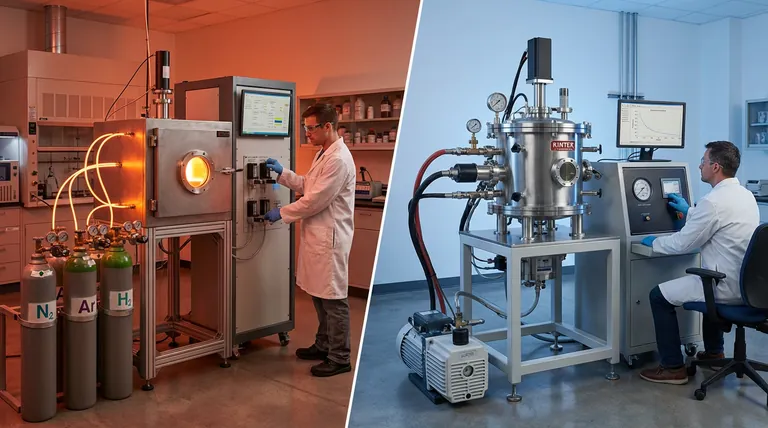
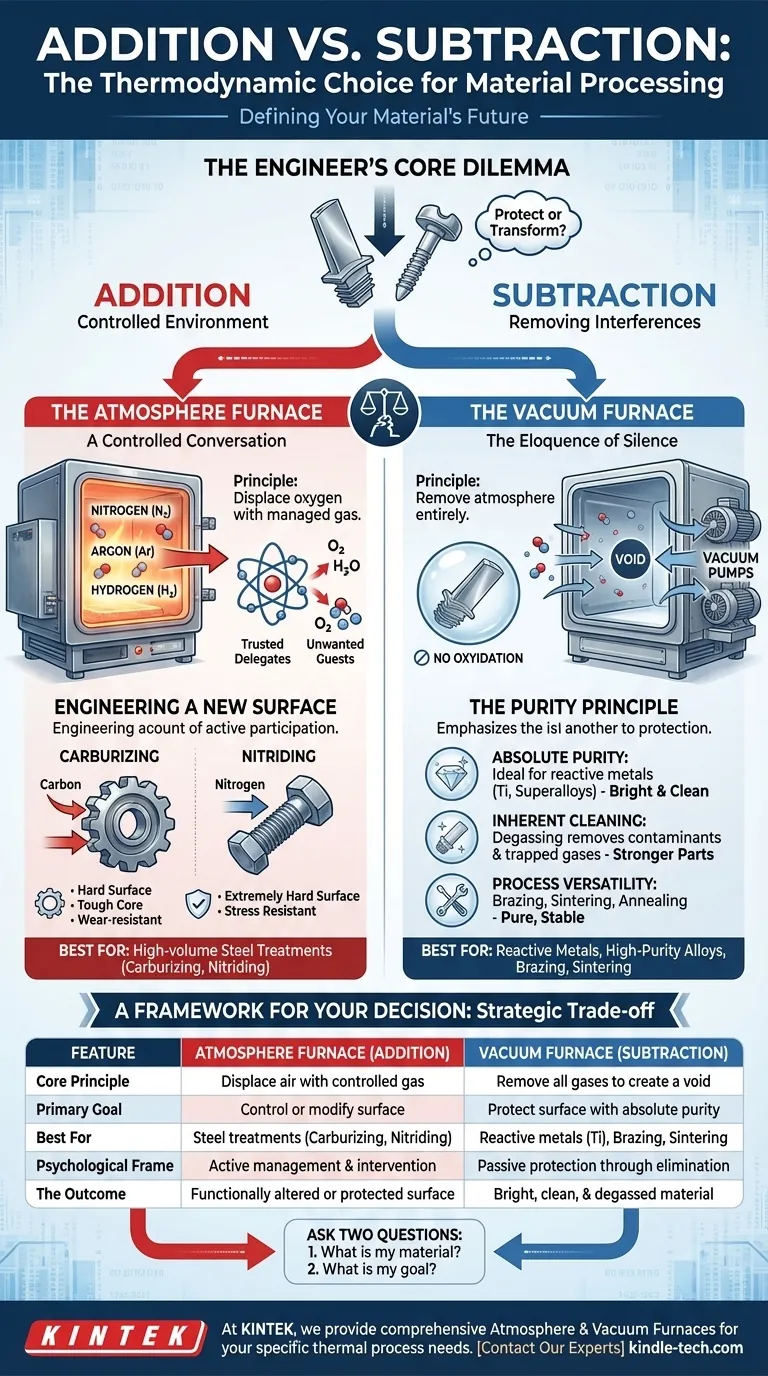
An atmosphere furnace works by the principle of addition. It displaces the chaotic, oxygen-rich air in its chamber with a precisely managed gas.

Think of it as hosting a diplomatic meeting. You can’t allow unwanted guests (oxygen, water vapor) to disrupt the proceedings, as they cause destructive oxidation and decarburization. Instead, you fill the room with trusted delegates—gases like nitrogen, argon, or hydrogen.

Engineering a New Surface

Sometimes, the goal isn't just protection. It's transformation.

This is where the atmosphere becomes an active participant. Processes like carburizing and nitriding don't just shield the material; they use the controlled gas to intentionally infuse the steel's surface with carbon or nitrogen.

  • Carburizing: Adds carbon to create a hard, wear-resistant outer case while keeping the core tough.
  • Nitriding: Uses nitrogen to form an even harder surface, ideal for components under extreme stress.

For these applications, the atmosphere furnace is the perfect, cost-effective tool. It is the workhorse of the steel industry, built for high-volume processes where the surface must be actively changed.

The Vacuum Furnace: The Eloquence of Silence

A vacuum furnace operates on the opposite, more radical principle: subtraction. It removes the atmosphere entirely.

Before heating begins, powerful pumps draw out the air and all other molecules, creating a void. In this near-perfect silence, there is no medium for a destructive chemical conversation to take place. Oxidation becomes an impossibility.

The Purity Principle

By eliminating the environment, the vacuum furnace offers the ultimate form of protection. This isn't just about preventing rust or scaling; it's about preserving the material in its most pristine state.

The benefits are profound:

  • Absolute Purity: Reactive metals like titanium and superalloys, which would be ruined by the slightest trace of oxygen at high temperatures, remain perfectly bright and clean.
  • Inherent Cleaning: The vacuum actually pulls contaminants and trapped gases out of the material itself, a process called degassing, resulting in a stronger, more reliable final part.
  • Process Versatility: From brazing delicate aerospace components to sintering powdered metals, the pure, stable environment of a vacuum is incredibly versatile.

For the most sensitive and high-performance materials, a vacuum isn't just an option; it's the only way to guarantee integrity.

A Framework for Your Decision

Choosing between these two technologies is a strategic trade-off between control, purity, and cost. Neither is universally "better"—the right choice is the one that serves your material's specific needs.

Feature Atmosphere Furnace Vacuum Furnace
Core Principle Addition: Displace air with a controlled gas. Subtraction: Remove all gases to create a void.
Primary Goal Control or modify the surface. Protect the surface with absolute purity.
Best For Steel treatments (Carburizing, Nitriding). Reactive metals (Ti), brazing, sintering.
Psychological Frame Active management and intervention. Passive protection through elimination.
The Outcome A functionally altered or protected surface. A bright, clean, and degassed material.

Ask Two Questions

To simplify your choice, consider these two factors:

  1. What is my material? If you are working with standard steels, an atmosphere furnace is often the most efficient solution. If you're working with titanium, refractory metals, or high-purity alloys, a vacuum furnace is non-negotiable.

  2. What is my goal? If you need to add something to the surface (like carbon), you need an atmosphere furnace designed for that reaction. If your only goal is to join two parts via brazing or anneal a component without any surface change, the purity of a vacuum is your greatest asset.

At KINTEK, we understand that your laboratory's success depends on having the right tool for your specific thermal process. We provide a comprehensive range of both atmosphere and vacuum furnaces, ensuring you can implement the exact thermodynamic strategy your material demands.

Navigating this choice determines the ultimate integrity of your work, and having the right equipment is paramount. Contact Our Experts

Visual Guide
Addition vs. Subtraction: The Thermodynamic Choice That Defines Your Material's Future Visual Guide

Related Products

Related Articles

Related Products

1200℃ Controlled Atmosphere Furnace Nitrogen Inert Atmosphere Furnace

1200℃ Controlled Atmosphere Furnace Nitrogen Inert Atmosphere Furnace

Discover our KT-12A Pro Controlled atmosphere furnace - high precision, heavy duty vacuum chamber, versatile smart touch screen controller, and excellent temperature uniformity up to 1200C. Ideal for both laboratory and industrial application.

1400℃ Controlled Atmosphere Furnace with Nitrogen and Inert Atmosphere

1400℃ Controlled Atmosphere Furnace with Nitrogen and Inert Atmosphere

Achieve precise heat treatment with KT-14A controlled atmosphere furnace. Vacuum sealed with a smart controller, it's ideal for lab and industrial use up to 1400℃.

1700℃ Controlled Atmosphere Furnace Nitrogen Inert Atmosphere Furnace

1700℃ Controlled Atmosphere Furnace Nitrogen Inert Atmosphere Furnace

KT-17A Controlled atmosphere furnace: 1700℃ heating, vacuum sealing technology, PID temperature control, and versatile TFT smart touch screen controller for laboratory and industrial use.

Controlled Nitrogen Inert Hydrogen Atmosphere Furnace

Controlled Nitrogen Inert Hydrogen Atmosphere Furnace

KT-AH Hydrogen atmosphere furnace - induction gas furnace for sintering/annealing with built-in safety features, dual housing design, and energy-saving efficiency. Ideal for lab and industrial use.

Mesh belt controlled atmosphere furnace

Mesh belt controlled atmosphere furnace

Discover our KT-MB mesh belt sintering furnace - perfect for high-temperature sintering of electronic components & glass insulators. Available for open air or controlled atmosphere environments.

Small Vacuum Heat Treat and Tungsten Wire Sintering Furnace

Small Vacuum Heat Treat and Tungsten Wire Sintering Furnace

The small vacuum tungsten wire sintering furnace is a compact experimental vacuum furnace specially designed for universities and scientific research institutes. The furnace features a CNC welded shell and vacuum piping to ensure leak-free operation. Quick-connect electrical connections facilitate relocation and debugging, and the standard electrical control cabinet is safe and convenient to operate.

Vacuum Heat Treat Furnace and Levitation Induction Melting Furnace

Vacuum Heat Treat Furnace and Levitation Induction Melting Furnace

Experience precise melting with our Vacuum Levitation Melting Furnace. Ideal for high melting point metals or alloys, with advanced technology for effective smelting. Order now for high-quality results.

2200 ℃ Tungsten Vacuum Heat Treat and Sintering Furnace

2200 ℃ Tungsten Vacuum Heat Treat and Sintering Furnace

Experience the ultimate refractory metal furnace with our Tungsten vacuum furnace. Capable of reaching 2200℃, perfect for sintering advanced ceramics and refractory metals. Order now for high-quality results.

Vacuum Heat Treat and Pressure Sintering Furnace for High Temperature Applications

Vacuum Heat Treat and Pressure Sintering Furnace for High Temperature Applications

Vacuum pressure sintering furnaces are designed for high temperature hot pressing applications in metal and ceramic sintering. Its advanced features ensure precise temperature control, reliable pressure maintenance, and a robust design for seamless operation.

Vacuum Heat Treat Sintering Brazing Furnace

Vacuum Heat Treat Sintering Brazing Furnace

A vacuum brazing furnace is a type of industrial furnace used for brazing, a metalworking process that joins two pieces of metal using a filler metal that melts at a lower temperature than the base metals. Vacuum brazing furnaces are typically used for high-quality applications where a strong, clean joint is required.

Graphite Vacuum Furnace IGBT Experimental Graphitization Furnace

Graphite Vacuum Furnace IGBT Experimental Graphitization Furnace

IGBT experimental graphitization furnace, a tailored solution for universities and research institutions, with high heating efficiency, user-friendliness, and precise temperature control.

Vacuum Arc Induction Melting Furnace

Vacuum Arc Induction Melting Furnace

Discover the power of Vacuum Arc Furnace for melting active & refractory metals. High-speed, remarkable degassing effect, and free of contamination. Learn more now!

Vertical High Temperature Graphite Vacuum Graphitization Furnace

Vertical High Temperature Graphite Vacuum Graphitization Furnace

Vertical high temperature graphitization furnace for carbonization and graphitization of carbon materials up to 3100℃.Suitable for shaped graphitization of carbon fiber filaments and other materials sintered in a carbon environment.Applications in metallurgy, electronics, and aerospace for producing high-quality graphite products like electrodes and crucibles.

Molybdenum Vacuum Heat Treat Furnace

Molybdenum Vacuum Heat Treat Furnace

Discover the benefits of a high-configuration molybdenum vacuum furnace with heat shield insulation. Ideal for high-purity, vacuum environments like sapphire crystal growth and heat treatment.

Vacuum Hot Press Furnace Heated Vacuum Press Machine Tube Furnace

Vacuum Hot Press Furnace Heated Vacuum Press Machine Tube Furnace

Reduce forming pressure & shorten sintering time with Vacuum Tube Hot Press Furnace for high-density, fine-grain materials. Ideal for refractory metals.

Lab-Scale Vacuum Induction Melting Furnace

Lab-Scale Vacuum Induction Melting Furnace

Get precise alloy composition with our Vacuum Induction Melting Furnace. Ideal for aerospace, nuclear energy, and electronic industries. Order now for effective smelting and casting of metals and alloys.

Vacuum Heat Treat and Molybdenum Wire Sintering Furnace for Vacuum Sintering

Vacuum Heat Treat and Molybdenum Wire Sintering Furnace for Vacuum Sintering

A vacuum molybdenum wire sintering furnace is a vertical or bedroom structure, which is suitable for withdrawal, brazing, sintering and degassing of metal materials under high vacuum and high temperature conditions. It is also suitable for dehydroxylation treatment of quartz materials.

Non Consumable Vacuum Arc Induction Melting Furnace

Non Consumable Vacuum Arc Induction Melting Furnace

Explore the benefits of Non-Consumable Vacuum Arc Furnace with high melting point electrodes. Small, easy to operate & eco-friendly. Ideal for laboratory research on refractory metals & carbides.

Vacuum Hot Press Furnace Machine Heated Vacuum Press

Vacuum Hot Press Furnace Machine Heated Vacuum Press

Discover the advantages of Vacuum Hot Press Furnace! Manufacture dense refractory metals & compounds, ceramics, and composites under high temp and pressure.

Graphite Vacuum Furnace Bottom Discharge Graphitization Furnace for Carbon Materials

Graphite Vacuum Furnace Bottom Discharge Graphitization Furnace for Carbon Materials

Bottom-out graphitization furnace for carbon materials, ultra-high temperature furnace up to 3100°C, suitable for graphitization and sintering of carbon rods and carbon blocks. Vertical design, bottom discharging, convenient feeding and discharging, high temperature uniformity, low energy consumption, good stability, hydraulic lifting system, convenient loading and unloading.


Leave Your Message