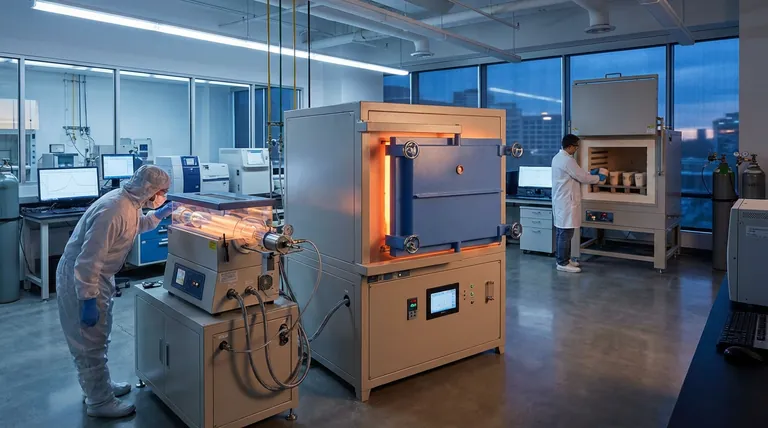
The Illusion of a Simple Choice
Imagine a materials scientist working to grow a perfect, single-crystal semiconductor. In their process, even a single stray atom of oxygen is a catastrophic contaminant. Their challenge isn't just reaching 1200°C; it's building a tiny, perfect universe, utterly isolated from the world's chaotic atmosphere.
We often fall for a cognitive bias: focusing on the most obvious metric. With furnaces, that metric is temperature. But the most critical question isn't "how hot?" It's "what's the environment?"
The decision between a tube furnace and a muffle furnace is a choice between two distinct engineering philosophies: the absolute, sealed-off control of a specific environment versus the simple, high-volume capacity of heating in the open.
The Anatomy of Control: The Tube Furnace
A World in a Tube
A tube furnace isn't just a heater; it's a vessel. It works by passing a sealed tube, typically quartz or ceramic, through its heating elements. This simple design is profound. It transforms a heating chamber into a controllable micro-environment.
This is the instrument for the scientist who cannot tolerate variables. You can flood the tube with an inert gas like argon, create a specific reactive atmosphere, or pull it into a near-perfect vacuum. Ambient air isn't neutral; it's a reactive, unpredictable variable to be eliminated. The tube furnace is an instrument of certainty.
Mastering the Thermal Journey
Control extends beyond the atmosphere. The linear shape of a tube furnace is uniquely suited for creating precise temperature gradients. With multiple heating zones along its length, you can design a specific thermal journey for a sample to travel through.
This is the difference between a floodlight and a series of individually controlled spotlights. It's essential for advanced processes like chemical vapor deposition (CVD) or zone refining, where where the heat is applied is as important as how much.
The Virtue of Simplicity: The Muffle Furnace
The Workhorse of the Lab
Now, picture a quality control technician who needs to ash fifty polymer samples to verify their inorganic filler content. Their goal is speed, reliability, and throughput. For them, oxygen isn't a contaminant; it's a necessary reagent for combustion.
A muffle furnace is the tool for this job. It is, in essence, a perfectly insulated box designed for one thing: getting samples hot in ambient air, quickly and efficiently. It's not less precise; it's purpose-built for a different mission. Its simplicity is its greatest strength.
The Freedom of an Open Chamber
The muffle furnace’s large, rectangular chamber prioritizes access and volume. You can load multiple crucibles, large components, or awkwardly shaped parts with ease.
It solves a different kind of problem—an economic and logistical one. It's designed to maximize sample throughput with minimal complexity, making it the undeniable standard for ashing, calcination, and general heat treatments.
How Geometry Defines Function
The physical shape of the furnace is not a superficial detail; it dictates the workflow and the types of results you can achieve. The choice reflects a fundamental trade-off.
| Feature | Tube Furnace | Muffle Furnace |
|---|---|---|
| Primary Goal | Precise control over atmosphere & thermal profile | High-volume heating in ambient air |
| Chamber Shape | Narrow, cylindrical tube | Large, rectangular box |
| Sample Access | Limited by tube diameter | High, for multiple or bulky samples |
| Core Psychology | Eliminate all external variables | Leverage air as part of the process |
| Ideal Use Case | Annealing, CVD, Crystal Growth | Ashing, Calcination, Hardening |
The Decision Framework: What is Your True Goal?
To choose the right instrument, look past the spec sheet and define your scientific intent. Ask yourself:
- Is the atmosphere around my sample a variable to eliminate or a tool to be used?
- Is my priority perfecting a single, sensitive process or reliably running many samples at once?
- Does my material require a controlled thermal journey (gradient) or just a destination temperature?
Your answer reveals whether you need an instrument of precise control or one of rugged capacity.
This level of process-specific thinking is what separates a good lab from a great one. At KINTEK, we understand that you aren't just buying a piece of equipment; you are acquiring a capability. Whether you need the sealed, controlled world of a tube furnace or the high-throughput power of a muffle furnace, our mission is to provide the right tool for your specific mindset.
If you're navigating this choice, understanding these subtle trade-offs is key. We can help you match the engineering to your scientific ambition. Contact Our Experts
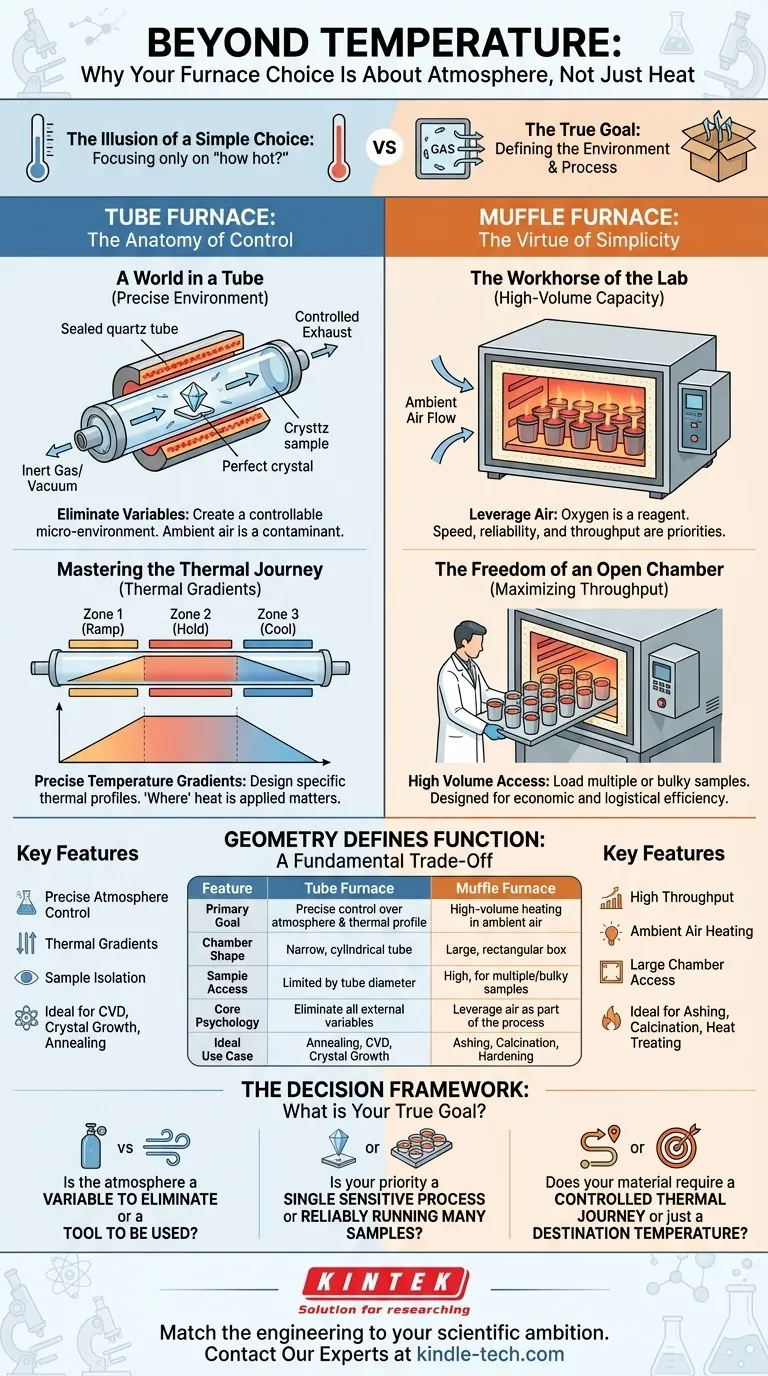
Visual Guide
Related Products
- 1700℃ Controlled Atmosphere Furnace Nitrogen Inert Atmosphere Furnace
- 1200℃ Controlled Atmosphere Furnace Nitrogen Inert Atmosphere Furnace
- 1400℃ Controlled Atmosphere Furnace with Nitrogen and Inert Atmosphere
- Controlled Nitrogen Inert Hydrogen Atmosphere Furnace
- Mesh belt controlled atmosphere furnace
Related Articles
- Controlled Atmosphere Furnace: Comprehensive Guide to Advanced Heat Treatment
- The Benefits of Controlled Atmosphere Furnaces for Sintering and Annealing Processes
- How Controlled Atmosphere Furnaces Improve Quality and Consistency in Heat Treatment
- The Silent Saboteur in Your Furnace: Why Your Heat Treatment Fails and How to Fix It
- The Importance of Inert Atmosphere Gases in Furnace Atmospheres



















