The Illusion of Simplicity
At first glance, a hydraulic hot press seems to perform a simple task: it squeezes and heats things. But this apparent simplicity masks a profound act of material transformation.
We are psychologically wired to understand force as a direct push or pull. The genius of the hydraulic press lies in its counter-intuitive elegance—it multiplies a small effort into an immense, unyielding force, fundamentally changing how we interact with the physical world.
This isn't just about crushing something; it's about meticulously re-engineering its internal state.
Pascal's Law: The Quiet Multiplier
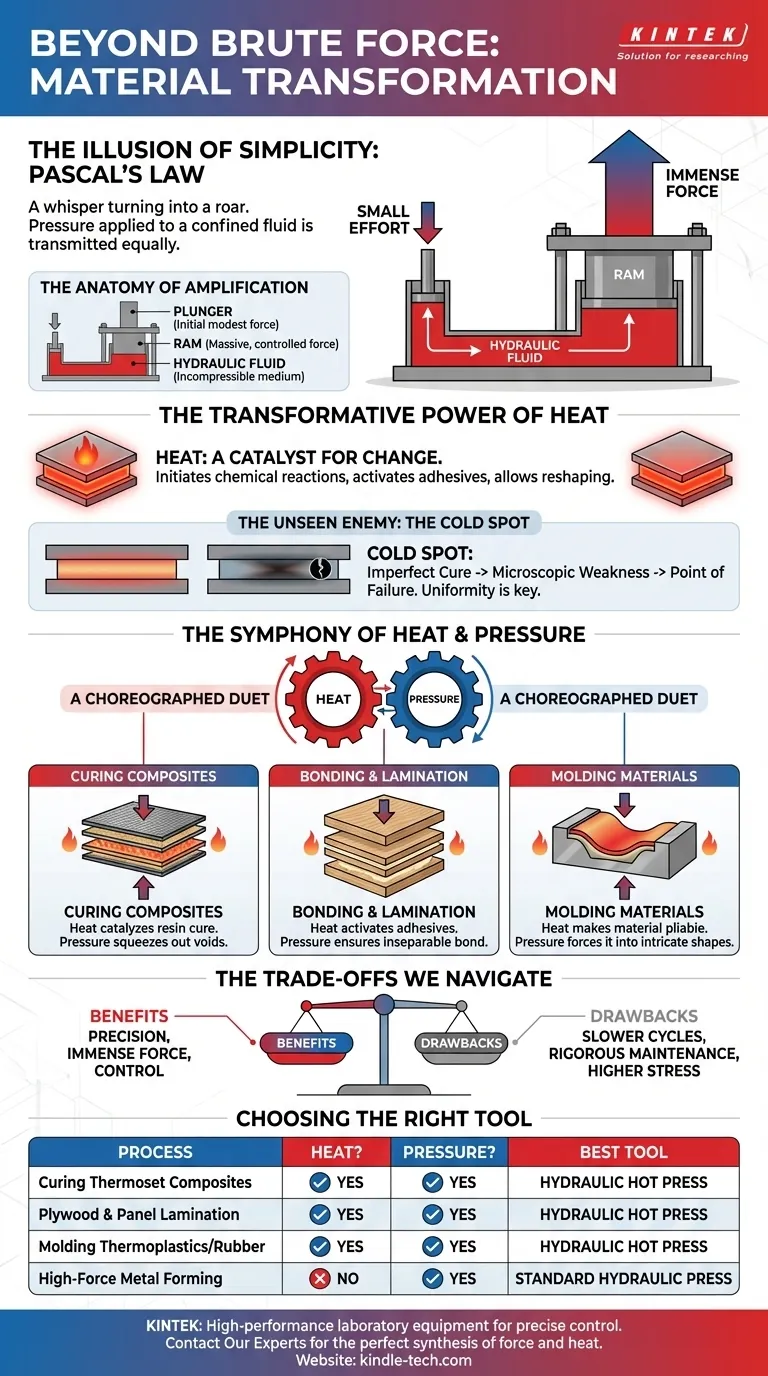
The entire system hinges on a principle discovered in the 17th century: Pascal's Law. It states that pressure applied to a confined fluid is transmitted equally in all directions.
Think of it as a quiet conversation within the machine. A small push on a narrow piston (the plunger) creates pressure in the hydraulic oil. This pressure travels instantly and speaks with the same intensity to a much larger piston (the ram). Because the ram has a vast surface area, that quiet pressure translates into a colossal, amplified force.
It’s the mechanical equivalent of a whisper turning into a roar.
The Anatomy of Amplification
This force multiplication is achieved through a beautifully simple set of components:
- The Plunger: Where the initial, modest force is applied.
- The Ram: The workhorse that delivers the massive, controlled compressive force.
- Hydraulic Fluid: The incompressible medium—typically oil—that faithfully transmits the pressure.
This system allows us to apply hundreds of tons of force with a level of precision that brute mechanical systems can only dream of.
The Transformative Power of Heat
The "hot" in "hot press" is where true alchemy begins. Heat is not merely a tool for softening; it's a catalyst for fundamental change.
When we apply thermal energy through the machine's heated platens, we are initiating chemical reactions, activating dormant properties in adhesives, or giving materials the flexibility to be reborn in a new shape.
The Unseen Enemy: The Cold Spot
The greatest challenge in a hot press isn't generating heat, but ensuring its absolute uniformity.
Imagine crafting a critical aerospace component from carbon fiber. A single "cold spot" on the platen—a variation of just a few degrees—means the resin in that area will not cure properly. To the naked eye, the part looks perfect. But microscopically, it contains a fatal weakness. Under stress, failure will begin right there, in that one improperly formed section.
This is why perfect temperature distribution isn't a feature; it's the entire point.
The Symphony of Heat and Pressure
Neither force nor heat can achieve on its own what they can accomplish together. Their combination is a carefully choreographed duet that unlocks new material possibilities.
A Duet of Forces
This partnership is essential across numerous applications:
- Curing Composites: In materials like carbon fiber or fiberglass, heat catalyzes the chemical reaction that cures the resin, turning it into a rigid matrix. Pressure compacts the layers, squeezing out any microscopic voids that could become points of failure.
- Bonding and Lamination: When creating plywood, heat activates the thermosetting adhesives between wood veneers. The immense pressure ensures a complete, inseparable bond across every square inch.
- Molding Materials: For thermoplastics or rubber, heat makes the material pliable and ready to be shaped. The hydraulic pressure then forces it to conform perfectly to the intricate details of a mold.
The Trade-Offs We Navigate
This power comes with inherent trade-offs. Hydraulic systems are masters of precision and force but are typically slower than mechanical presses. The time required for platens to heat and cool—the cycle time—is a critical factor in production.
Furthermore, the immense stress of high pressure and high temperature demands rigorous maintenance. It is a powerful tool that commands respect and diligence to ensure safety and consistent performance.
Choosing the Right Tool for the Job
The decision to use a hydraulic hot press depends entirely on the material's needs. The key question is always: does the transformation require both forces working in concert?
| Material Process | Heat Required? | Pressure Required? | Best Tool |
|---|---|---|---|
| Curing Thermoset Composites | Yes | Yes | Hydraulic Hot Press |
| Plywood & Panel Lamination | Yes | Yes | Hydraulic Hot Press |
| Molding Thermoplastics/Rubber | Yes | Yes | Hydraulic Hot Press |
| High-Force Metal Forming | No | Yes | Standard Hydraulic Press |
In a laboratory environment, where research and development demand the highest level of precision, controlling these two variables is paramount. Reproducible results depend on a machine that can deliver the exact same temperature and pressure profiles, time and time again.
KINTEK specializes in high-performance laboratory equipment, including hydraulic hot presses engineered for the precise control needed for curing composites, testing new laminates, and developing advanced molding processes. Our systems provide the reliability and accuracy essential for turning innovative ideas into tangible results.
If your work demands the perfect synthesis of force and heat, we can help you find the right instrument for your material transformation goals. Contact Our Experts
Visual Guide
Related Products
- Heated Hydraulic Press Machine with Heated Plates for Vacuum Box Laboratory Hot Press
- Automatic High Temperature Heated Hydraulic Press Machine with Heated Plates for Lab
- Manual High Temperature Heated Hydraulic Press Machine with Heated Plates for Lab
- 24T 30T 60T Heated Hydraulic Press Machine with Heated Plates for Laboratory Hot Press
- Heated Hydraulic Press Machine with Integrated Manual Heated Plates for Lab Use
Related Articles
- Why Your Composite and Polymer Parts Keep Failing: The Secret Is Simultaneous Heat and Pressure
- The Physics of Flawless Materials: Deconstructing the Hydraulic Hot Press
- Hydraulic Hot Press: Principles, Components, Features, Advantages, and Applications
- More Than a Squeeze: The Physics and Psychology of the Hydraulic Hot Press
- Comprehensive Guide to Hydraulic Hot Press: Function, Features and Applications



















