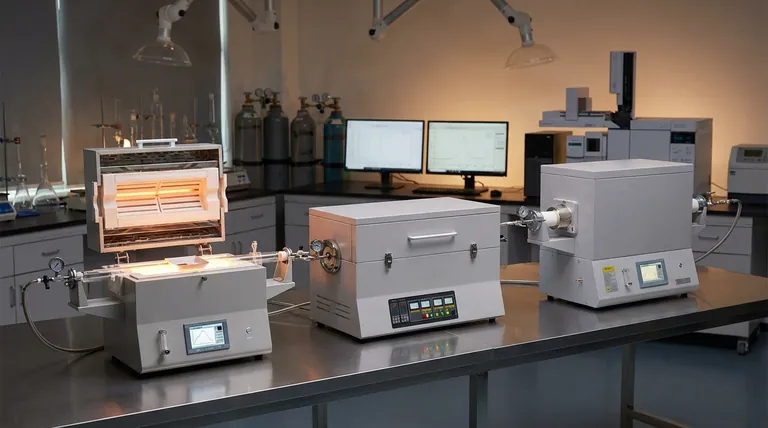
The Illusion of Simple Heat
In materials science, the goal is rarely just to heat something. It’s to transform it. A researcher might be trying to grow a perfect single crystal, synthesize a novel ceramic powder, or anneal a thin film to achieve specific electrical properties.
The enemy in this process is chaos. An unwanted wisp of oxygen, a one-degree temperature fluctuation, a subtle impurity—any of these can ruin weeks of work. The challenge isn't applying heat; it's creating a perfectly controlled, predictable, and repeatable universe on a very small scale.
This is the quiet genius of the horizontal tube furnace. It’s not a mere oven. It is an instrument designed to conquer environmental variables.
Anatomy of a Controlled World
To appreciate its function, you must see the furnace not as a collection of parts, but as a system for imposing order on matter. Each component serves to eliminate a specific type of uncertainty.
The Horizontal Axis: Simplicity as a Virtue
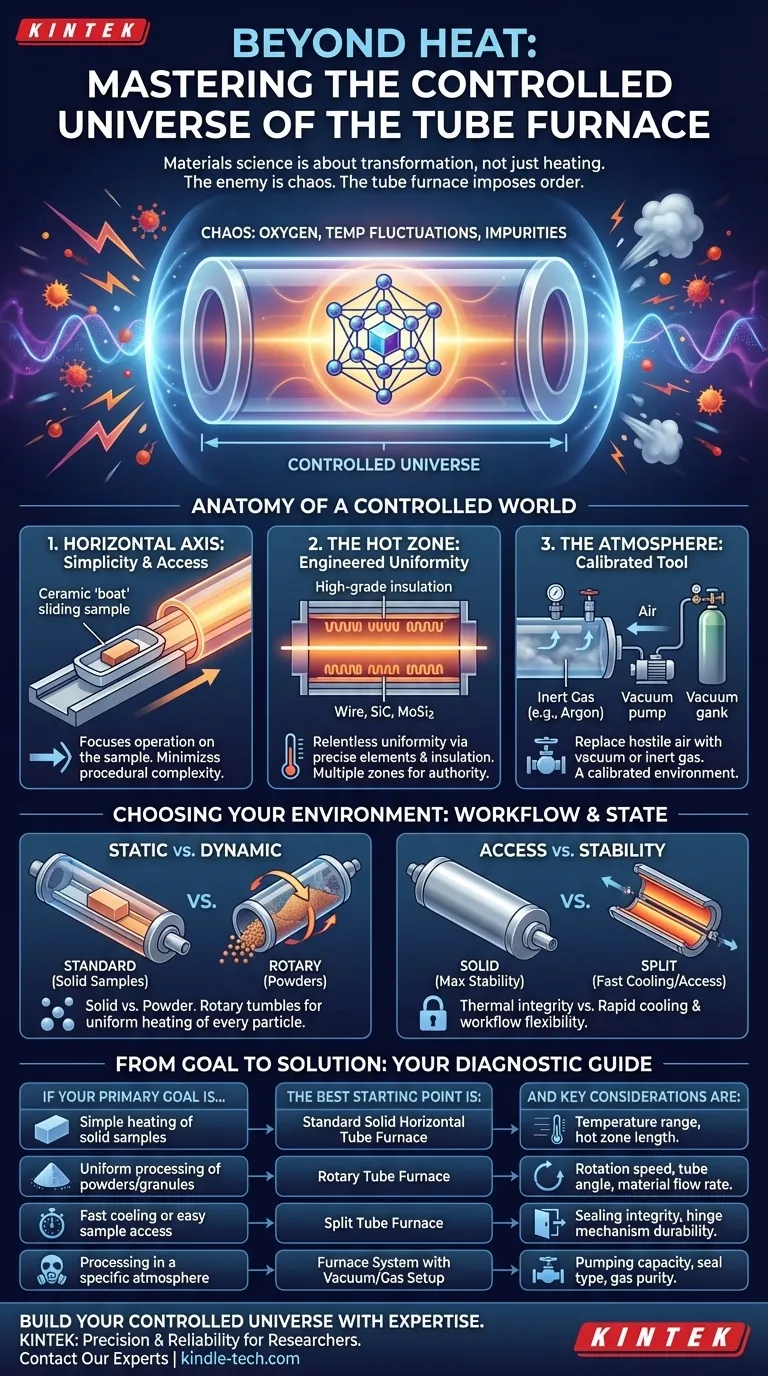
The horizontal orientation is a deliberate design choice favoring simplicity and access. Samples, often held in ceramic "boats," slide smoothly into the core of the heating chamber. This straightforward path minimizes procedural complexity, which itself is a source of error. It focuses the entire operation on one thing: the sample in the center.
The Hot Zone: Engineering Uniformity
Materials don't react well to ambiguity. If one part of a sample is at 800°C while another is at 805°C, the resulting material will be inconsistent.
The furnace's "hot zone" is the engineered solution. This is the central region of the tube where the temperature is relentlessly uniform. It's achieved through the careful placement of heating elements—like wire, Silicon Carbide (SiC), or Molybdenum Disilicide (MoSi2)—and high-grade insulation. Advanced systems use multiple, independently controlled zones to extend this uniformity, giving the operator absolute authority over the thermal gradient.
The Atmosphere: From Hostile to Helper
For many reactions, Earth's atmosphere is a contaminant. Oxygen is highly reactive and often the primary cause of failure.
A tube furnace solves this by enabling you to replace the atmosphere entirely. By sealing the ends of the process tube, you can evacuate the air to create a vacuum or introduce a precisely controlled flow of an inert gas like argon. The atmosphere is no longer an unpredictable variable; it becomes a calibrated tool.
The Psychology of Choosing the Right Environment
The type of furnace you choose reflects a deeper understanding of your material's nature and your process's priorities. It's a decision about what kind of control you need most.
The Static vs. The Dynamic: A Question of State
A standard horizontal tube furnace holds its sample perfectly still. This is ideal for solid objects, films, or small components.
But what about powders? A static pile of powder will heat unevenly. The particles on the surface get the full thermal load, while those in the center remain insulated. This introduces a hidden variable. The cognitive leap is realizing your material needs to be dynamic even if the furnace isn't. The solution here is a rotary tube furnace, which tumbles the material, ensuring every single particle experiences the same conditions.
Access vs. Stability: The Workflow Trade-off
A solid tube furnace offers maximum thermal stability and insulation. But what if your process requires rapid cooling or frequent sample inspection? Waiting for a solid tube to cool can be a significant bottleneck.
The split tube furnace is the answer. Its chamber can be opened along its length, exposing the process tube to room temperature for rapid cooling. The choice is a psychological one: do you prioritize the absolute thermal integrity of a solid cylinder or the speed and workflow flexibility of a split design?
From Standard Tool to Specific Solution
No two research goals are identical. Therefore, no "one-size-fits-all" furnace can be the optimal solution. The base unit is merely a platform for a specialized system.
The selection process is a diagnostic one, driven entirely by your objective.
| If Your Primary Goal Is... | ...The Best Starting Point Is: | ...And Key Considerations Are: |
|---|---|---|
| Simple heating of solid samples | A standard solid horizontal tube furnace | Temperature range, hot zone length. |
| Uniform processing of powders/granules | A rotary tube furnace | Rotation speed, tube angle, material flow rate. |
| Fast cooling or easy sample access | A split tube furnace | Sealing integrity, hinge mechanism durability. |
| Processing in a specific atmosphere | A furnace system with vacuum-tight flanges and a gas delivery setup | Pumping capacity, seal type (e.g., water-cooled), gas purity. |
Building this controlled universe requires not just the right components, but the right expertise. At KINTEK, we provide high-performance laboratory equipment designed for precision and reliability, helping researchers move from concept to creation. To ensure your thermal processing is built on a foundation of control and repeatability, Contact Our Experts.
Visual Guide
Related Products
- Horizontal High Temperature Graphite Vacuum Graphitization Furnace
- Rotary Tube Furnace Split Multi Heating Zone Rotating Tube Furnace
- Vertical Laboratory Tube Furnace
- Laboratory Vacuum Tilt Rotary Tube Furnace Rotating Tube Furnace
- 1200℃ Split Tube Furnace with Quartz Tube Laboratory Tubular Furnace
Related Articles
- Unveiling Vacuum Graphite Furnaces: Performance, Applications, and Expert Insights
- Maximizing Efficiency and Precision with Vacuum Graphite Furnaces
- Optimizing Performance with Graphite Vacuum Furnaces: A Comprehensive Guide
- High-Temperature Vacuum Furnace: Classification, Applications, and Components
- Classification, Applications, and Components of High-Temperature Vacuum Furnaces



















