The Allure of the Highest Number
In engineering, as in life, we are often drawn to extremes. The fastest car, the highest-resolution screen, the most powerful computer. It's a natural cognitive bias.
When selecting a vacuum furnace, this bias manifests as a fixation on a single metric: maximum temperature. An engineer might see a furnace rated for 2500°C and instinctively feel it's superior to one rated for 1600°C.
But this is a trap. The true limit of a furnace isn't just a number on a specification sheet. It's a complex and elegant balance of material science, operational physics, and process chemistry. Choosing wrong doesn't just cost money upfront; it can compromise the very integrity of your work.
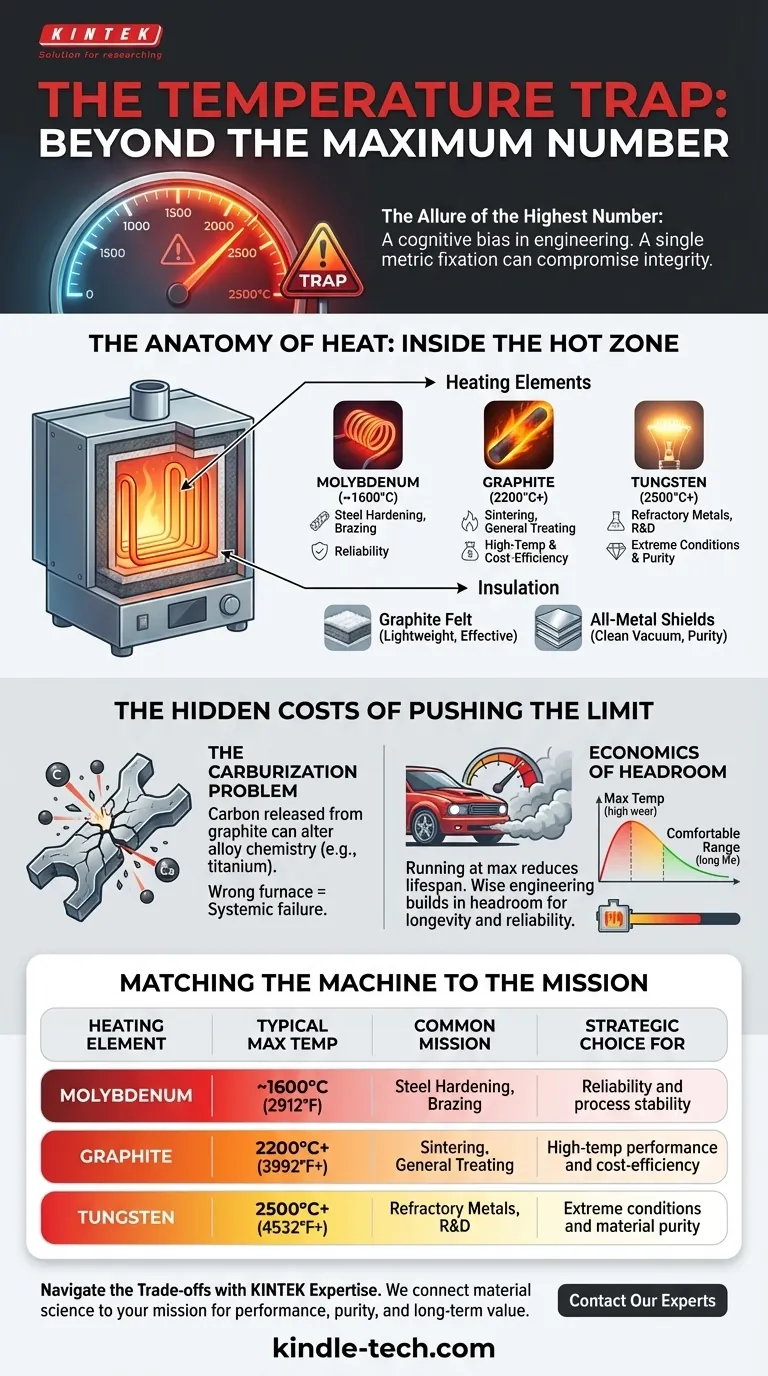
The Anatomy of Heat: Inside the Hot Zone
A vacuum furnace’s performance ceiling is dictated by its heart: the "hot zone." This is where the laws of thermodynamics meet the limits of material engineering.
The maximum sustainable temperature is governed by two core components and the materials they are made from.
The Engines of Heat: Heating Elements
These are the components that convert electrical energy into thermal energy. Their material composition defines the furnace's operational range.
- Molybdenum (Moly): The reliable industry workhorse. Moly elements comfortably operate up to around 1600°C, making them perfect for brazing stainless steel and heat-treating most tool steels. They are stable and predictable.
- Graphite: The high-performance, cost-effective champion. Graphite can easily push past 2200°C, offering excellent thermal uniformity for sintering ceramics and other demanding processes. It is a marvel of material efficiency.
- Tungsten: The uncompromising material for the frontier. For applications that demand the absolute highest temperatures—processing refractory metals, advanced ceramics research—tungsten is the only choice, operating in excess of 2500°C.
The Guardians of Energy: Insulation
Generating immense heat is only half the battle. Containing it is just as critical. The insulation package must withstand the temperatures generated by the elements and prevent that energy from escaping.
- Graphite Felt: The standard partner for graphite elements. It's lightweight, effective, and provides superb insulation at extreme temperatures.
- All-Metal Shields: For processes where purity is paramount. These shields, often made of layered molybdenum and stainless steel, create an exceptionally clean vacuum environment. Unlike fibrous insulation, they don't shed particles, which is critical in medical, aerospace, and semiconductor applications.
The Hidden Costs of Pushing the Limit
Choosing a furnace is not about maximizing temperature; it's about optimizing for your specific process. Pushing for the highest number introduces trade-offs that are often invisible on a spec sheet.
The Carburization Problem: When Your Furnace Changes Your Material
Imagine this scenario: you're heat-treating a specialized titanium alloy in a high-temperature graphite furnace. The process runs perfectly, but the final part is brittle and fails inspection.
What happened? At high temperatures, the graphite elements released carbon atoms, which were absorbed by the alloy—a process called carburization. The furnace itself altered the material's chemistry.
This is a classic systemic failure. The "right" furnace for this job wasn't the one with the highest temperature; it was an all-metal furnace that could provide a chemically inert environment, even if its temperature rating was lower.
The Economics of Headroom
Consistently running a furnace at its absolute maximum temperature is like driving a car with the engine always at the redline. It will work, for a while. But the lifespan of the heating elements and insulation will be drastically reduced, leading to frequent, costly maintenance cycles.
Wise engineering involves building in headroom. If your process requires 1400°C, a furnace with a comfortable maximum of 1600°C is a far better long-term investment than one that barely meets the mark. It's a decision that prioritizes longevity and reliability over a seductive but impractical peak number.
Matching the Machine to the Mission
The right choice begins not with the furnace, but with your application. A clear understanding of your process requirements—temperature, atmosphere, and material compatibility—will lead you to the right tool for the job.
The table below outlines this philosophy, connecting the material science of the furnace to the real-world task.
| Heating Element | Typical Max Temp | Common Mission | Strategic Choice For |
|---|---|---|---|
| Molybdenum | ~1600°C (2912°F) | Steel Hardening, Brazing | Reliability and process stability |
| Graphite | 2200°C+ (3992°F+) | Sintering, General Treating | High-temp performance and cost-efficiency |
| Tungsten | 2500°C+ (4532°F+) | Refractory Metals, R&D | Extreme conditions and material purity |
Navigating these trade-offs requires more than a datasheet; it requires expertise. At KINTEK, we specialize in understanding the deep connection between your laboratory's mission and the equipment needed to achieve it. We help you look beyond the numbers to find a solution that delivers performance, purity, and long-term value.
If you are ready to match the right technology to your true operational need, we can help you build the right system. Contact Our Experts
Visual Guide
Related Products
- Vacuum Hot Press Furnace Heated Vacuum Press Machine Tube Furnace
- 600T Vacuum Induction Hot Press Furnace for Heat Treat and Sintering
- Vacuum Heat Treat Furnace with Ceramic Fiber Liner
- Vacuum Heat Treat and Pressure Sintering Furnace for High Temperature Applications
- Vacuum Heat Treat Furnace and Levitation Induction Melting Furnace
Related Articles
- The Purity Paradox: Choosing the Heart of Your Vacuum Hot Press Furnace
- Comprehensive Guide to Vacuum Hot Press Furnace Application
- Vacuum Hot Press Furnace: A Comprehensive Guide
- Forging Perfection in a Void: The Physics of Ultra-Dense Materials
- Defeating the Void: The Quiet Power of Vacuum Hot Pressing