The Unseen Enemy in Every Lab
Imagine spending weeks developing a new crystalline material, only to find its properties compromised by an invisible flaw. The culprit isn't a mistake in your formula, but the very air around you. Oxygen, nitrogen, and water vapor—benign in our daily lives—are saboteurs at the atomic level, eagerly reacting with hot materials to form unwanted oxides and nitrides.
This is the fundamental challenge in advanced material science: the quest for absolute purity. It’s a psychological drive for control, an obsession with eliminating every variable that could corrupt the final product. To achieve this, scientists don't just need to control heat; they need to engineer a perfect, empty stage. This is the world of the vacuum tube furnace.
Deconstructing the Controlled Void
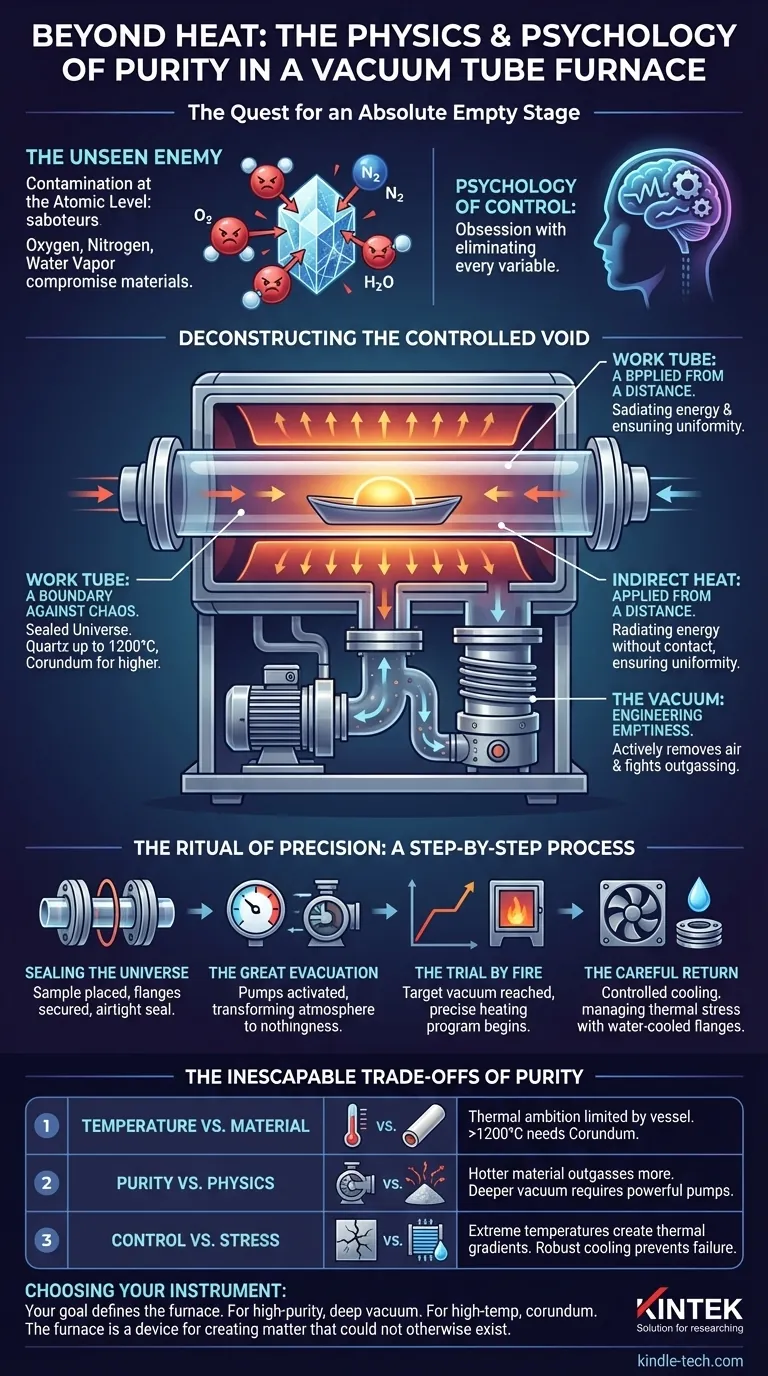
A vacuum tube furnace isn't just a high-temperature oven. It's a system built on a philosophy of isolation. It physically separates the sample from the heat source and chemically separates it from the atmosphere. This is achieved through three elegant, interlocking systems.
The Vessel: A Boundary Against Chaos
The first line of defense is the work tube. Typically crafted from high-purity quartz or corundum (alumina), this tube is the sealed universe where your reaction takes place. It’s a simple component with profound implications.
Your ambition is defined by this boundary. A quartz tube serves admirably up to about 1200°C, but pushing beyond that requires the superior thermal resilience of a corundum tube. The choice isn't just technical; it's a declaration of how far into the extremes you're willing to go.
The Heat: Applied from a Distance
The heating elements never touch the work tube directly. In a "hot wall" design, they surround the exterior, radiating energy inward. This indirect approach is crucial.
Heat gently envelops the tube, which then transfers that energy to the sample inside. The result is uniform, controlled heating without introducing electrical or physical interference, ensuring the sample's environment remains pristine.
The Vacuum: Engineering Emptiness
This is the furnace's soul. A powerful vacuum system, often combining a rotary vane pump with a high-speed diffusion pump, actively removes the air from the work tube. It's not a passive state; it's an aggressive act of purification.
As the material heats up, it begins to "outgas"—releasing trapped molecules from its surface. A robust vacuum system must not only create the initial void but also continuously fight this internal contamination, pumping away these material ghosts to maintain an ultra-low pressure.
The Ritual of Precision: A Step-by-Step Process
Operating a vacuum furnace is less a procedure and more a deliberate ritual, where each step ensures the integrity of the experiment.
-
Sealing the Universe: The sample is placed inside the work tube. Vacuum flanges, fitted with o-rings, are secured at both ends, creating an airtight seal. The outside world is now locked out.
-
The Great Evacuation: The pumps are activated. The operator watches the vacuum gauge not as a simple dial, but as a confirmation that the environment is being transformed from chaotic atmosphere to controlled nothingness.
-
The Trial by Fire: Once the target vacuum is reached, the heating program begins. The furnace controller precisely executes the temperature ramp and "soak" time, allowing the material to transform under ideal conditions.
-
The Careful Return: Cooling is as critical as heating. The immense thermal stress between the furnace's hot zone and its room-temperature ends must be managed. Water-cooled flanges are often essential to protect the seals from melting, which would cause a catastrophic vacuum failure.
The Inescapable Trade-offs of Purity
Like any pursuit of perfection, creating materials in a vacuum involves fundamental trade-offs. Understanding them is key to mastery.
| Constraint | The Engineering Reality |
|---|---|
| Temperature vs. Material | Your thermal ambition is limited by your vessel. Pushing past 1200°C requires investing in a corundum tube. |
| Purity vs. Physics | The hotter a material gets, the more it outgasses. A deeper vacuum requires a more powerful pumping system to win this battle. |
| Control vs. Stress | Extreme temperatures create extreme thermal gradients. This necessitates robust cooling systems to prevent mechanical failure. |
Choosing Your Instrument of Creation
The right vacuum tube furnace depends entirely on your scientific or industrial goal. It’s a choice about the problem you are trying to solve.
- For high-purity annealing or sintering, where even a single atom of oxygen can be a defect, a system with a deep vacuum capability is non-negotiable.
- For processing advanced ceramics or alloys above 1200°C, your entire setup must be built around a corundum work tube and high-temperature elements.
- For developing novel materials, the furnace is your most critical tool, providing the pristine, repeatable environment that innovation demands.
Ultimately, a vacuum tube furnace is more than an instrument; it's a device for creating matter that could not otherwise exist. To achieve this level of control in your work, you need equipment built with the same philosophy of precision. KINTEK's range of lab equipment is designed to provide this exact environment for your most demanding applications. Contact Our Experts
Visual Guide
Related Products
- Vacuum Sealed Continuous Working Rotary Tube Furnace Rotating Tube Furnace
- Laboratory High Pressure Vacuum Tube Furnace
- Laboratory Vacuum Tilt Rotary Tube Furnace Rotating Tube Furnace
- Split Chamber CVD Tube Furnace with Vacuum Station Chemical Vapor Deposition System Equipment Machine
- 1200℃ Controlled Atmosphere Furnace Nitrogen Inert Atmosphere Furnace
Related Articles
- Unlocking Efficiency: The Ultimate Guide to Rotary Tube Furnaces
- Unlocking Efficiency: Exploring the Advantages and Applications of Rotary Tube Furnaces
- Exploring the Benefits and Applications of Rotary Furnaces: A Comprehensive Guide
- The Physics of Perfection: How Rotary Furnaces Eliminate Randomness in Material Processing
- The Geometry of Heat: Engineering the Perfect Thermal Environment