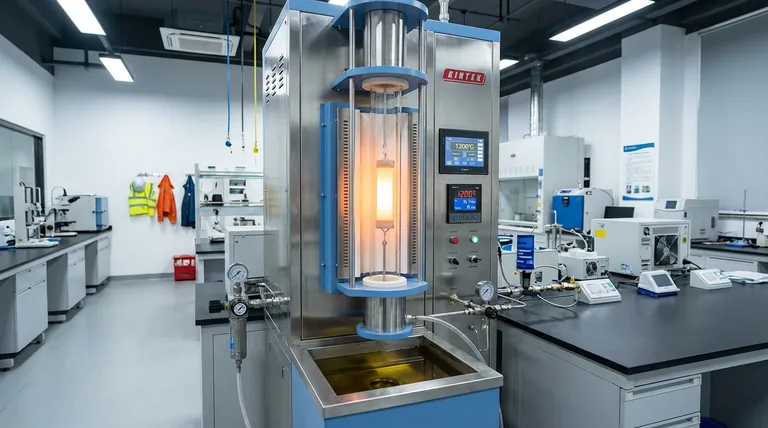
The Architecture of Thermal Precision
In the world of material science, gravity is often treated as a nuisance. It is the force that makes structures heavy, causes machinery to sag, and imposes strict limits on how we build.
Most laboratory equipment is designed to resist gravity. However, there is a specific category of thermal processing where engineers stopped fighting this fundamental force and decided to collaborate with it.
Enter the Vertical Tube Furnace.
While the horizontal furnace remains the workhorse of general annealing, the vertical configuration is not merely an alternative design choice. It is a specific solution to a set of physical problems that occur when high heat meets delicate matter.
The Physics of Orientation
When you heat a material to 1200°C or higher, its structural integrity changes. It becomes pliable.
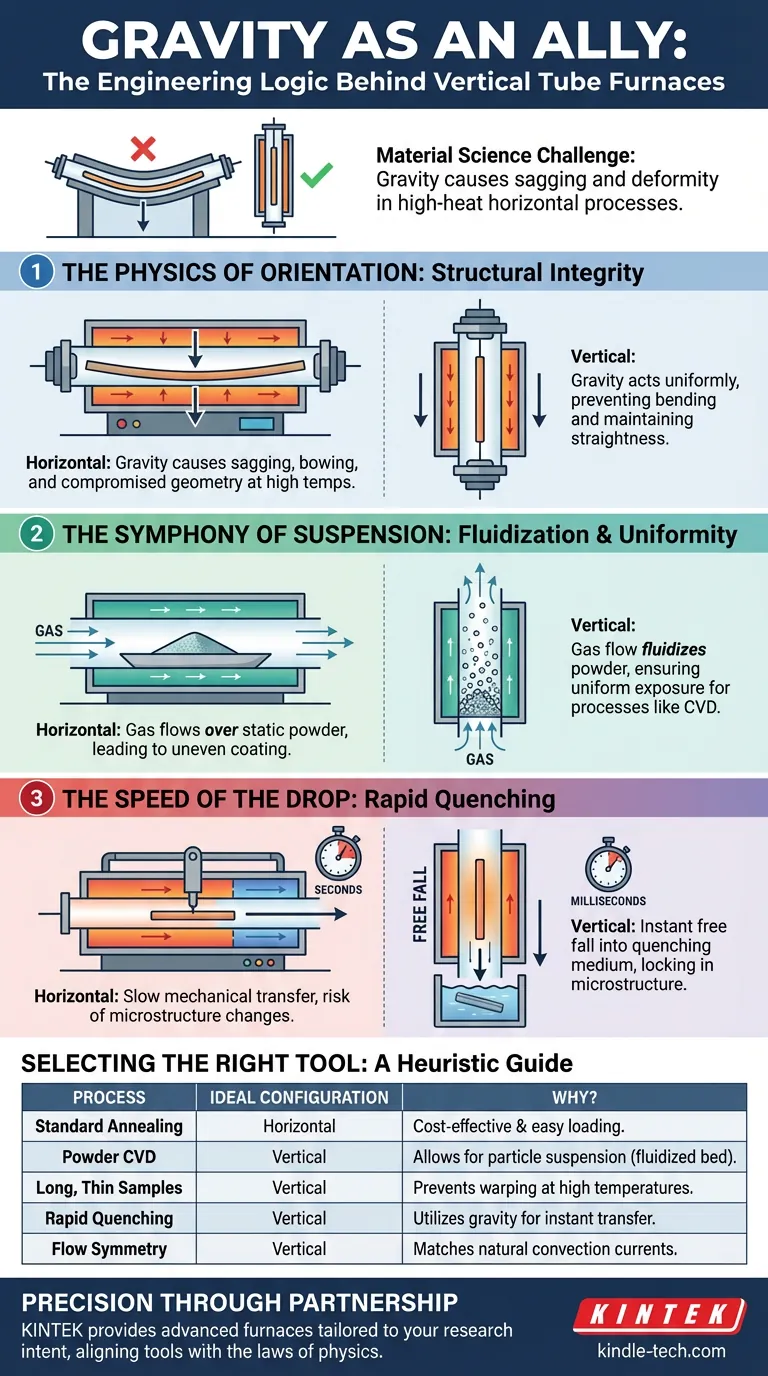
In a standard horizontal furnace, a long ceramic rod or metal sample is held at both ends. As the temperature rises, gravity pulls the unsupported center downward. The sample bows. The geometry is compromised.
The vertical tube furnace solves this by changing the axis of stress.
By suspending the sample vertically, gravity acts uniformly along the length of the material. There is no bending moment. The force that once deformed the sample now helps maintain its straightness.
The Symphony of Suspension
The vertical orientation offers more than just structural support. It changes how the sample interacts with the atmosphere inside the tube.
In a horizontal setup, powders sit in a static pile. Gas flows over them, reacting mostly with the top layer. To get a uniform coating, you have to mechanically agitate the boat, which is clumsy and inconsistent.
The vertical furnace changes the dynamic entirely:
- Fluidization: By introducing gas flow from the bottom, the vertical furnace can lift particles against gravity.
- Uniformity: The powder becomes a "fluidized bed," where every single particle is suspended and exposed to the heat and reactive gas from all sides.
- Result: This is critical for processes like Chemical Vapor Deposition (CVD) on porous materials or powders.
The Speed of the Drop
There is a psychological aspect to engineering: the desire for control versus the need for speed.
In quenching processes—where a material must be cooled instantly to lock in a specific microstructure—speed is everything.
In a horizontal system, moving a sample from the "hot zone" to the "cold zone" involves mechanical extraction. It takes seconds. In material science, seconds are an eternity.
The vertical furnace utilizes the most reliable transport mechanism in the universe: Free fall.
The sample is suspended in the hot zone. When the cycle ends, the suspension is released. The sample drops instantly into a quenching medium (oil or water) positioned directly below. The transition time is virtually zero.
The Engineering Trade-offs
If vertical furnaces are so effective, why aren't they the default?
Every design choice carries a tax. As Morgan Housel might observe about finance, nothing is free; the cost is just hidden. The "tax" of the vertical furnace is complexity and height.
- Headroom: They require significant vertical clearance.
- Loading: You cannot simply slide a sample in; you must suspend it using specialized jigs or baskets.
- Cost: The engineering required to stabilize a vertical heat zone is often more involved than a simple horizontal box.
Selecting the Right Tool
The decision between vertical and horizontal is not about which machine is "better." It is about understanding the specific constraints of your experiment.
Use the following heuristic to determine if you need vertical architecture:
| If your process involves... | The Ideal Configuration is... | Why? |
|---|---|---|
| Standard Annealing | Horizontal | Cost-effective and easiest to load for stable solids. |
| Powder CVD | Vertical | Allows for particle suspension (fluidized bed). |
| Long, Thin Samples | Vertical | Prevents warping or sagging at high temperatures. |
| Rapid Quenching | Vertical | Utilizing gravity for instant transfer to cooling media. |
| Flow Symmetry | Vertical | Cylindrical symmetry matches natural convection currents. |
Precision Through Partnership
At KINTEK, we understand that a furnace is not just a heater box. It is a controlled environment designed to manipulate the fundamental properties of matter.
Whether you require the gravitational neutrality of a vertical system or the straightforward utility of a horizontal one, the equipment must match the intent of the researcher. We provide the advanced PID controllers, the high-purity quartz tubes, and the thermal engineering required to make those choices pay off.
Don't let equipment limitations dictate your results. Align your tools with the laws of physics.
Visual Guide
Related Products
- Vertical Laboratory Tube Furnace
- Vertical High Temperature Graphite Vacuum Graphitization Furnace
- Customer Made Versatile CVD Tube Furnace Chemical Vapor Deposition Chamber System Equipment
- Rotary Tube Furnace Split Multi Heating Zone Rotating Tube Furnace
- Laboratory Vacuum Tilt Rotary Tube Furnace Rotating Tube Furnace
Related Articles
- Understanding Laboratory Tube Furnaces
- How to Choose a Laboratory Tube Furnace
- The Architecture of Heat: Inside the Precision of Laboratory Tube Furnaces
- When Gravity is Your Ally: The Strategic Choice of a Vertical Tube Furnace
- From Crack to Complete: A Scientist's Guide to Eliminating Catastrophic Tube Furnace Failures



















