The Scientist's Dilemma: Controlling the Uncontrollable
In research and advanced manufacturing, the greatest enemy is the uncontrolled variable. We spend our careers trying to isolate, measure, and tame them.
Heat is one of the most powerful and yet most chaotic tools we wield. Anyone can make something hot. The real challenge is creating a perfect, predictable, and pure thermal environment, time and time again.
This isn't about heating. It's about control.
A standard oven heats a space. A tube furnace crafts an environment. Its power lies not in its temperature, but in its precision.
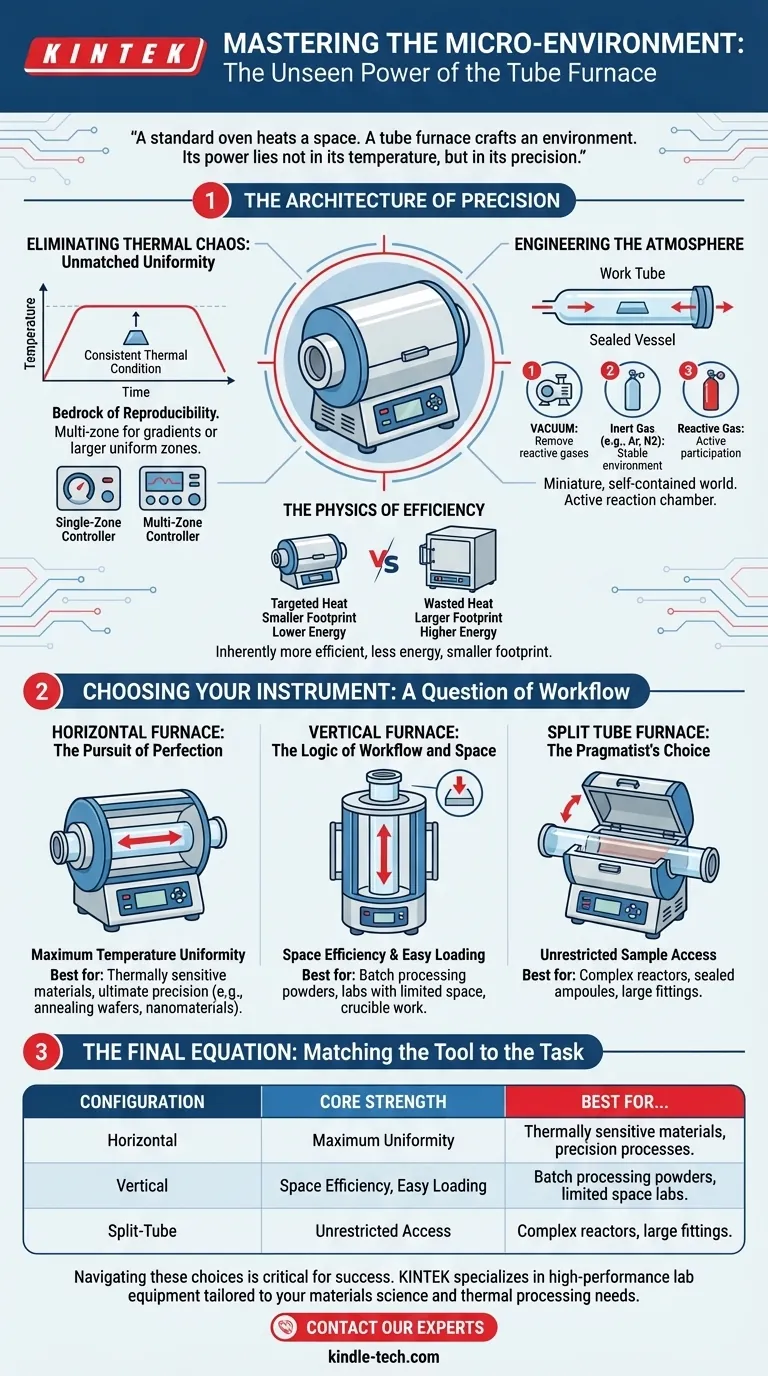
The Architecture of Precision
The unique power of a tube furnace comes directly from its design: a cylindrical chamber with heating elements wrapped around a central tube. This simple geometry is the foundation for overcoming the limitations of conventional box furnaces.
Eliminating Thermal Chaos: Unmatched Uniformity
The primary benefit of this design is an exceptionally uniform temperature distribution along the heated zone. For a sample inside, this means the entire material experiences the exact same thermal conditions. This is the bedrock of reproducibility.
For more demanding processes, multi-zone furnaces allow for programmable temperature gradients or an even larger, flatter, and more uniform heating zone. This is critical for growing crystals or annealing sensitive components where the slightest variation could mean failure.
Engineering the Atmosphere
By its nature, the work tube is a sealed vessel. It isolates the sample from the outside world and, crucially, from the heating elements themselves. This separation is key to achieving absolute atmospheric control.
This allows you to create a miniature, self-contained world for your sample. You can operate under:
- Vacuum: To remove reactive gases.
- Inert Gas: To provide a stable, non-reactive environment (e.g., Argon, Nitrogen).
- Reactive Gas: To actively participate in a chemical synthesis or surface treatment.
This level of control transforms the furnace from a simple heater into an active reaction chamber.
The Physics of Efficiency
Targeting heat around a small-diameter tube is inherently more efficient than heating a large box. This translates to a smaller footprint on the lab bench and significantly lower energy consumption, especially over the long run.
Choosing Your Instrument: A Question of Workflow
The term "tube furnace" describes a family of instruments. The right choice depends entirely on your process, your sample, and your space. This is not just a technical specification; it's a strategic decision.
The Horizontal Furnace: The Pursuit of Perfection
This is the classic configuration, and for good reason. The horizontal orientation is the undisputed champion for achieving the highest possible thermal uniformity.
It is the instrument of choice for processes where consistency is non-negotiable—annealing wafers, synthesizing delicate nanomaterials, or performing critical calibration tests.
The Vertical Furnace: The Logic of Workflow and Space
By orienting the tube vertically, these furnaces offer a much smaller footprint, a critical advantage in crowded labs.
Their top-loading design also simplifies batch processing. For applications like powder calcination or crucible-based work, gravity becomes an asset, making loading and unloading faster and more convenient.
The Split Tube Furnace: The Pragmatist's Choice
A split tube furnace's body is hinged, allowing it to open completely. This provides unobstructed access to the work tube.
This feature is not a luxury; it's a necessity for any process involving complex reactor vessels with large flanges, multiple sensor ports, or other fittings that make it physically impossible to slide them into a standard furnace. It solves a fundamental problem of access.
The Final Equation: Matching the Tool to the Task
Selecting the right furnace is the first, most critical step toward reliable results. The decision balances the need for precision against the practical demands of your workflow.
| Configuration | Core Strength | Best For... |
|---|---|---|
| Horizontal | Maximum Temperature Uniformity | Thermally sensitive materials; processes requiring ultimate precision. |
| Vertical | Space Efficiency & Easy Loading | Batch processing powders; labs where floor space is a premium. |
| Split-Tube | Unrestricted Sample Access | Complex reactors or sealed quartz ampoules with large fittings. |
Navigating these choices is critical for success. At KINTEK, we specialize in providing high-performance lab equipment tailored to the specific demands of materials science and thermal processing. Our range of horizontal, vertical, and split-tube furnaces is designed to deliver the precise control and reliability your work depends on.
To ensure you select the ideal configuration for your research or production needs, Contact Our Experts
Visual Guide
Related Products
- Rotary Tube Furnace Split Multi Heating Zone Rotating Tube Furnace
- Laboratory Vacuum Tilt Rotary Tube Furnace Rotating Tube Furnace
- 1200℃ Split Tube Furnace with Quartz Tube Laboratory Tubular Furnace
- 1400℃ Laboratory High Temperature Tube Furnace with Alumina Tube
- 1700℃ Laboratory High Temperature Tube Furnace with Alumina Tube
Related Articles
- The Geometry of Heat: Why Motion Matters in Material Synthesis
- Exploring the Functions and Advantages of Rotary Tube Furnaces
- The Geometry of Heat: Engineering the Perfect Thermal Environment
- Exploring the Advantages of Rotary Tube Furnaces in Industrial and Laboratory Applications
- The Physics of Perfection: How Rotary Furnaces Eliminate Randomness in Material Processing



















