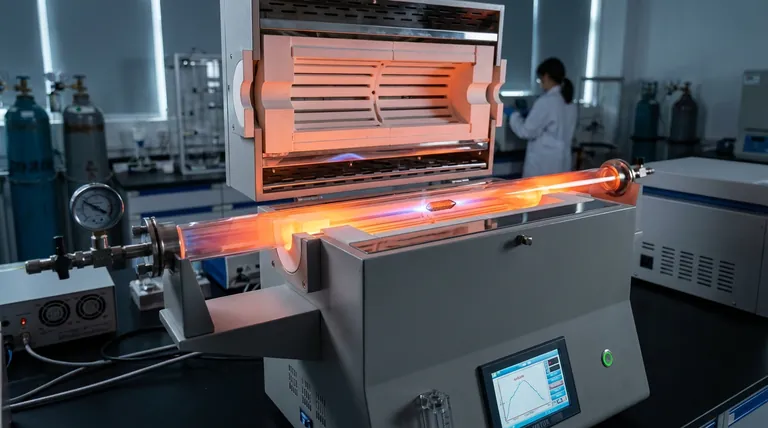
The Unseen Enemy in High-Temperature Science
Imagine spending months developing a novel semiconductor material. Your calculations are flawless, your precursors are ultra-pure. You initiate the final high-temperature synthesis, but an invisible saboteur—oxygen from the ambient air—contaminates the lattice structure, rendering the entire batch useless.
This isn't a failure of chemistry. It's a failure of environment.
In advanced materials science, heat treatment, and chemical synthesis, the most critical variable is often the one we can't see: the atmosphere. The difference between a breakthrough and a setback can be a few stray molecules of oxygen or water vapor. This is the problem the tube furnace was born to solve.
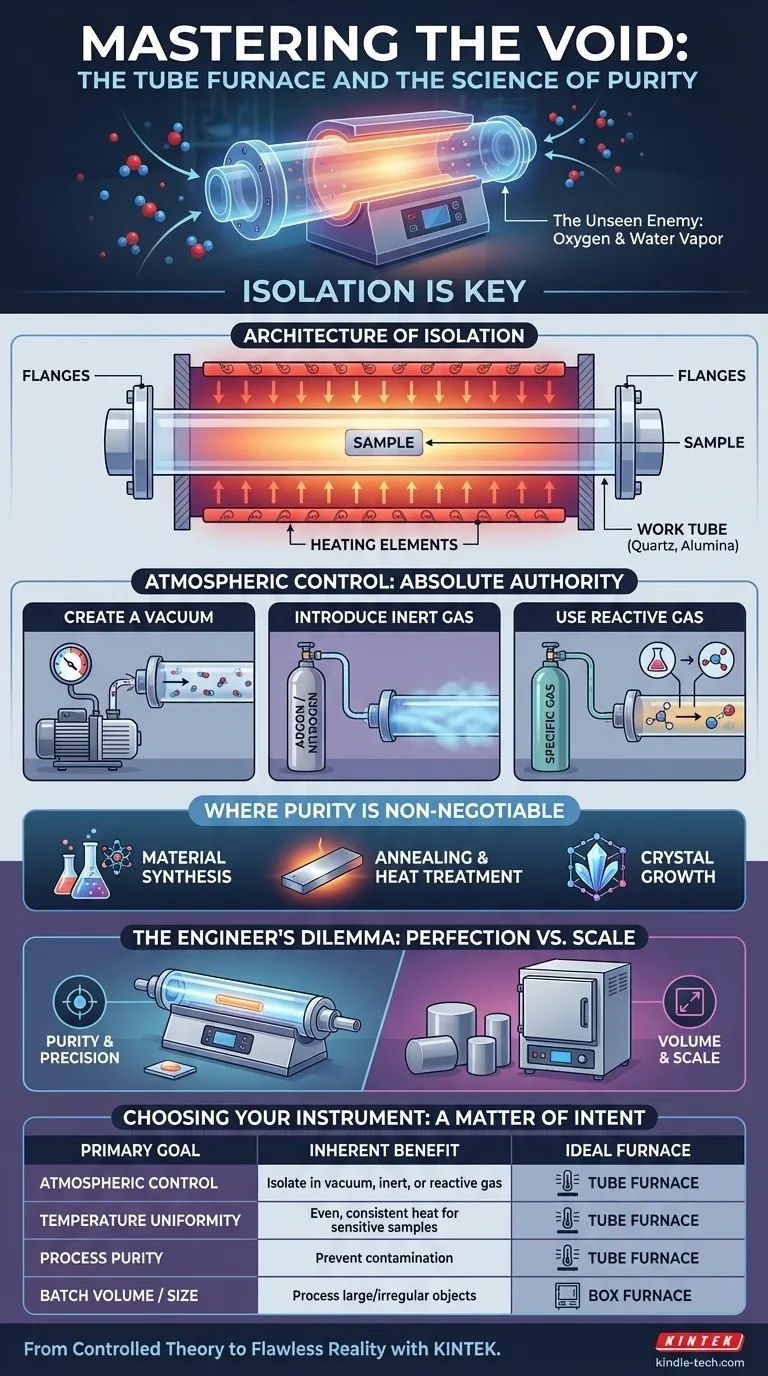
An Architecture of Isolation
A tube furnace appears simple—a heated cylinder. But its design is a masterclass in control, engineered around a single, core principle: isolating a process from the outside world.
It's not just a heater; it's a self-contained universe.
The Tube: A Private Cosmos
At the heart of the system is the work tube, typically crafted from quartz, alumina, or a specialized metal alloy. This tube is the vessel for your sample. It acts as an impermeable barrier, physically separating your critical process from the heating elements and the ambient lab environment.
By sealing the ends with flanges, this simple tube becomes a private cosmos where you, the scientist, dictate the laws of atmospheric physics.
Heat from the Outside In
The heating elements are wrapped around the exterior of the tube. This design is deliberate and brilliant. It ensures heat radiates inward, uniformly, from all directions.
The result is a zone of exceptional thermal stability along the tube's length, eliminating the hot spots and temperature gradients that can ruin sensitive processes like crystal growth or thin-film deposition.
The Power to Dictate the Atmosphere
The true genius of the tube furnace is unlocked when you control what’s inside the tube. Its sealed design gives you absolute authority over the internal environment.
- Create a Vacuum: You can evacuate the tube, removing reactive gases to a high vacuum level, creating a near-perfectly clean environment.
- Introduce Inert Gas: You can flood the chamber with an inert gas like argon or nitrogen, creating a protective blanket that prevents oxidation and other unwanted reactions.
- Use Reactive Gas: You can introduce a specific reactive gas, making it a key ingredient in a chemical synthesis reaction, all while knowing no other gases are interfering.
This level of atmospheric control is the defining feature that separates it from almost every other type of furnace.
Where Purity is Non-Negotiable
This capability makes the tube furnace indispensable for applications where process purity and environmental control are paramount.
- Material Synthesis: Creating air-sensitive compounds or novel alloys that would be impossible to form in the presence of oxygen.
- Annealing & Heat Treatment: Modifying the properties of a material without introducing surface defects like oxidation, ensuring the bulk properties are exactly what you designed.
- Crystal Growth: Providing the pristine, stable thermal environment required to slowly grow a perfect, single-crystal structure from a seed.
The Engineer's Dilemma: Perfection vs. Scale
The choice to use a tube furnace reflects a fundamental tension in science and engineering: the pursuit of absolute perfection versus the need for practical throughput.
The Purity Principle
The tube furnace is the tool of choice when perfection is the goal. Its geometry guarantees a level of atmospheric control and temperature uniformity that is difficult to achieve otherwise. You are prioritizing the quality and integrity of your sample above all else.
The Geometric Constraint
This pursuit of perfection comes with a trade-off: size. The cylindrical nature of the furnace inherently limits the dimensions and shape of your samples. It is not designed for large, bulky, or irregularly shaped components.
For those applications, where strict atmospheric control is less critical than batch size, a box furnace offers a more practical, voluminous alternative. It's a different tool for a different philosophy.
Choosing Your Instrument: A Matter of Intent
The right furnace is not the "best" one, but the one that aligns with the primary goal of your process. Your choice is a declaration of your experimental priorities.
| Your Primary Goal | The Inherent Benefit | The Ideal Furnace |
|---|---|---|
| Atmospheric Control | Isolate a sample in a vacuum, inert, or reactive gas | Tube Furnace |
| Temperature Uniformity | Provide even, consistent heat for a sensitive sample | Tube Furnace |
| Process Purity | Prevent any contamination from air or heating elements | Tube Furnace |
| Batch Volume / Size | Process large or irregularly shaped objects | Box Furnace |
Ultimately, to choose a tube furnace is to decide that the environment in which your process occurs is just as important as the process itself.
From Controlled Theory to Flawless Reality
For laboratories and researchers who cannot afford to let an unseen variable compromise their work, mastering the process environment is key. KINTEK provides high-performance tube furnaces that deliver the precise control and thermal uniformity your research demands. We empower you to move from theoretical perfection to tangible, repeatable results.
If your work demands an environment as pure as your ambition, we have the right instrument for you. Contact Our Experts
Visual Guide
Related Products
- Rotary Tube Furnace Split Multi Heating Zone Rotating Tube Furnace
- Laboratory Vacuum Tilt Rotary Tube Furnace Rotating Tube Furnace
- 1200℃ Split Tube Furnace with Quartz Tube Laboratory Tubular Furnace
- 1400℃ Laboratory High Temperature Tube Furnace with Alumina Tube
- 1700℃ Laboratory High Temperature Tube Furnace with Alumina Tube
Related Articles
- The Geometry of Heat: Why Motion Matters in Material Synthesis
- Exploring the Functions and Advantages of Rotary Tube Furnaces
- The Geometry of Heat: Engineering the Perfect Thermal Environment
- Exploring the Advantages of Rotary Tube Furnaces in Industrial and Laboratory Applications
- The Physics of Perfection: How Rotary Furnaces Eliminate Randomness in Material Processing



















