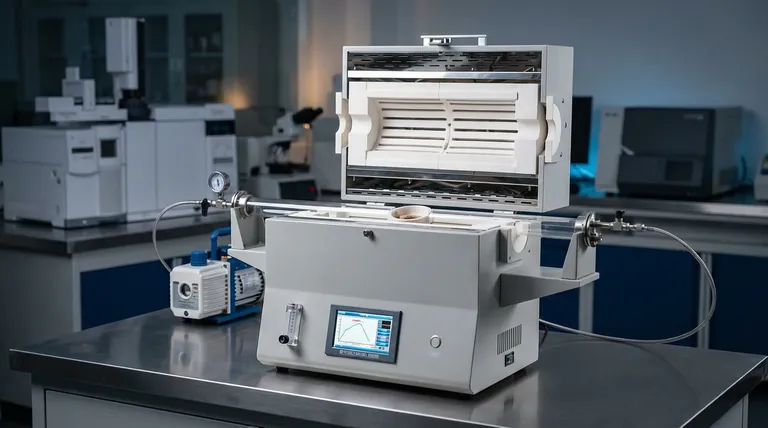
The Illusion of an Empty Space
Imagine a researcher attempting to grow a flawless, single-atom-thick sheet of graphene. In their world, the enemy isn't just contamination—it's chaos. A stray oxygen molecule, a temperature fluctuation of a single degree, or an uneven heat signature across the sample can render weeks of work useless.
Their goal is to create a perfect, predictable void. A small universe where every variable is known and managed.
This is the fundamental challenge that the tube furnace was designed to solve. It’s more than a high-temperature oven; it’s an instrument for imposing order on the microscopic world. Its value isn't just in the heat it generates, but in the control it provides.
The Anatomy of Control
At first glance, a tube furnace seems simple. A box that gets hot. But its elegance lies in how its components collaborate to create a highly stable and isolated environment.
The Heart: The Heating Chamber
Coils of heating elements, wrapped around a cylindrical ceramic cavity, are the furnace's engine. But raw power is useless without containment. These elements are encased in a dense matrix of thermal insulation, which does two things: it directs heat inward with fierce efficiency and prevents that energy from escaping.
This design enables rapid heating, but more importantly, it creates a stable thermal foundation.
The Stage: The Working Tube
This is where the magic happens. A tube of quartz, alumina, or ceramic is slid into the heart of the furnace. This tube is the "stage"—an isolated vessel for the sample.
Crucially, its ends can be sealed. This allows you to dictate the atmosphere. You can pull a vacuum to remove reactive gases or introduce a specific inert gas like argon. The sample is no longer in a room; it’s in its own self-contained world.
The Brain: The Control System
This is the furnace's nervous system. A thermocouple—a sensitive temperature probe—acts as a nerve ending, constantly reporting the exact temperature back to a digital controller.
The controller is the brain, running a constant feedback loop. It compares the real-time temperature to the user's setpoint and makes infinitesimal adjustments to the power sent to the heating elements. This silent, relentless negotiation is what transforms brute heat into precise, unwavering control.
The Architecture of Intention
Not all controlled voids are created equal. The physical design of a tube furnace is a direct reflection of its intended purpose, revealing a series of deliberate engineering choices.
One Zone or Many? The Pursuit of Uniformity
- Single-Zone: A single set of heating elements creates one uniform hot zone in the center. It's the simple, robust, and cost-effective workhorse for countless applications like annealing or calcination.
- Multi-Zone: Features two or more independently controlled heating zones. This design is a direct answer to a law of physics: heat dissipates at the ends of the tube. By adding zones, you can create an exceptionally long and uniform hot zone or even introduce precise temperature gradients. It’s a choice for perfectionists.
Open or Closed? The Psychology of Access
- Solid-Core: A single, solid cylinder. The tube is inserted from one end. It’s simple and durable.
- Split-Tube: The furnace is built in two halves on a hinge. This allows the chamber to be opened completely. The psychological benefit is immense: easier sample placement, quick observation, and faster cooling. It trades some structural simplicity for a vastly improved workflow, especially in research and development.
Up or Sideways? The Subtle Influence of Gravity
- Horizontal: The default orientation. It is versatile and simple to set up.
- Vertical: Often available in split-tube models, this orientation uses gravity to its advantage. It's ideal for certain crystal growth methods or for preventing powdered samples from spreading and contaminating the working tube.
The Engineering Compromise
Every design feature represents a trade-off. Choosing a furnace isn't about finding a "perfect" model; it's about understanding which compromises align with your goals. This is where we move from engineering to philosophy.
| You Are Trading... | For... | The Underlying Question |
|---|---|---|
| Simplicity | Versatility | Do you need a tool that does one thing perfectly, or one that can do many things well? |
| Lower Cost | Higher Precision (e.g., Multi-Zone) | Is "good enough" uniformity sufficient, or does your process demand near-perfect stability? |
| Component Lifespan | Speed (Ramp Rate) | Is throughput more critical than the long-term cost of ownership? |
| Durability | Convenience (e.g., Split-Tube) | Is your workflow routine, or does it require frequent, rapid intervention? |
Thinking through these trade-offs is the most critical step in selecting the right instrument. It forces you to define what truly matters for your work.
Choosing Your Instrument
The right configuration becomes clear when you define your primary objective. At KINTEK, we help labs navigate these choices every day, and a pattern emerges:
- For Novel Materials Synthesis: Researchers working on nanomaterials or advanced composites need the ultimate control. A multi-zone furnace with gas and vacuum compatibility is non-negotiable.
- For Routine Heat Treatment: In quality control or production, reliability is king. A solid-core, single-zone horizontal furnace offers the best balance of performance, durability, and cost.
- For Rapid Sample Analysis: When the goal is testing materials, workflow is everything. A split-tube design dramatically accelerates sample exchange, saving invaluable time.
A tube furnace is ultimately an instrument for turning abstract requirements—stability, purity, uniformity—into a physical reality. The right choice creates a reliable and predictable environment where discovery can happen.
To create the perfect controlled environment for your research, Contact Our Experts.
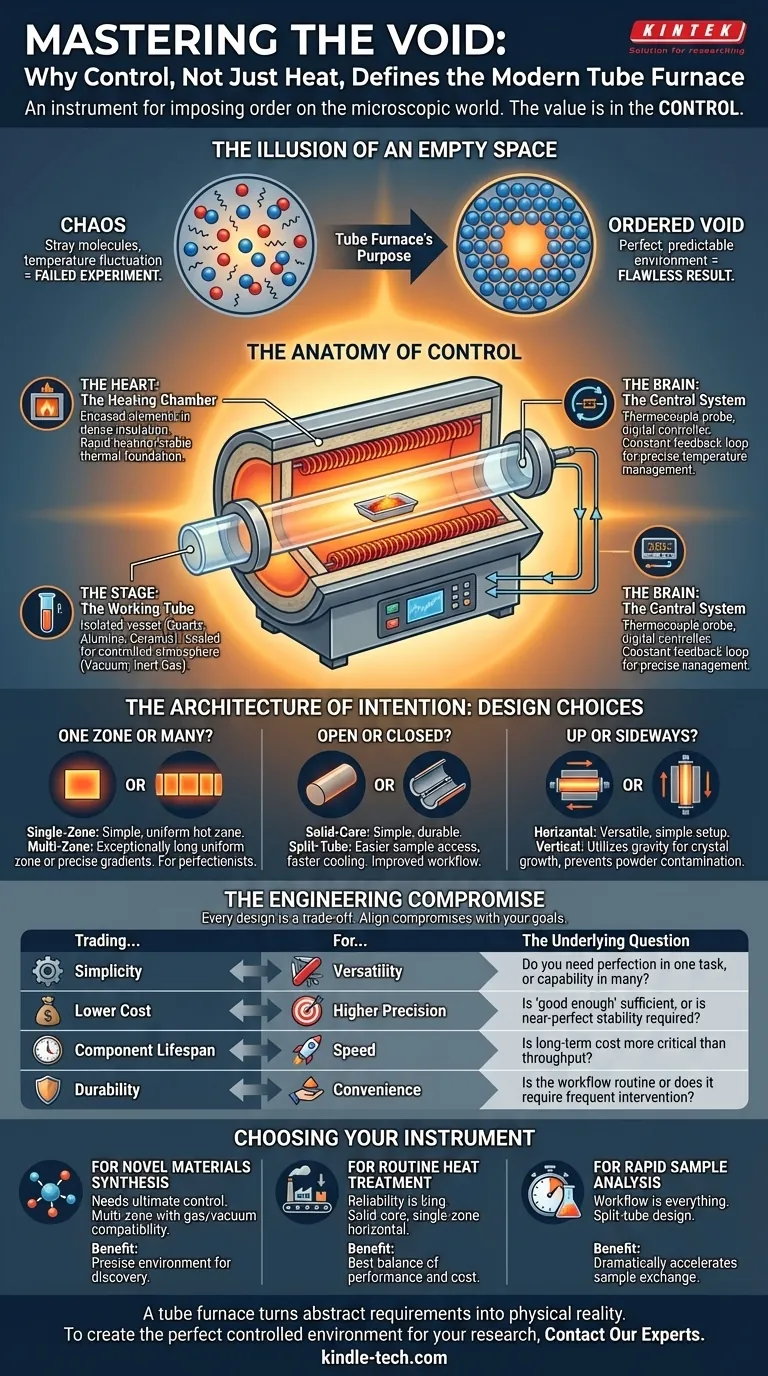
Visual Guide
Related Products
- Rotary Tube Furnace Split Multi Heating Zone Rotating Tube Furnace
- Laboratory Vacuum Tilt Rotary Tube Furnace Rotating Tube Furnace
- 1200℃ Split Tube Furnace with Quartz Tube Laboratory Tubular Furnace
- 1400℃ Laboratory High Temperature Tube Furnace with Alumina Tube
- 1700℃ Laboratory High Temperature Tube Furnace with Alumina Tube
Related Articles
- The Geometry of Heat: Why Motion Matters in Material Synthesis
- Exploring the Advantages of Rotary Tube Furnaces in Industrial and Laboratory Applications
- The Geometry of Heat: Engineering the Perfect Thermal Environment
- Exploring the Functions and Advantages of Rotary Tube Furnaces
- Exploring Rotary Tube Furnaces: A Comprehensive Guide



















