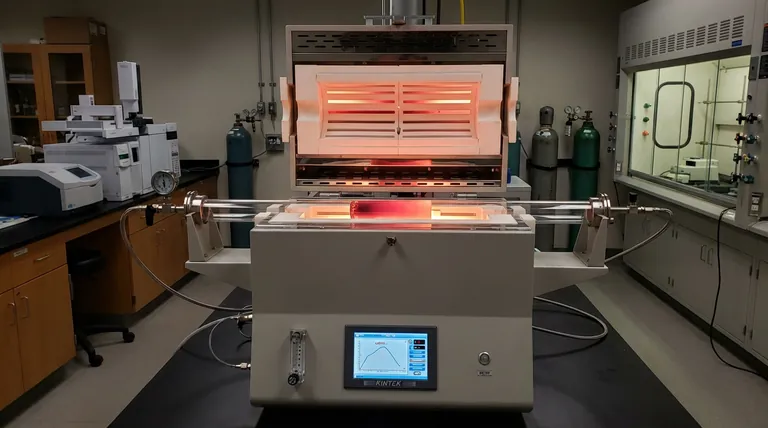
The Hidden Variable in High-Temperature Work
At 1200°C, heat isn't your only variable. The very air surrounding your sample becomes a reactive agent, an unpredictable contaminant. Oxygen, nitrogen, and moisture—normally harmless—transform into potent forces that can ruin an experiment or compromise the integrity of a new material.
The fundamental challenge in material science isn't just reaching a target temperature. It's about reaching that temperature within a perfectly controlled, isolated environment. It’s about creating a small, pristine universe where only your intended reaction can occur.
This is the quiet genius of the tube furnace.
An Elegant Solution: The Power of Isolation
On the surface, a tube furnace is deceptively simple: a heating chamber wrapped around a tube. But this design is not about simplicity; it’s about control.
The tube, typically made of high-purity ceramic or quartz, acts as a shield. It isolates the sample from the heating elements and, more importantly, from the ambient atmosphere.
This separation is everything.
It allows you to dictate the exact environment your material will experience. You can pull a high-purity vacuum to degas a metal, introduce an inert gas like argon to prevent oxidation during annealing, or use a reactive gas for processes like chemical vapor deposition (CVD).
The furnace isn’t just a heater; it's an environment controller.
From Raw Substance to Refined Material
This level of control unlocks processes that are foundational to modern technology. We can group them into three primary ambitions.
1. Building Materials from Scratch
These are processes of pure creation, where new structures are grown atom by atom.
- Chemical Vapor Deposition (CVD): Growing ultra-thin films for semiconductors and coatings.
- Graphene Synthesis: Creating one of the strongest, most conductive materials known to science.
- Sublimation: Purifying chemical compounds to achieve exceptional purity.
2. Perfecting and Enhancing Properties
Here, the goal is to transform a material’s inherent character, making it stronger, more ductile, or more stable.
- Annealing: Heating and slow cooling to relieve internal stresses in metals and glass.
- Sintering: Fusing powders under heat to create dense ceramics or solid-oxide fuel cells.
- Calcination: Driving off volatile substances to prepare catalysts or cements.
3. Preparing for Discovery
In research and quality control, the furnace is an essential tool for preparing samples for analysis.
- Ashing: Determining the non-combustible content of a sample.
- Drying: Removing all moisture with absolute precision.
Form Follows Function: Which Geometry Fits Your Goal?
The physical orientation of the furnace isn't an arbitrary choice. It's a deliberate engineering decision that leverages physics to solve specific problems. The right furnace configuration depends entirely on your material and your goal.
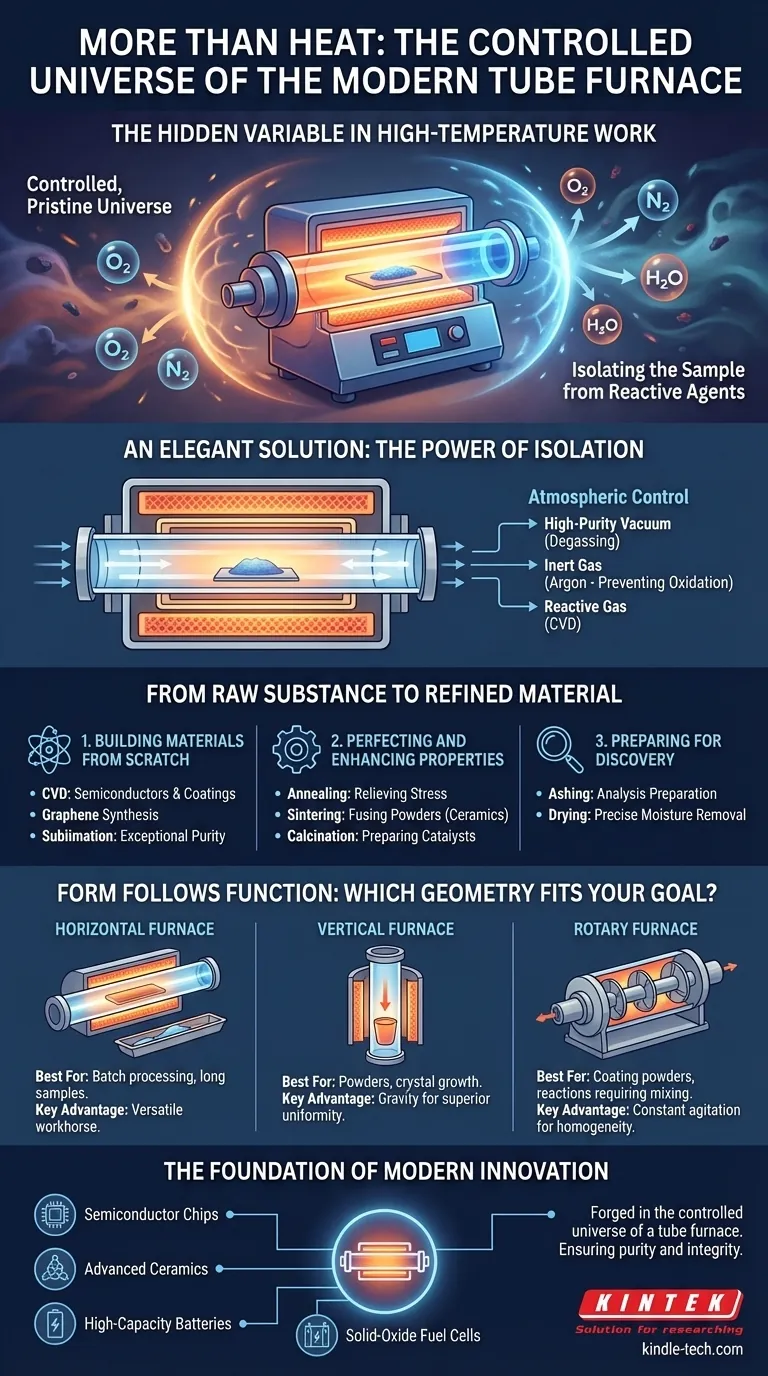
| Furnace Type | Best For | Key Advantage |
|---|---|---|
| Horizontal Furnace | Batch processing, long samples (wires, rods) | The versatile workhorse for general-purpose use. |
| Vertical Furnace | Powders, crystal growth | Uses gravity for superior uniformity and even heating. |
| Rotary Furnace | Coating powders, reactions requiring mixing | Ensures constant agitation for homogenous results. |
A vertical furnace uses gravity as a tool to prevent powders from segregating, ensuring every particle receives uniform thermal treatment. A horizontal furnace offers the flexibility to handle samples of varying shapes and sizes. A rotary furnace introduces dynamic motion, essential for ensuring a chemical reaction permeates an entire batch of material.
The choice reflects a deep understanding of the process.
The Foundation of Modern Innovation
This precise control over heat and atmosphere is not an abstract academic exercise. It is the critical enabling technology behind countless industries.
It’s in the semiconductor chips that power our digital world, the advanced ceramics used in aerospace, the high-capacity batteries driving the energy transition, and the solid-oxide fuel cells that promise a cleaner future. Each of these innovations relies on materials forged in the controlled universe of a tube furnace.
Choosing the right tool is about more than meeting a temperature specification; it's about ensuring the purity and integrity of your final product. Whether you are annealing a critical component or synthesizing a next-generation material, the quality of your furnace dictates the quality of your result.
At KINTEK, we provide the specialized equipment—from versatile horizontal furnaces to high-uniformity vertical models—that gives you absolute control over your thermal processes. Understanding your unique application is the first step toward achieving flawless, repeatable results.
To find the precise configuration for your material science or production goals, Contact Our Experts.
Visual Guide
Related Products
- Rotary Tube Furnace Split Multi Heating Zone Rotating Tube Furnace
- Laboratory Vacuum Tilt Rotary Tube Furnace Rotating Tube Furnace
- 1200℃ Split Tube Furnace with Quartz Tube Laboratory Tubular Furnace
- 1400℃ Laboratory High Temperature Tube Furnace with Alumina Tube
- 1700℃ Laboratory High Temperature Tube Furnace with Alumina Tube
Related Articles
- The Geometry of Heat: Why Motion Matters in Material Synthesis
- The Geometry of Heat: Engineering the Perfect Thermal Environment
- Exploring the Functions and Advantages of Rotary Tube Furnaces
- Exploring Rotary Tube Furnaces: A Comprehensive Guide
- Exploring the Advantages of Rotary Tube Furnaces in Industrial and Laboratory Applications



















