An engineer stares at a fractured component under a microscope. The failure wasn't spectacular; it was a quiet, insidious creep of micro-voids that coalesced into a critical flaw. The question isn't just what failed, but why. The answer often lies not in the material's service life, but in its very first moments of creation.
In powder metallurgy, the journey from loose particles to a solid, functional part is a story of pressure and heat. The two dominant narratives are hot pressing and cold pressing. Choosing between them is less a technical checklist and more a philosophical decision about the part's ultimate purpose.
The Pursuit of the Voidless Solid: Hot Pressing
Imagine trying to build a perfectly solid wall with stones. You can stack them tightly, but tiny gaps will always remain. Now, imagine heating those stones until they become soft like clay while simultaneously pressing them together. The gaps would vanish.
This is the essence of hot pressing.
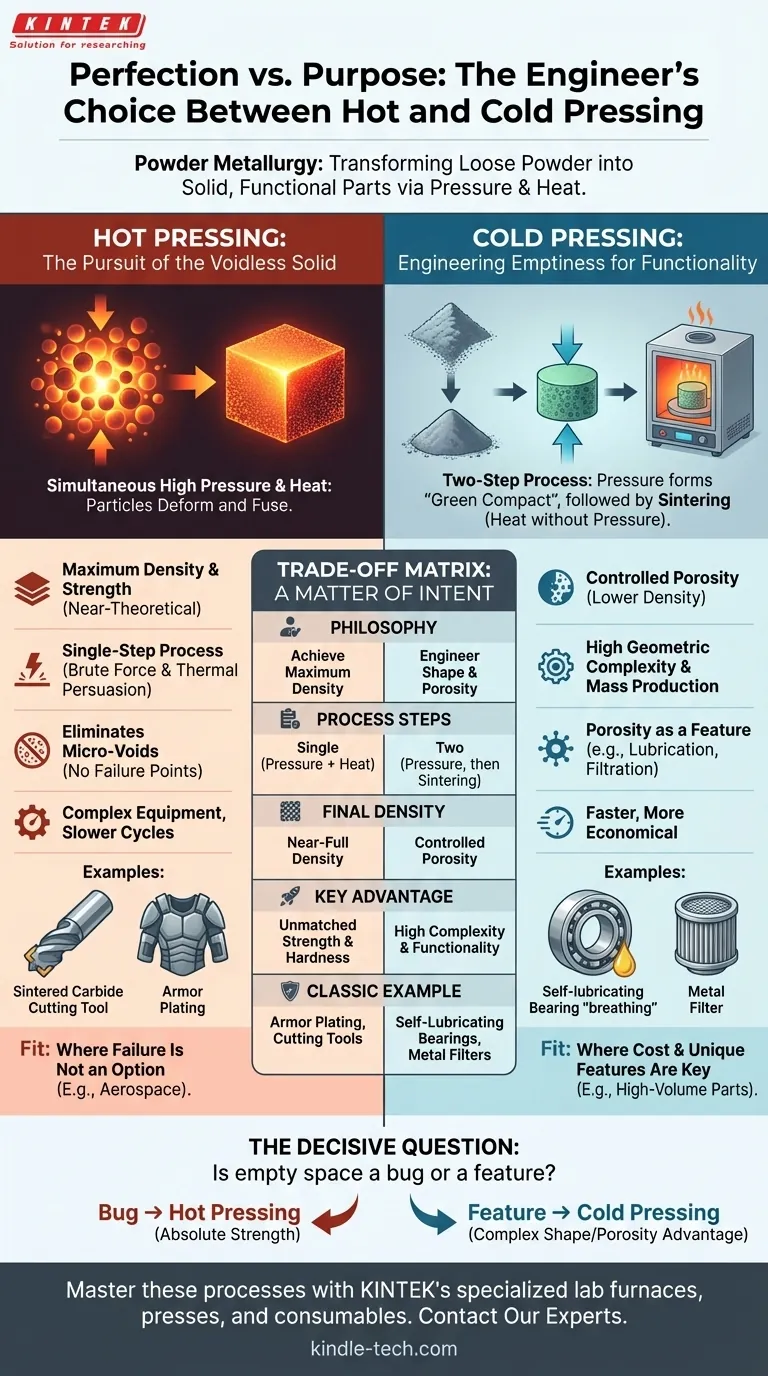
It combines immense pressure with high temperature in a single, decisive action. The heat lowers the material's resistance, making it profoundly cooperative. Powder particles don't just lock together; they deform and fuse, eliminating the microscopic voids that can become failure points.
This method is chosen when the psychological cost of failure is astronomical. It's the path of brute force and thermal persuasion, used for creating parts with near-theoretical density and maximum strength. Think of sintered carbide cutting tools that must endure extreme forces, or specialized aerospace components where every gram of material must perform flawlessly.
Hot pressing is the pursuit of absolute material integrity. It's expensive, the equipment is complex, and the cycle times are slow. But it's the price you pay for perfection.
Engineering Emptiness: The Genius of Cold Pressing
The alternative path seems counterintuitive. Instead of eliminating voids, cold pressing can be used to engineer them. It treats emptiness not as a flaw, but as a feature.
Consider the self-lubricating bearing. Its genius lies in its porosity. It is a metal sponge, intentionally designed with a network of internal voids.
From Green Promise to Sintered Reality
The process begins at room temperature. Metal powder is poured into a die and subjected to immense pressure, forming a fragile but precisely shaped "green compact." This part has the geometry of the final product but none of its strength. It is a promise.
That promise is fulfilled in a separate furnace during a process called sintering. Here, heat is applied without pressure. The particles bond, and the part gains its strength, but the network of pores remains. In the case of our bearing, these pores are then impregnated with oil. During operation, as the bearing heats up, it "breathes" out a thin film of lubricant.
This is not a lesser technology; it's a more subtle one. It prioritizes intricate geometry and clever functionality over raw, monolithic strength. It is the economical choice for mass production of parts like metal filters, gears, and components where porosity is a design advantage.
A Matter of Intent: The Trade-Off Matrix
Neither process is inherently superior. The choice is a deliberate trade-off, balancing ambition against practicality.
The Price of Perfection
Hot pressing delivers unparalleled density, but at a high cost. The dies, often made of graphite or superalloys, wear out quickly under the simultaneous assault of heat and pressure. The process is slower, making it ill-suited for high-volume manufacturing.
The Strength of Subtlety
Cold pressing is faster and cheaper, allowing for complex shapes that would be impossible or prohibitively expensive to machine. Its limitation is that the final parts will almost always have some residual porosity. While this can be a feature, if the goal is maximum strength, it's a built-in compromise.
Comparison at a Glance
| Feature | Hot Pressing | Cold Pressing |
|---|---|---|
| Philosophy | Achieve maximum density; eliminate flaws. | Engineer shape and porosity; use voids as a feature. |
| Process Steps | Single Step (Pressure + Heat) | |
| Two Steps (Pressure, then Heat/Sintering) | ||
| Final Density | Near-Full Density (Low Porosity) | Controlled Porosity (Lower Density) |
| Key Advantage | Unmatched mechanical strength and hardness. | High geometric complexity and engineered functionality. |
| Psychological Fit | For applications where failure is not an option. | For applications where cost and unique features are key. |
| Classic Example | Armor plating, high-performance cutting tools. | Self-lubricating bearings, metal filters. |
The Decisive Question
Ultimately, the choice comes down to one question: in your component, is empty space a bug or a feature?
- If your design requires the absolute highest strength and views any void as a potential point of failure, the path is hot pressing.
- If your design requires a complex shape, or if you can use porosity to your advantage for things like lubrication or filtration, the path is cold pressing.
Understanding this fundamental distinction is the first step toward creating a component that doesn't just work, but works elegantly. Whether you're chasing theoretical density limits in a hot press or engineering intricate porous structures, having the right laboratory equipment to test and validate your materials is foundational.
At KINTEK, we provide the specialized lab furnaces, presses, and consumables that empower engineers to master these processes. Contact Our Experts
Visual Guide
Related Products
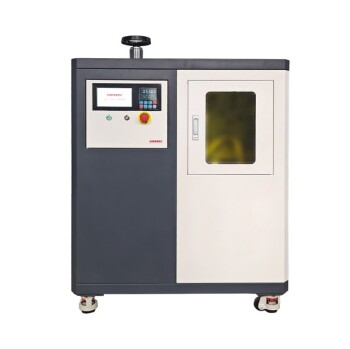
- Automatic Heated Hydraulic Press Machine with Heated Plates for Laboratory Hot Press
- Heated Hydraulic Press Machine with Heated Plates for Vacuum Box Laboratory Hot Press
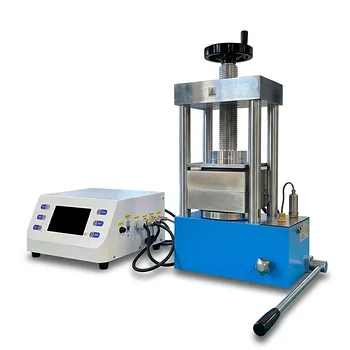
- Heated Hydraulic Press Machine with Heated Plates Split Manual Laboratory Hot Press
- 30T 40T Split Automatic Heated Hydraulic Press Machine with Heated Plates for Laboratory Hot Press
- 24T 30T 60T Heated Hydraulic Press Machine with Heated Plates for Laboratory Hot Press