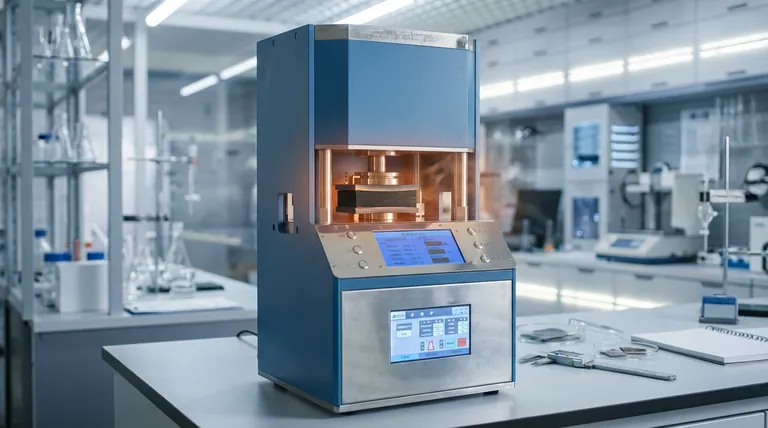
You pull the newly formed composite sample from your press. It looks perfect—the surface is smooth, the shape is exact. But during quality testing, the layers peel apart under a fraction of the expected load.
Another sample fails. And another.
You’ve spent weeks tweaking the pressure, pre-heating the materials in a separate oven, and racing against the clock to assemble everything before it cools. Yet, the results are maddeningly inconsistent. One sample holds, the next five delaminate. It feels less like science and more like a game of chance.
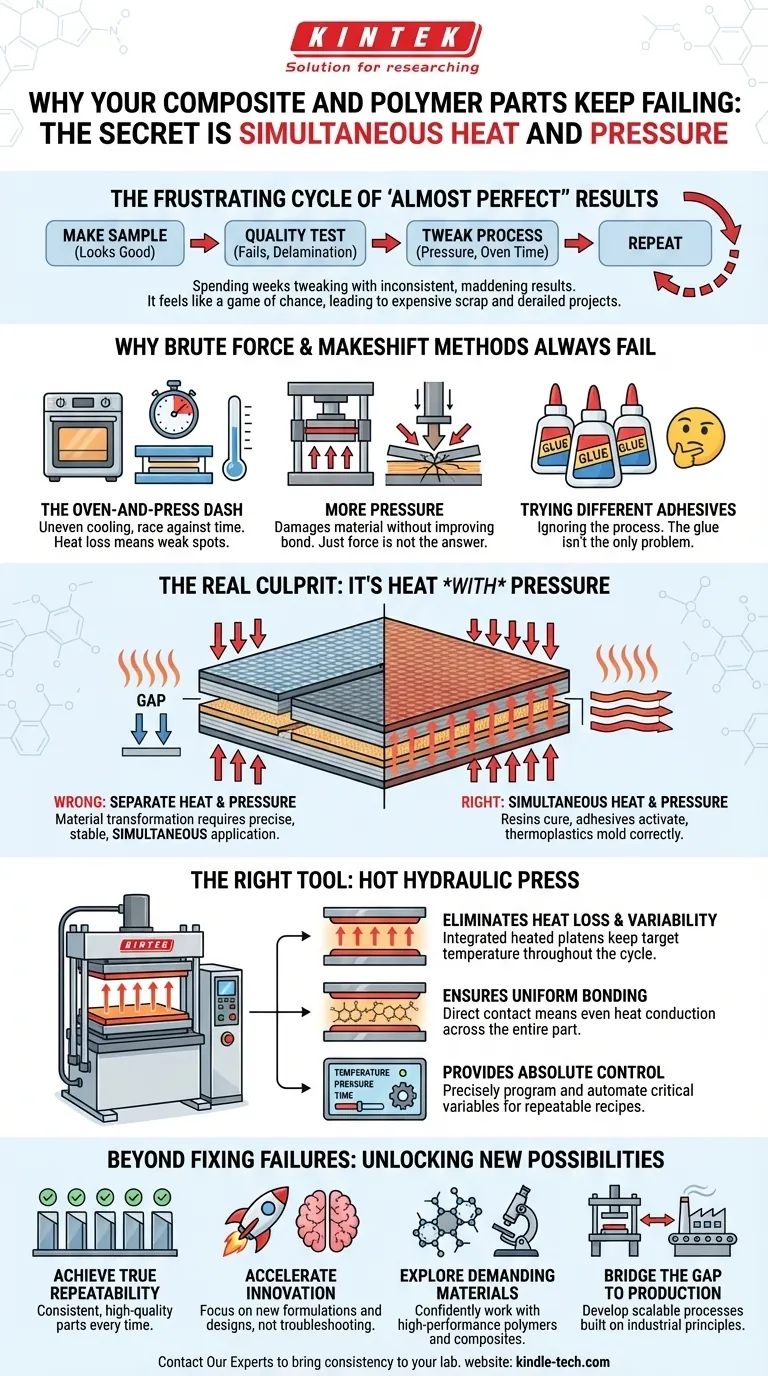
The Frustrating Cycle of 'Almost Perfect' Results
If this scenario sounds familiar, you're not alone. In labs and R&D departments everywhere, teams wrestle with the challenge of bonding or molding advanced materials like composites, laminates, and thermoplastics. The goal is to create a strong, uniform part, but the reality is often a pile of expensive scrap.
Why Brute Force and Makeshift Methods Always Fail
Faced with inconsistent results, the natural instinct is to try and overpower the problem. This leads to a common set of "solutions" that rarely work:
- The Oven-and-Press Dash: You heat the material in an oven, then quickly transfer it to a standard cold press. You hope the residual heat is enough, but the results are a lottery.
- More Pressure: You crank up the force on your hydraulic press, believing that more tonnage will literally squeeze the materials into submission. This can damage the material without improving the bond.
- Trying Different Adhesives: You cycle through different bonding agents, assuming the glue is the problem, while ignoring the process itself.
These efforts don't just waste time; they have serious consequences. Project timelines are derailed, costly raw materials are discarded, and promising research stalls because you can't even produce a reliable baseline sample. You can't validate a new material if you can't consistently create it in the first place.
The Real Culprit: It's Not Just Heat and Pressure, It's Heat with Pressure
The frustration isn't due to a lack of effort. It’s because these common workarounds are fighting against the fundamental physics of the materials themselves.
Advanced materials like composites, resins, and thermoplastics don't just get "stuck" together with force. They undergo a chemical or physical transformation to achieve their final properties.
- The resin in a composite must cure.
- The adhesive in a laminate must activate and bond.
- A thermoplastic must reach a precise molten state to mold correctly.
This transformation requires a precise, stable, and—most importantly—simultaneous application of heat and pressure.
This is the critical detail that makeshift methods miss. When you heat a material in an oven and then move it to a cold press, it immediately begins cooling, and it cools unevenly. The surface loses heat faster than the core. By the time the pressure is applied, the ideal thermal conditions for a perfect bond are gone. The result is a part with weak spots, internal stresses, and unpredictable performance.
You aren't controlling the process; you're just getting lucky when a sample occasionally survives.
The Right Tool for a Fundamental Truth
To solve this, you don't need more pressure or a hotter oven. You need to control the material's environment during the pressing stage. You need to apply uniform heat and precise pressure in a single, unified, and controllable step.
This is the core principle behind a Hot Hydraulic Press. It’s not just a press that gets hot; it's an integrated system designed from the ground up to master this exact challenge. It's the physical embodiment of the correct scientific approach.
How a Hot Press Solves the Core Problem
A true hot press, like those engineered by KINTEK, directly addresses the root causes of failure:
- Eliminates Heat Loss and Variability: With integrated heated platens, the material is brought to the target temperature and pressed in the same location. There is no "race from the oven," no uneven cooling. The heat is applied uniformly and constantly throughout the entire cycle.
- Ensures Uniform Bonding: Because the entire surface of the material is in direct contact with the temperature-controlled platens, the heat is conducted evenly. This ensures the chemical or physical transformation happens consistently across the entire part, not just in patches.
- Provides Absolute Control: Modern hot presses allow you to precisely program and automate the three critical variables: temperature, pressure, and time. You can create a specific, repeatable recipe for your material—ensuring every sample is produced under the exact same conditions.
It stops being a game of chance and becomes a predictable, scientific process.
Beyond Fixing Failures: Unlocking New Material Possibilities
When you stop fighting your materials and start controlling their transformation, a world of new potential opens up. The conversation shifts from "Why did this fail?" to "What can we test next?"
With a reliable process, you can:
- Achieve True Repeatability: Move from hoping a sample works to producing consistent, high-quality parts every single time, forming a reliable baseline for all your R&D.
- Accelerate Innovation: Spend your valuable time testing new material formulations and designs, not troubleshooting a flawed and inconsistent production method.
- Explore Demanding Materials: Confidently work with high-performance polymers and advanced composites that are simply impossible to process correctly with makeshift setups.
- Bridge the Gap to Production: Develop and perfect a manufacturing process in the lab that is directly scalable, because it's built on the same principles of precise, integrated control used in industrial production.
A reliable process isn't just about avoiding scrap; it's the foundation for meaningful innovation. It's what allows your lab to move faster, explore further, and generate results that can be trusted.
If you're ready to move past inconsistent results and unlock the full potential of your advanced materials, our team is here to help. We can discuss your specific project challenges and find the right equipment to bring consistency and control to your lab. Contact Our Experts.
Visual Guide
Related Products
- Automatic High Temperature Heated Hydraulic Press Machine with Heated Plates for Lab
- Manual High Temperature Heated Hydraulic Press Machine with Heated Plates for Lab
- Automatic Heated Hydraulic Press Machine with Heated Plates for Laboratory Hot Press 25T 30T 50T
- 24T 30T 60T Heated Hydraulic Press Machine with Heated Plates for Laboratory Hot Press
- Heated Hydraulic Press Machine with Heated Plates for Vacuum Box Laboratory Hot Press
Related Articles
- Precision Under Pressure: The Physics and Psychology of the Hydraulic Hot Press
- More Than a Squeeze: The Physics and Psychology of the Hydraulic Hot Press
- Comprehensive Guide to Hydraulic Hot Press: Function, Features and Applications
- Hydraulic Hot Press: Principles, Components, Features, Advantages, and Applications
- The Physics of Flawless Materials: Deconstructing the Hydraulic Hot Press



















