You’re staring at the report, and the feeling is all too familiar: another critical metal component has failed quality control. On the surface, it looks perfect. But deep inside, microscopic analysis reveals the tiny fractures and inconsistencies that make it unusable. The project timeline is slipping, the cost of wasted specialty alloy is piling up, and the pressure is mounting. You’ve tried everything—a bigger hammer, a faster press, tweaking the heat treatment—but the results are still a lottery.
If this scenario sounds painfully real, you are not alone.
The Expensive Cycle of "Try and Fail"
Across aerospace, energy, and heavy industry, engineering teams constantly battle to forge large, complex metal components that are both strong and reliable. The default response to a forging failure is often intuitive: just apply more force, faster. We turn to powerful mechanical presses or massive drop hammers, believing that overwhelming the material is the path to success.
But this approach often backfires, leading to a frustrating cycle:
- Wasted Resources: Each failed component means scrapping expensive, high-performance alloys and losing valuable machine time.
- Project Delays: Unpredictable results make it impossible to stick to production schedules, delaying final assembly and delivery.
- Reputational Risk: Worst of all, if a flawed part slips through, it poses a catastrophic risk to the final product, whether it's an aircraft landing gear or a power plant turbine.
These "solutions" fail because they are based on a fundamental misunderstanding. They address the shape of the metal, but they neglect—and often damage—its most important quality: its internal structure.
The Root of the Problem: The Difference Between a Punch and a Squeeze
The core issue isn't a lack of power. It's the wrong type of power. Forging a strong, reliable component isn't about winning a boxing match with a series of quick, sharp punches. It’s about winning a wrestling match with a single, sustained, and inescapable hold.
-
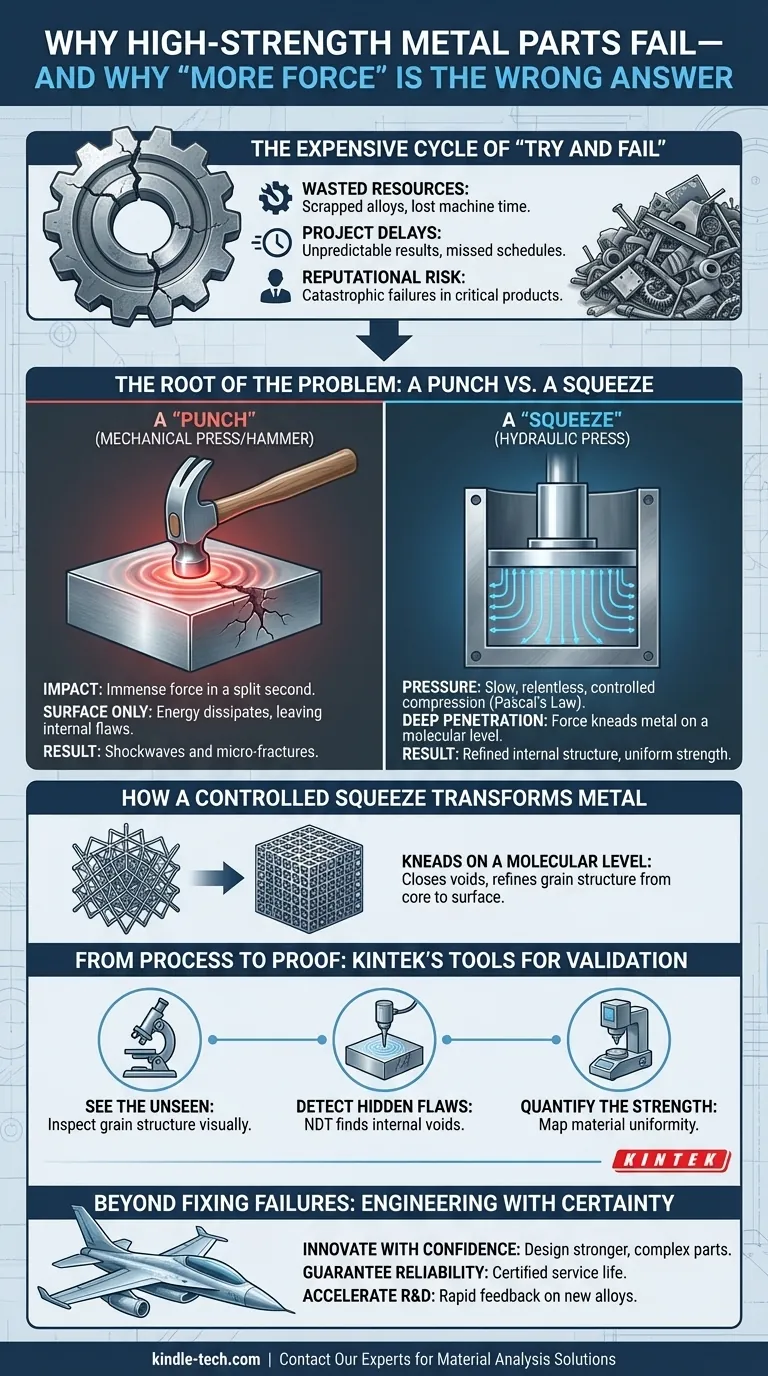
A "Punch" (Mechanical Presses/Hammers): These methods deliver an immense force in a split second. This impact is excellent for shaping a surface quickly, but the energy dissipates rapidly. It's like searing a thick steak on a scorching-hot pan; the outside might look done, but the force and heat never penetrate deep enough to properly cook the inside. This shallow impact can even create shockwaves that introduce new micro-fractures deep within the material.
-
A "Squeeze" (Hydraulic Presses): This method works on a completely different principle. Instead of impact, it uses a slow, relentless, and controlled compression.
How a Controlled Squeeze Transforms Metal
This process leverages a basic law of physics called Pascal's Law. Imagine pushing a small piston into a sealed container of fluid. That pressure is transmitted equally and undiminished to every corner of the container. A hydraulic press uses a small pump to pressurize oil, which then acts on a much larger piston, or ram. This multiplies the initial force enormously, generating a powerful, non-stop squeeze.
This sustained pressure does something a hammer blow cannot: it "kneads" the metal on a molecular level. The force penetrates deep into the workpiece, closing internal voids and refining the metal's internal grain structure. The result isn't just a part that's the right shape; it's a part that is fundamentally stronger and more uniform from its core to its surface.
The common "solutions" fail because they only treat the symptom (the external shape) while ignoring the disease (a weak internal structure). The hydraulic squeeze is the cure.
From Process to Proof: The Tools for Forging with Confidence
Adopting the right process—the deep squeeze of hydraulic forging—is the first step. But how can you be certain the process worked? How do you prove that you’ve achieved the superior internal structure you need without cutting every part in half?
This is where you must move from simply applying a process to validating the outcome. To forge with confidence, you need tools designed to give you a clear window into the material's internal world. This is precisely where KINTEK's expertise in laboratory equipment becomes your strategic advantage.
Our advanced material testing and analysis solutions are not just about a pass/fail grade. They are designed to give you actionable data on the why behind your results. With KINTEK’s support, you can:
- See the Unseen: Use our metallographic preparation equipment and high-power microscopes to visually inspect the grain structure, confirming that the hydraulic process delivered the desired refinement.
- Detect Hidden Flaws: Employ non-destructive testing (NDT) consumables and systems to find and characterize internal voids or inconsistencies without damaging the component.
- Quantify the Strength: Utilize our precision hardness testers to map the material's uniformity, providing concrete data that your part is as strong on the inside as it is on the outside.
Our role is to provide the proof. We equip your lab with the tools to validate that your forging process is delivering the superior material properties you expect, every single time.
Beyond Fixing Failures: Engineering a New Class of Components
When you can stop worrying about random failures and start reliably producing internally flawless components, everything changes. You're no longer just avoiding problems; you're unlocking new potential.
With a validated, controlled forging process, your team can now:
- Innovate with Confidence: Design lighter, more complex, yet stronger components for next-generation aircraft and vehicles.
- Guarantee Long-Term Reliability: Manufacture critical infrastructure parts with a certified service life, drastically reducing maintenance costs and increasing safety.
- Accelerate R&D: Get rapid, accurate feedback on how new alloys respond to processing, shortening the development cycle for breakthrough materials.
You move from a reactive state of fixing what’s broken to a proactive state of engineering what was previously thought impossible.
This transformation from unpredictable art to predictable science is the true promise of mastering your material processes. If you're ready to move beyond the cycle of trial and error and start engineering with certainty, our team of specialists is here to help you equip your lab for success. Let's discuss the specific challenges of your project and how the right analytical tools can provide the clarity you need. Contact Our Experts.
Visual Guide
Related Products
- Automatic High Temperature Heated Hydraulic Press Machine with Heated Plates for Lab
- Heated Hydraulic Press Machine with Heated Plates for Vacuum Box Laboratory Hot Press
- Manual High Temperature Heated Hydraulic Press Machine with Heated Plates for Lab
- 24T 30T 60T Heated Hydraulic Press Machine with Heated Plates for Laboratory Hot Press
- Laboratory Hydraulic Press Split Electric Lab Pellet Press
Related Articles
- Why Your Composite and Polymer Parts Keep Failing: The Secret Is Simultaneous Heat and Pressure
- Precision Under Pressure: The Physics and Psychology of the Hydraulic Hot Press
- More Than a Squeeze: The Physics and Psychology of the Hydraulic Hot Press
- Comprehensive Guide to Hydraulic Hot Press: Function, Features and Applications
- Hydraulic Hot Press: Principles, Components, Features, Advantages, and Applications



















