The Illusion of Brute Force
We tend to think of immense pressure as a destructive force. We picture a car crusher or a demolition tool—something designed to obliterate, not create.
But this is a misunderstanding of what pressure, when precisely controlled, can achieve.
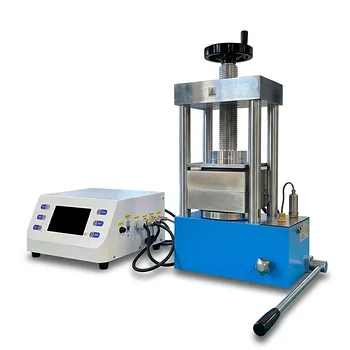
A hydraulic hot press isn't a tool of brute force. It's an instrument of transformation. It uses the quiet, relentless power of physics to persuade materials—wood fibers, polymers, composites—to become something stronger, more unified, and more useful than they were before. It’s about imposing order, not chaos.
This process taps into a fundamental human and engineering desire: to exert perfect control over the physical world.
The Two Pillars of Creation: Heat and Pressure
At its heart, the machine orchestrates a delicate dance between two powerful principles: thermal energy and hydraulic force. One makes the material willing to change; the other makes the change permanent.
Pascal's Law: The Quiet Multiplier
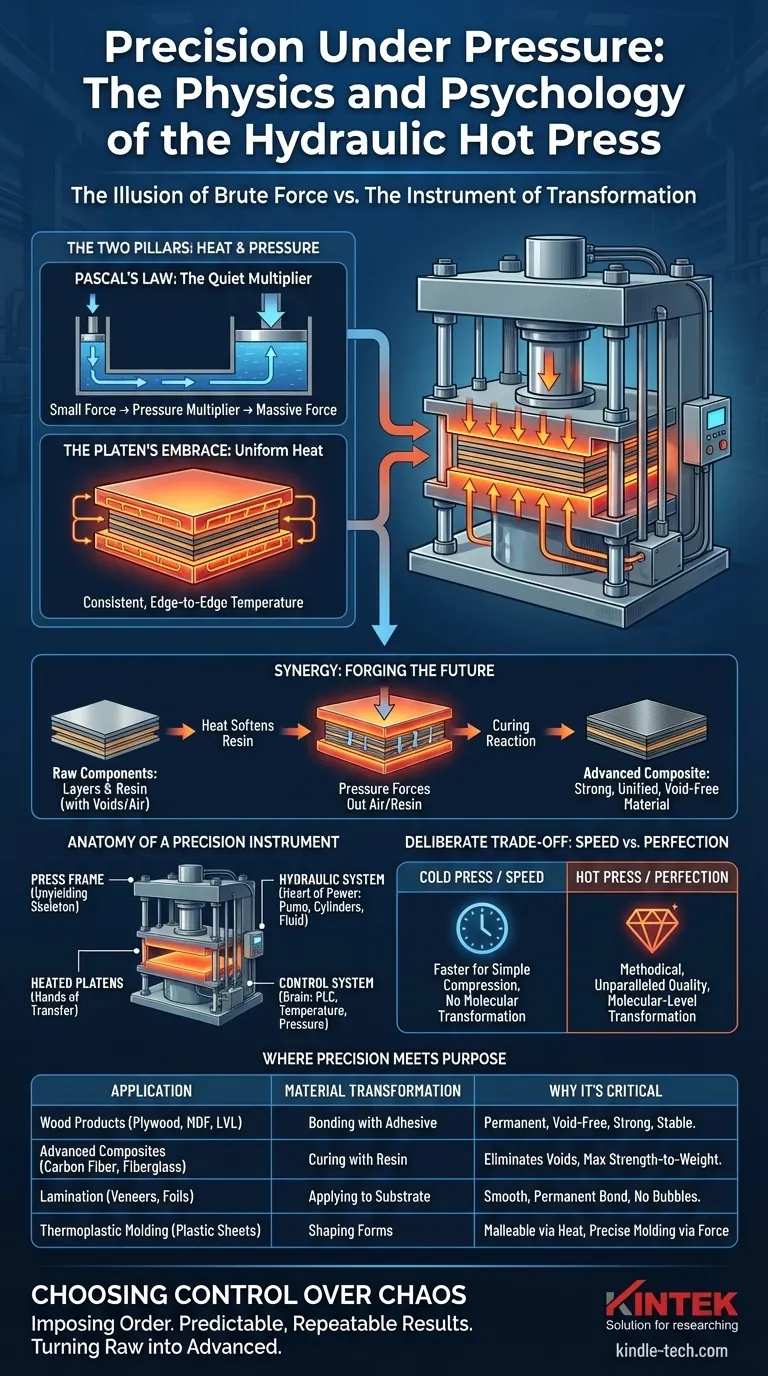
The immense strength of the press comes from a beautifully simple principle of fluid dynamics: Pascal's Law. It states that pressure applied to a confined fluid is transmitted equally in all directions.
In a hydraulic press, a small force applied to a small piston creates pressure in hydraulic oil. This pressure travels through the fluid and acts on a much larger piston (the ram), multiplying the initial force exponentially.
It's not violent. It’s a quiet, invisible leverage that generates tons of force with deceptive ease. This ensures the pressure is not just massive, but also perfectly uniform across the entire surface—a critical factor for quality and consistency.
The Platen's Embrace: Delivering Uniform Heat
The "hot" in the hot press comes from its platens—the heavy, flat steel plates that make contact with the material.
These aren't just crude heating elements. They are engineered systems designed to deliver consistent, edge-to-edge temperature. By circulating heated oil or using integrated electrical elements, they bring the workpiece to a precise thermal state.
This heat isn't for melting things down. It's for making them pliable, for activating thermosetting adhesives, or for initiating the chemical curing process in a composite. It’s the catalyst for change.
The Synergy That Forges the Future
Imagine constructing a high-performance carbon fiber panel for an aerospace component.
You start with layers of woven carbon fiber fabric, each impregnated with a plastic resin. At room temperature, they are just a stack of separate, flexible sheets.
First, the press's platens heat the stack. The resin softens and begins to flow, seeping into every microscopic void within the carbon weave. This is the moment of potential.
Then, the hydraulic system engages. The immense, even pressure squeezes the layers together, forcing out any trapped air or excess resin. It ensures every single fiber is perfectly bonded to its neighbor. The pressure holds the material in its final shape as the heat triggers a chemical reaction, curing the resin into a hard, incredibly strong, and lightweight solid.
Without heat, the bond would be weak. Without pressure, the part would be full of imperfections and structural voids. Together, they create a material far greater than the sum of its parts.
Anatomy of a Precision Instrument
While designs vary, every hydraulic hot press is a system of coordinated components, each with a critical role.
- The Press Frame: This is the unyielding skeleton, built to withstand the machine's own incredible forces without flexing or deforming.
- The Hydraulic System: The heart of the machine, comprising the pump, cylinders, and fluid that act as the source of its relentless power.
- The Heated Platens: Perfectly flat and parallel, they are the hands that transfer both heat and force directly to the workpiece.
- The Control System: Often a PLC, this is the brain, precisely regulating temperature, pressure, and cycle time to ensure every operation is repeatable down to the finest detail.
The Deliberate Trade-Off: Speed vs. Perfection
A hydraulic hot press is not fast. It is deliberate.
Heating massive steel platens takes time. Cooling them down takes time. The process is methodical by necessity. This is the machine's primary trade-off: it sacrifices speed for unparalleled quality.
In a world obsessed with cycle times, choosing a hot press is a psychological choice. It’s an admission that for some tasks, there are no shortcuts. When structural integrity, a flawless bond, or a void-free cure is the goal, the patient application of heat and pressure is the only path.
A cold press might be faster for simple compression, but it cannot achieve the molecular-level transformation that a hot press can.
Where Precision Meets Purpose
The unique capabilities of the hot press make it indispensable across industries where material failure is not an option.
| Application | Material Transformation | Why It's Critical |
|---|---|---|
| Wood Products | Bonding wood veneers with adhesive to create plywood, MDF, or LVL. | Ensures a permanent, void-free bond, creating strong, stable, and flat engineered wood panels. |
| Advanced Composites | Curing carbon fiber or fiberglass parts with resin. | Eliminates voids and ensures complete resin saturation for maximum strength-to-weight ratio. |
| Lamination | Applying decorative veneers, foils, or plastic laminates to a substrate like particleboard. | The heat activates the adhesive while the pressure guarantees a smooth, permanent bond without bubbles. |
| Thermoplastic Molding | Shaping plastic sheets or other heat-sensitive materials into specific forms. | Provides the thermal energy to make the material malleable and the force to mold it precisely. |
Choosing Control Over Chaos
Ultimately, a hydraulic hot press is more than a piece of lab equipment; it's a system for imposing order on materials at a fundamental level. It replaces guesswork with predictable, repeatable results, turning raw components into advanced materials with superior properties.
For researchers and engineers dedicated to achieving this level of material perfection, having the right instrument is non-negotiable. At KINTEK, we provide laboratory-scale hydraulic hot presses engineered for the precision and control your work demands. If your goal is to master the interplay of heat and pressure, let's build the right solution together.
Visual Guide
Related Products
- Automatic High Temperature Heated Hydraulic Press Machine with Heated Plates for Lab
- Manual High Temperature Heated Hydraulic Press Machine with Heated Plates for Lab
- Heated Hydraulic Press Machine with Heated Plates for Vacuum Box Laboratory Hot Press
- 24T 30T 60T Heated Hydraulic Press Machine with Heated Plates for Laboratory Hot Press
- Heated Hydraulic Press Machine with Heated Plates for Vacuum Box Laboratory Hot Press
Related Articles
- Why Your Composite and Polymer Parts Keep Failing: The Secret Is Simultaneous Heat and Pressure
- More Than a Squeeze: The Physics and Psychology of the Hydraulic Hot Press
- Comprehensive Guide to Hydraulic Hot Press: Function, Features and Applications
- Hydraulic Hot Press: Principles, Components, Features, Advantages, and Applications
- The Physics of Flawless Materials: Deconstructing the Hydraulic Hot Press