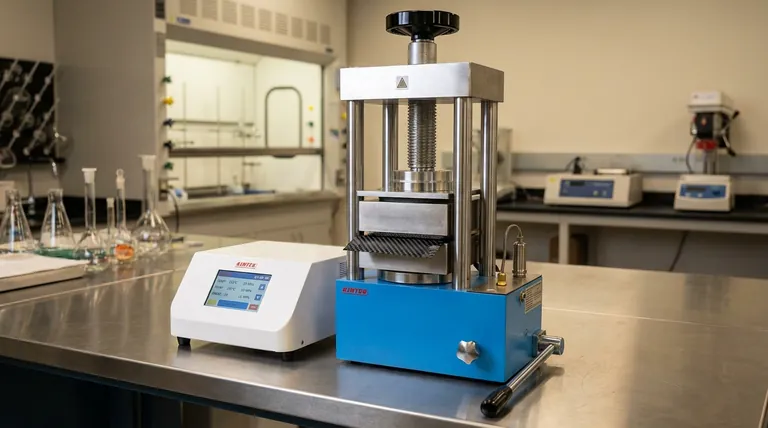
The Illusion of Brute Force
Imagine trying to bond a carbon fiber composite for an aerospace component. Simply squeezing it in a vise won't work. Baking it in an oven won't either. The magic happens in the synthesis of these two actions—immense, uniform pressure and precise, sustained heat.
This is the world of the hydraulic hot press. It’s easy to see it as a machine of brute force, a titan that simply squashes things. But that’s a misconception. At its heart, it’s an instrument of profound control, designed not just to press, but to fundamentally transform a material's inner structure.
The Elegance of Force Multiplication
The most counter-intuitive aspect of a hydraulic press is how it generates its power. It doesn’t rely on massive gears or motors for direct force. Instead, it exploits a simple, elegant principle of physics.
A Principle in a Bottle
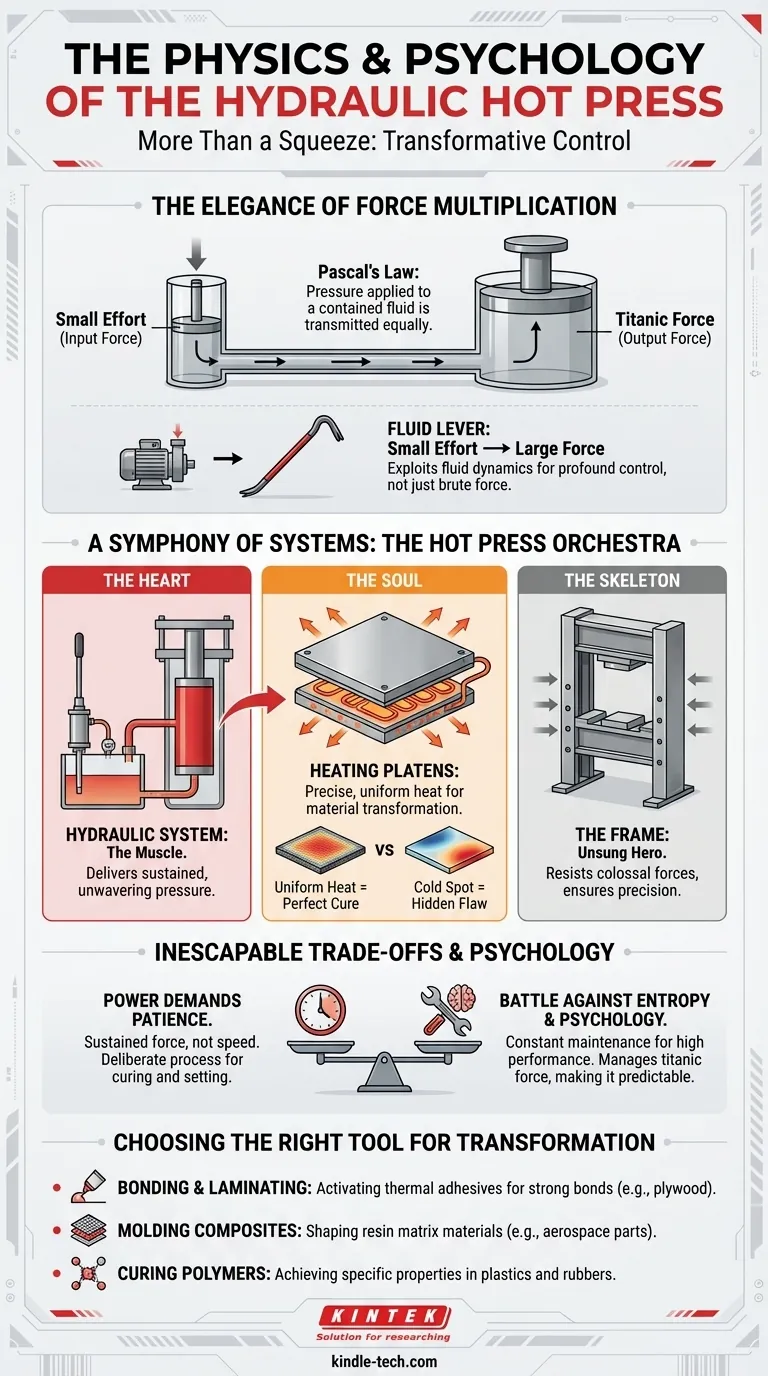
The machine operates on Pascal's Law, a foundational rule of fluid dynamics. It states that pressure applied to a contained, incompressible fluid is transmitted equally in all directions.
Think of it this way: pressure doesn't care about the shape of its container. A small push on a tiny piston creates a specific pressure (say, 100 PSI) in the hydraulic oil. That same 100 PSI then pushes against a massive piston with 100 times the surface area. The result? The output force is multiplied one hundredfold.
The Psychology of Leverage
This is a fluid lever. As humans, we are wired to understand the leverage of a crowbar—a small effort over a long distance creates a large force over a short distance.
A hydraulic system is just a more sophisticated version of this. A small, unassuming electric pump can generate tonnage that feels almost impossible. This leverage is what makes the hydraulic press a cornerstone of modern manufacturing and material science; it makes titanic force manageable, predictable, and controllable.
A Symphony of Systems
A hydraulic hot press isn't a single entity. It’s an orchestra where three critical systems must perform in perfect harmony. A failure in one renders the entire instrument useless.
The Heart: The Hydraulic System
This is the muscle. A pump moves hydraulic fluid from a reservoir into a cylinder, driving the ram that applies the force. It's the source of the "squeeze," delivering sustained and unwavering pressure throughout the entire process cycle.
The Soul: The Heating Platens
Herein lies the true engineering challenge. The platens—the massive steel plates that contact the material—are heated, often with electric cartridges or circulating thermal oil. But the goal isn't just heat; it's perfectly uniform heat.
Consider a large composite panel being cured. A single cold spot on the platen, just a few degrees cooler than the rest, can create a hidden flaw—an area where the resin doesn't fully cure. This spot becomes a systemic weakness, an invisible point of failure that could compromise the entire part under stress. Achieving thermal uniformity is a relentless battle against physics, and it's what separates a great press from a mediocre one.
The Skeleton: The Unsung Frame
The quiet hero of the machine is its frame. It does nothing but stand still and resist the colossal forces generated internally. If the frame flexes even slightly, the precision of the pressure is lost, and the uniformity of the platens is compromised. It’s the rigid, unyielding foundation upon which all the machine's precision is built.
The Inescapable Trade-offs
As with any powerful tool, the hydraulic hot press comes with inherent trade-offs. Understanding them is key to using it effectively.
Power Demands Patience
Hydraulic presses are masters of sustained force, but they are not fast. Unlike a mechanical press that stamps in a rapid cycle, a hydraulic press is deliberate. Its value lies in its ability to apply a specific pressure and temperature for a required duration—a "soak" time needed for adhesives to cure or composites to set. It trades raw speed for absolute control.
The Constant Battle Against Entropy
These machines are not "set it and forget it" devices. They are high-performance instruments. The hydraulic system demands clean fluid and healthy seals to prevent leaks and pressure loss. The heating system requires constant monitoring to ensure safety and performance. Maintenance isn't a chore; it's the necessary process of holding a complex system in its optimal state.
Choosing the Right Tool for Transformation
The decision to use a hydraulic hot press comes down to a single question: Does my process require the simultaneous, controlled application of both heat and pressure to change a material's state?
- For Bonding & Laminating: Activating thermal adhesives in materials like plywood or decorative panels requires both forces to ensure a strong, void-free bond.
- For Molding Composites: Heat makes the resin matrix pliable, while sustained pressure shapes the material and holds it steady as it cures into a rigid, final form.
- For Curing Polymers: Specific pressure and temperature profiles are needed to achieve the desired material properties in many advanced plastics and rubbers.
In the laboratory setting, where new materials and processes are born, the precision and reliability of these systems are non-negotiable. A high-quality hydraulic hot press is an essential instrument for innovation. For labs navigating these complex material challenges, having the right instrument is paramount. Contact Our Experts
Visual Guide
Related Products
- Automatic High Temperature Heated Hydraulic Press Machine with Heated Plates for Lab
- Manual High Temperature Heated Hydraulic Press Machine with Heated Plates for Lab
- Heated Hydraulic Press Machine with Heated Plates for Vacuum Box Laboratory Hot Press
- 24T 30T 60T Heated Hydraulic Press Machine with Heated Plates for Laboratory Hot Press
- Heated Hydraulic Press Machine with Heated Plates for Vacuum Box Laboratory Hot Press
Related Articles
- Why Your Composite and Polymer Parts Keep Failing: The Secret Is Simultaneous Heat and Pressure
- Precision Under Pressure: The Physics and Psychology of the Hydraulic Hot Press
- Comprehensive Guide to Hydraulic Hot Press: Function, Features and Applications
- Hydraulic Hot Press: Principles, Components, Features, Advantages, and Applications
- The Physics of Flawless Materials: Deconstructing the Hydraulic Hot Press



















