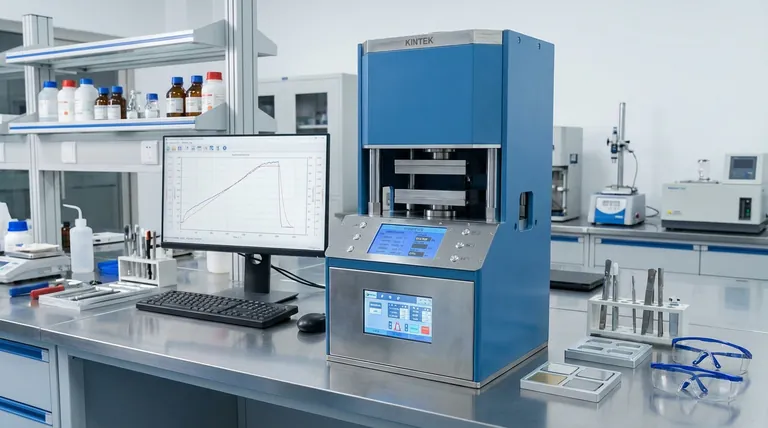
The Scientist's Dilemma: The Quest for Repeatable Perfection
Imagine a materials science lab. A team is developing a new, lightweight composite laminate. The theory is sound, the materials are cutting-edge, but the test results are maddeningly inconsistent. Sample A is perfect. Sample B, made under what appears to be identical conditions, delaminates under stress.
The invisible culprit is often not the material, but the process. Microscopic voids, uneven adhesive curing, or imperceptible variations in pressure can create hidden weaknesses.
This isn't a failure of chemistry. It's a failure of physics—a failure to perfectly control the two fundamental forces of material transformation: heat and pressure.
The Two Forces That Shape a Material's Future
At its heart, a hydraulic hot press is an instrument designed to master these two forces with unwavering precision. It's a simple concept built on an elegant synergy.
Pascal's Law: The Genius of Uniform Force
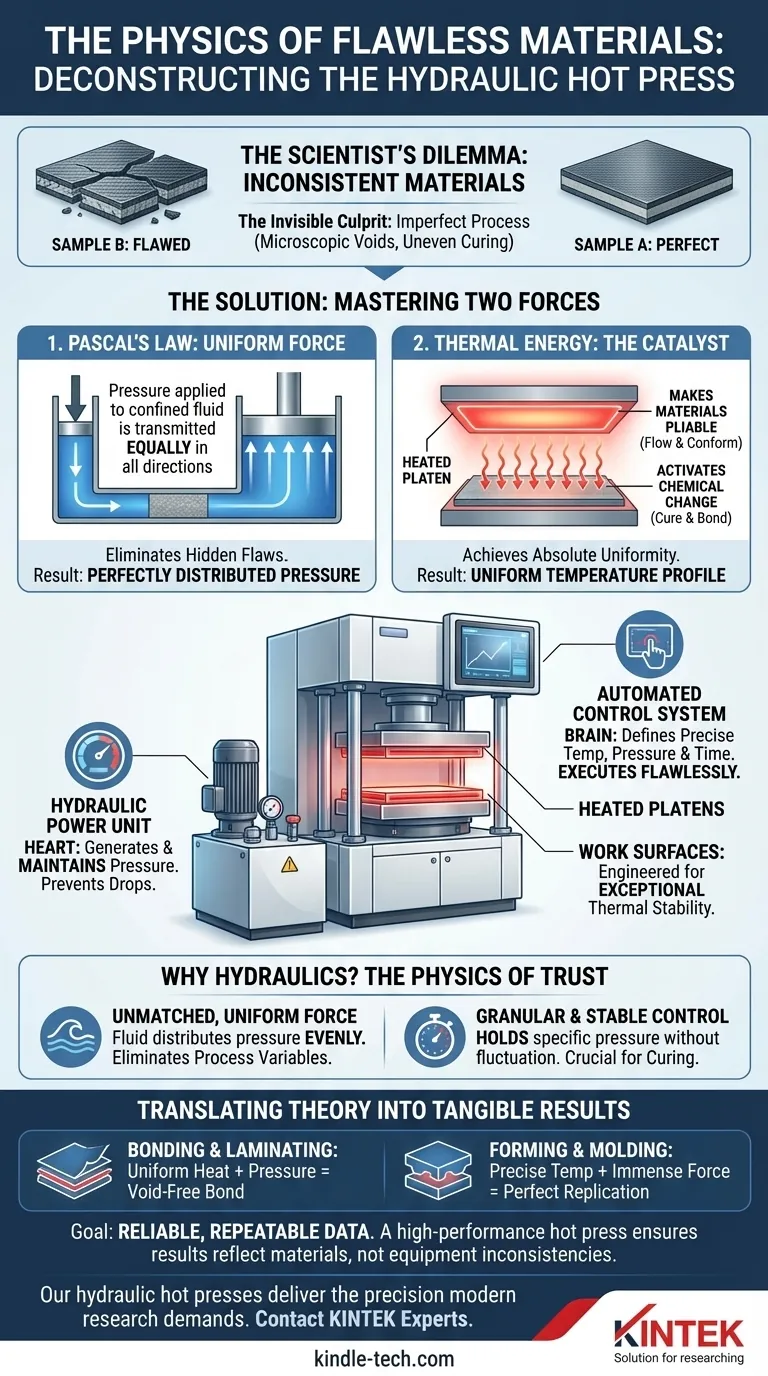
The machine's immense power comes from a principle discovered in the 17th century. Pascal's Law states that pressure applied to a confined fluid is transmitted equally in all directions.
A hydraulic system exploits this with beautiful efficiency. A small pump applies pressure to a column of oil, and that pressure is transferred to a much larger piston. The result is a massive multiplication of force.
But the true genius isn't the force itself; it's the uniformity. Because the fluid pushes on every square millimeter of the piston face equally, the resulting pressure on the material is perfectly distributed. This is the first step to eliminating hidden flaws.
Thermal Energy: The Catalyst for Transformation
The "hot" in hot press refers to the heated platens. These plates transfer thermal energy to the workpiece, doing one of two things:
- It makes materials pliable: Softening polymers or composites so they can flow and conform to a mold.
- It activates chemical change: Curing thermosetting resins or activating adhesives for a permanent bond.
The engineering challenge here is identical to the pressure problem: achieving absolute uniformity. A single cold spot on the platen means an uncured patch in the adhesive, a point of future failure.
Anatomy of Control: From Command to Creation
A modern laboratory press isn't just a brute-force tool; it's a system where each part serves the goal of perfect, repeatable control.
-
The Hydraulic Power Unit: This is the heart of the machine. It doesn't just generate pressure; it maintains it. Sophisticated valves allow the system to hold pressure for extended periods and automatically replenish it if a microscopic drop is detected.
-
The Heated Platens: These are the work surfaces, engineered for exceptional thermal stability. High-quality systems use carefully mapped internal heating elements or fluid channels to guarantee an even temperature profile across the entire surface, edge to edge.
-
The Automated Control System: This is the brain. It allows the researcher to define a precise profile of temperature, pressure, and time. It executes the cycle flawlessly, ensuring the 100th sample undergoes the exact same physical experience as the first. This transforms the process from an art into a science.
Why Hydraulics? The Physics of Trust
While other methods exist to generate force, the hydraulic approach offers advantages that are critical for high-stakes laboratory and R&D work. It’s about building trust in your process.
Unmatched, Uniform Force
A fluid doesn't have a preference. It distributes pressure evenly by its very nature. This physical law eliminates a major process variable, allowing the researcher to focus on the material, not the machine's quirks.
Granular and Stable Control
The system’s ability to apply and hold a specific pressure without fluctuation is paramount. This stability is crucial for delicate curing processes that take time, ensuring the material is held in a constant, stress-free state.
Translating Theory into Tangible Results
Understanding these principles allows you to move from simply operating a machine to truly directing a material's transformation.
- For Bonding & Laminating: Success hinges on uniform heat activating the adhesive and uniform pressure ensuring an intimate, void-free bond across the entire surface.
- For Forming & Molding: Success requires precise temperature control to achieve perfect plasticity, combined with immense, uniform force to replicate every detail of a mold.
Ultimately, the goal of any laboratory is to produce reliable, repeatable data. A high-performance hot press is a critical instrument in this quest, ensuring that your results are a true reflection of your materials, not the inconsistencies of your equipment.
At KINTEK, we specialize in laboratory equipment engineered for this level of precision. Our hydraulic hot presses are designed to provide the exceptionally uniform heat and stable, controllable pressure that modern materials research demands. If your work requires flawless consistency, let us provide the instrument that makes it possible. Contact Our Experts
Visual Guide
Related Products
- Automatic High Temperature Heated Hydraulic Press Machine with Heated Plates for Lab
- Heated Hydraulic Press Machine with Heated Plates for Vacuum Box Laboratory Hot Press
- Manual High Temperature Heated Hydraulic Press Machine with Heated Plates for Lab
- 24T 30T 60T Heated Hydraulic Press Machine with Heated Plates for Laboratory Hot Press
- Heated Hydraulic Press Machine with Heated Plates for Vacuum Box Laboratory Hot Press
Related Articles
- Why Your Composite and Polymer Parts Keep Failing: The Secret Is Simultaneous Heat and Pressure
- Precision Under Pressure: The Physics and Psychology of the Hydraulic Hot Press
- More Than a Squeeze: The Physics and Psychology of the Hydraulic Hot Press
- Comprehensive Guide to Hydraulic Hot Press: Function, Features and Applications
- Hydraulic Hot Press: Principles, Components, Features, Advantages, and Applications



















