The Psychology of the Void
In materials science, waiting is not a passive act. The moments after a material reaches peak temperature—the cooling phase—are often more critical than the heating itself.
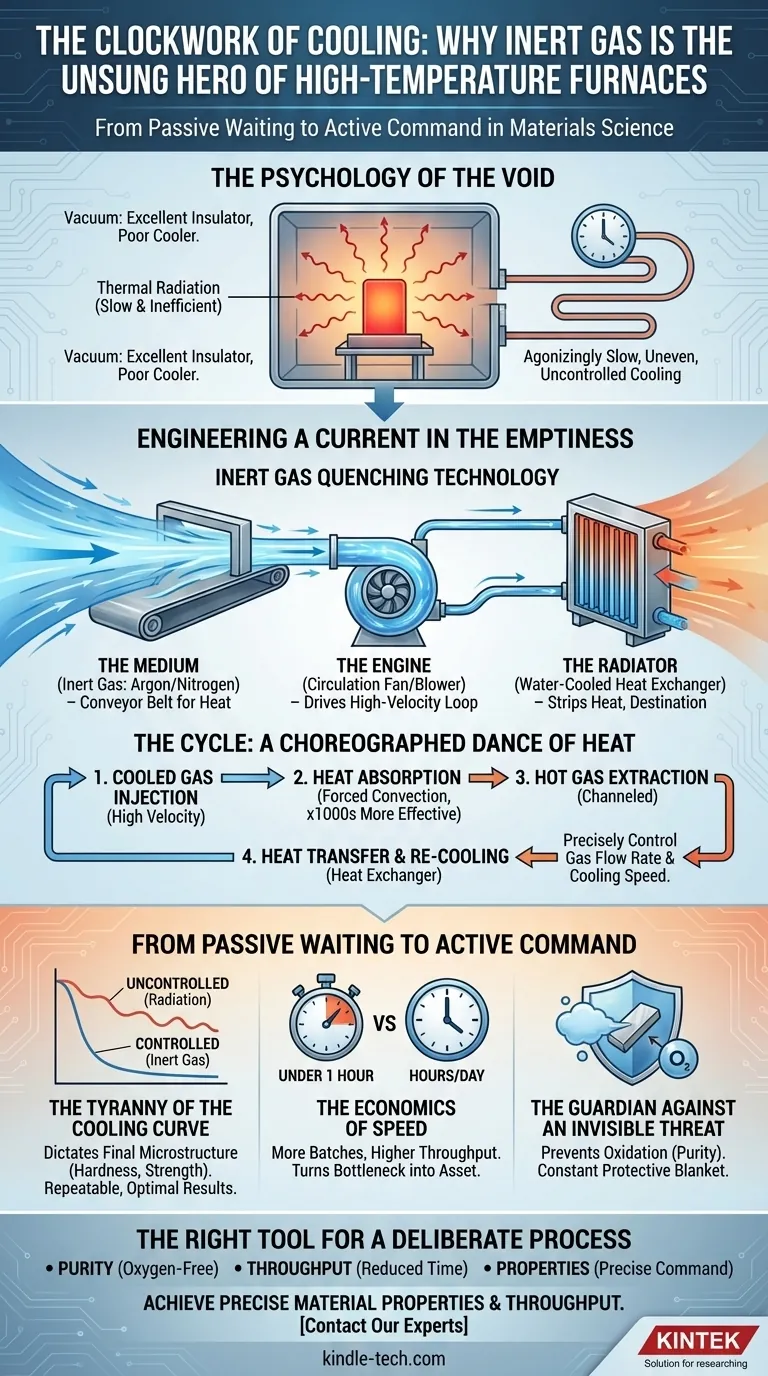
In a vacuum furnace, this wait can feel infinite. A vacuum is a superb insulator, which is excellent for reaching extreme temperatures efficiently. But when the time comes to cool down, that same property becomes a liability. Heat has only one slow, inefficient path out: thermal radiation.
It's like trying to empty a stadium through a single revolving door. The process is agonizingly slow, uneven, and profoundly out of your control.
Engineering a Current in the Emptiness
To master the cooling process, you can't fight the physics of a vacuum. You have to change the environment entirely. This is the elegant genius of inert gas quenching technology.
Instead of passively waiting for radiation, the system introduces a powerful agent of change: a high-speed flow of inert gas. It doesn't just create an atmosphere; it engineers a physical current designed for one purpose—to carry heat away with speed and precision.
This transforms the furnace from a passive chamber into an active thermal engine.
The Anatomy of a Thermal Engine
This system is a masterpiece of thermodynamic control, built on three core components working in perfect sync:
- The Medium: An inert gas, typically Argon or Nitrogen, which acts as a pure conveyor belt for thermal energy, refusing to react with the heated materials.
- The Engine: A powerful, sealed circulation fan or blower that drives the entire process, creating a continuous, high-velocity loop of gas.
- The Radiator: A water-cooled heat exchanger that acts as the destination for the heat, efficiently stripping it from the gas before sending the cooled gas back into the cycle.
The Cycle: A Choreographed Dance of Heat
Once the heating cycle is complete, this clockwork system engages.
- The fan forces cooled inert gas into the hot zone at high velocity.
- The gas flows over the workload, absorbing thermal energy through forced convection—a mechanism thousands of times more effective than radiation.
- This now-hot gas is immediately extracted and channeled through the heat exchanger.
- The heat is transferred away, and the newly cooled gas is injected back into the furnace to begin the cycle anew.
Operators can precisely control the gas flow rate, effectively giving them a throttle on the cooling speed. The wait is over. Command is established.
From Passive Waiting to Active Command
The ability to control the cooling rate is not a minor feature; it is a fundamental shift in capability that redefines what's possible in a lab.
The Tyranny of the Cooling Curve
For many advanced alloys and materials, their final properties—hardness, tensile strength, grain structure—are forged in the cooling phase. The specific rate of temperature drop, known as the cooling curve, dictates the material's final microstructure.
Uncontrolled cooling is a gamble. But with an inert gas system, you can dictate the exact cooling curve required for processes like hardening, annealing, or brazing, ensuring repeatable, optimal results every time.
The Economics of Speed
In a production or research environment, time is the ultimate currency. A natural radiation cool-down in a vacuum can take many hours, sometimes even a full day.
Inert gas quenching can slash that time to under an hour. This dramatic acceleration in cycle time means more batches, more experiments, and higher throughput. It turns the furnace from a bottleneck into a high-performance asset.
The Guardian Against an Invisible Threat
At extreme temperatures, even the most robust materials become vulnerable. Oxygen, a life-giving gas in our world, becomes a destructive contaminant in theirs, causing immediate oxidation that can ruin a product.
An inert gas atmosphere provides a constant, protective blanket, shielding the workload from this invisible threat throughout the entire heating and cooling cycle, ensuring absolute purity.
The Right Tool for a Deliberate Process
Choosing a furnace with inert gas quenching isn't an upgrade; it's a statement about the level of control your process demands. You need this technology if your work depends on:
- Purity: An oxygen-free environment is non-negotiable.
- Throughput: Reducing cooling time is critical to your lab's efficiency.
- Properties: Achieving specific metallurgical outcomes requires precise command over the cooling rate.
At KINTEK, we understand that advanced materials research is a deliberate process, not a game of chance. Our high-temperature atmosphere vacuum furnaces are engineered for exactly this level of active command, integrating sophisticated inert gas quenching systems that put you in complete control of the thermal environment. We provide the tools that turn scientific principles into tangible, repeatable results.
To achieve the precise material properties and throughput your work demands, you need more than just a furnace; you need a solution built for control. Contact Our Experts
Visual Guide
Related Products
- 1700℃ Laboratory High Temperature Tube Furnace with Alumina Tube
- 1400℃ Laboratory High Temperature Tube Furnace with Alumina Tube
- 1200℃ Muffle Furnace Oven for Laboratory
- 1700℃ Muffle Oven Furnace for Laboratory
- High Temperature Muffle Oven Furnace for Laboratory Debinding and Pre Sintering
Related Articles
- The Ultimate Guide to Choosing the Right Lab Furnace for Your Needs
- Why Your High-Temperature Experiments Fail: The Furnace Flaw Most Labs Overlook
- Why Your High-Temperature Furnace Failed—And How to Prevent It From Happening Again
- Why Your High-Temperature Furnace Fails—And How to Choose the Right One
- Why Your High-Temperature Experiments Fail: It's Not the Heat, It's the Furnace



















