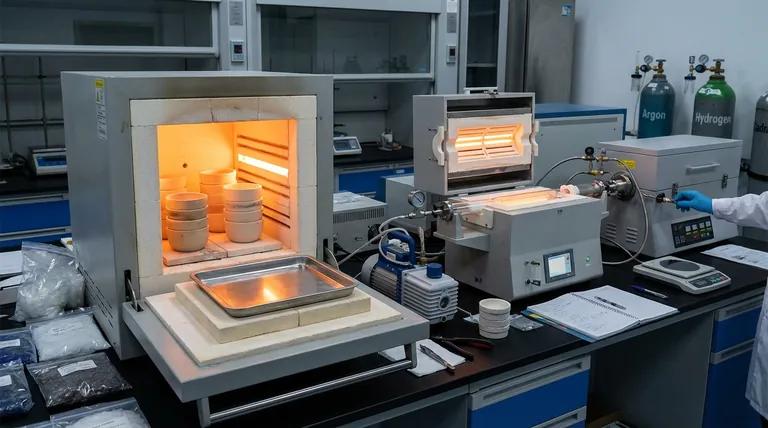
The Shape of the Question
In a laboratory, every tool represents a trade-off. The choice between a muffle furnace and a tube furnace is a classic example. It seems like a simple decision about heating equipment, but it’s really a fundamental question about your research priority: volume or control?
The answer is encoded in their most basic feature: the geometry of their heating chambers. One is a box, the other a cylinder. This simple difference in shape dictates everything that follows.
The Box: A World of Volume
Think of a muffle furnace as the workhorse of thermal processing. Its design is beautifully simple: a large, box-like chamber designed for maximum capacity and accessibility.
This is the furnace you choose when your goal is to process materials in bulk. Imagine a quality control lab needing to determine the ash content of dozens of polymer samples, or a metallurgist heat-treating a batch of small, irregularly shaped parts. The priority isn't the specific atmosphere; it's throughput and the ability to accommodate large or numerous samples with ease.
The muffle furnace excels at simplicity and scale. It's an open environment, designed to heat things efficiently in air.
The Cylinder: A World of Purity
A tube furnace, by contrast, is a world unto itself. Its entire design is centered around a narrow ceramic or quartz tube, creating a completely isolated and controllable environment.
This is the furnace for the scientist for whom the environment is the experiment.
Consider a materials researcher developing a new semiconductor wafer using Chemical Vapor Deposition (CVD). Any stray oxygen molecule could contaminate the process and render the results useless. The tube furnace allows them to create a perfect vacuum and then introduce ultra-pure reactive gases. Here, the limited sample size isn't a constraint; it's a feature that enables absolute environmental control.
For this researcher, the furnace isn't just a heater; it's a self-contained, high-purity reactor.
The Psychology of the Choice: What Do You Value Most?
Your decision isn't just about technical specifications; it’s a declaration of your primary experimental objective.
The Unyielding Demand for Atmosphere
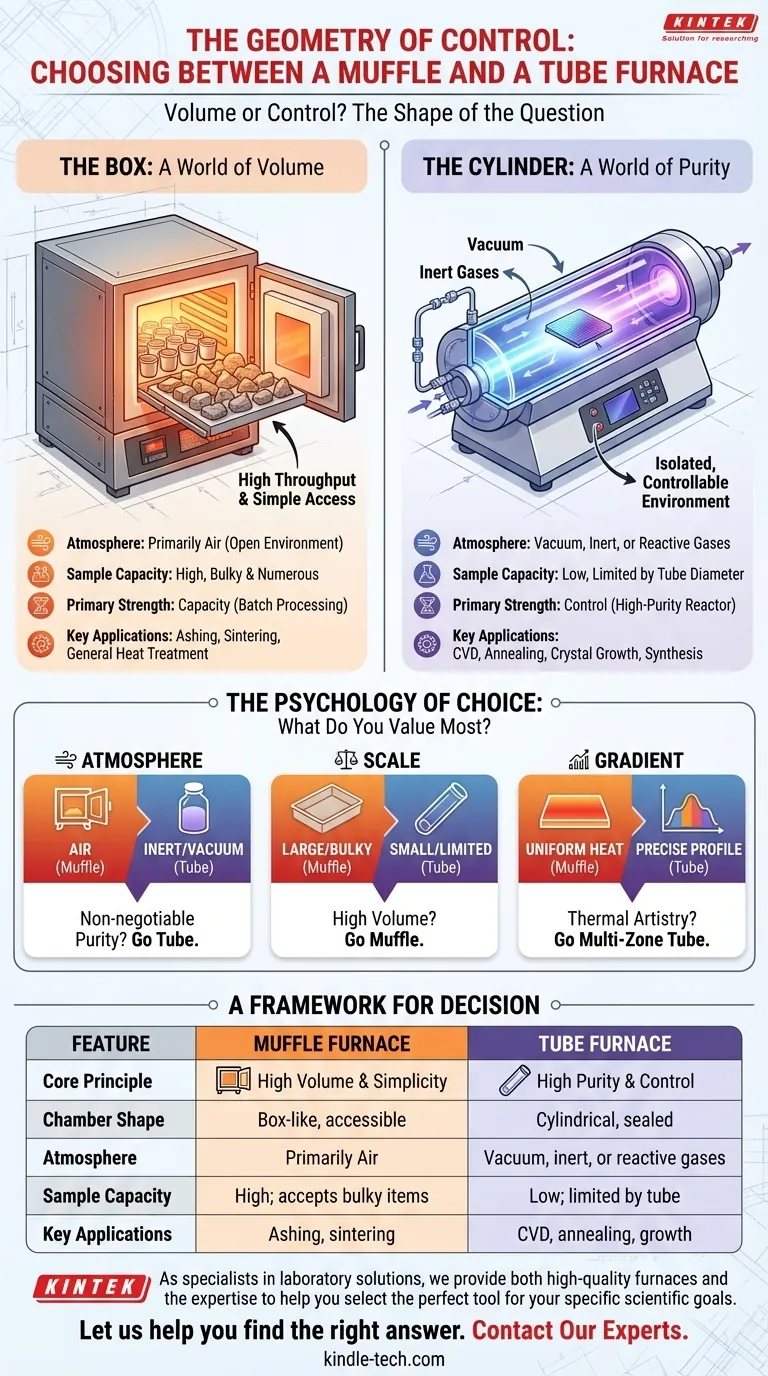
This is the sharpest dividing line. If your process requires an inert atmosphere (like Argon), a reducing atmosphere (like Hydrogen), or a vacuum, the conversation begins and ends with a tube furnace. Muffle furnaces are designed to operate in air. While some can be modified with a gas port, they are not sealed systems and cannot guarantee the purity required for sensitive applications.
- You need a Tube Furnace if: Your work involves annealing oxygen-sensitive alloys, growing single crystals, or performing specialized chemical synthesis.
The Pragmatism of Scale
A muffle furnace offers freedom. Its spacious chamber liberates you from the constraints of a tube's inner diameter. You can place large crucibles, trays of powders, or bulky components inside without a second thought.
The tube furnace, with its 1 to 6-inch typical diameter, demands that your sample conform to its world. For high-volume or large-format tasks, this is simply impractical.
- You need a Muffle Furnace if: Your work involves ashing, calcination, or general-purpose heat treatment of large batches or bulky items.
The Art of the Gradient
Sometimes, uniform heat isn't enough. Advanced processes like directional solidification or crystal growth require sculpting a precise temperature profile along the length of the sample.
This is a feat only achievable with a multi-zone tube furnace. With several independently controlled heating zones, it can create a stable, linear temperature gradient—a level of thermal artistry that is impossible in the single, large chamber of a muffle furnace.
A Framework for Decision
To make the right choice, you must be honest about what is non-negotiable for your process. The trade-offs are clear and direct.
| Feature | Muffle Furnace | Tube Furnace |
|---|---|---|
| Core Principle | High Volume & Simplicity | High Purity & Control |
| Chamber Shape | Box-like, accessible | Cylindrical, sealed |
| Atmosphere | Primarily air | Vacuum, inert, or reactive gases |
| Sample Capacity | High; accepts bulky or numerous samples | Low; limited by the tube's inner diameter |
| Key Applications | Ashing, sintering, general heat treatment | CVD, annealing, crystal growth, synthesis |
| Primary Strength | Capacity. Processing more, or larger, items at once. | Control. Creating a perfect, non-air environment. |
This framework simplifies the choice, but the reality of research is often nuanced, involving complex materials and multi-step processes. Understanding the fundamental trade-offs is the first step, but applying them to your unique challenge requires experience. As specialists in laboratory solutions, KINTEK provides not only the high-quality muffle and tube furnaces you need but also the expertise to help you select the perfect tool for your specific scientific goals.
If you are navigating the critical choice between processing volume and environmental purity, let us help you find the right answer. Contact Our Experts
Visual Guide
Related Products
- 1200℃ Muffle Furnace Oven for Laboratory
- 1800℃ Muffle Oven Furnace for Laboratory
- 1400℃ Muffle Oven Furnace for Laboratory
- 1700℃ Muffle Oven Furnace for Laboratory
- High Temperature Muffle Oven Furnace for Laboratory Debinding and Pre Sintering
Related Articles
- Calibration Methods for High-Temperature Muffle Furnaces
- Substances Suitable for Calcination in a High-Temperature Muffle Furnace
- Temperature Control Accuracy of High Temperature Experimental Chamber Muffle Furnace
- Laboratory Muffle Furnace Safety and Usage Guidelines
- Comprehensive Guide to Muffle Furnaces: Types, Uses, and Maintenance



















