Blog The Geometry of Control: Why Shape Dictates Chemistry in High-Temp Labs
The Geometry of Control: Why Shape Dictates Chemistry in High-Temp Labs

The Geometry of Control: Why Shape Dictates Chemistry in High-Temp Labs

3 hours ago

The "Best Tool" Fallacy

In laboratory engineering, there is rarely a single "best" tool. There is only the tool that aligns with the constraints of physics and the demands of chemistry.

When selecting high-temperature heating equipment, researchers often get bogged down in maximum temperature ratings. But heat is the easy part. The hard part—and the factor that actually determines the success of your experiment—is control.

Specifically, the control of the environment surrounding your sample.

This brings us to the two workhorses of the thermal processing world: the Muffle Furnace and the Tube Furnace.

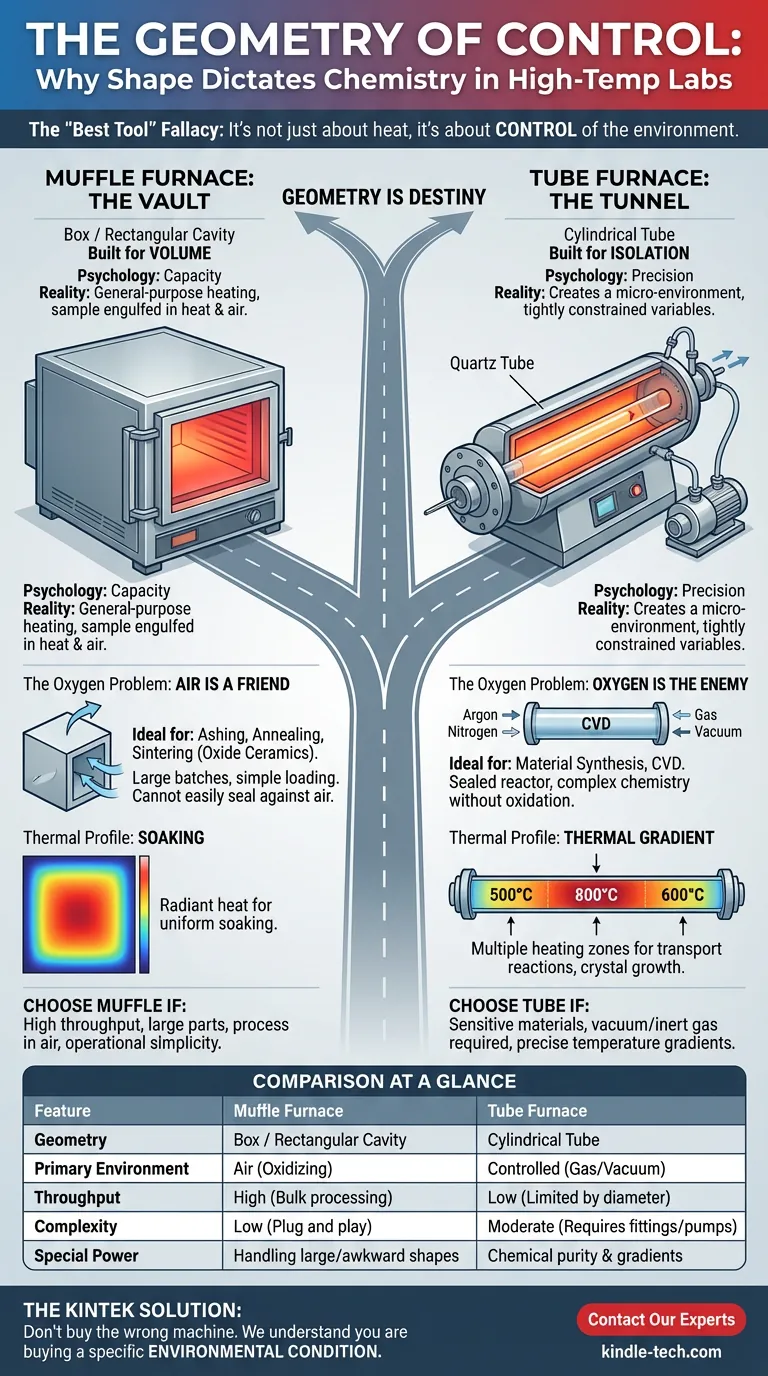
At a glance, they both make things hot. But their divergence lies in their design philosophy. One is built for volume; the other is built for isolation. Understanding this distinction requires looking past the specifications and looking at the geometry.

Geometry is Destiny

The fundamental difference between these units is the shape of the heating chamber. This shape is not an aesthetic choice; it dictates the physical limits of what you can achieve.

The Muffle Furnace: The Vault

Think of a muffle furnace as a high-tech kiln. It features a box-shaped chamber with a front-loading door.

  • ** The Psychology:** It invites bulk. The design screams "capacity."
  • ** The Reality:** It is perfect for general-purpose heating where the sample needs to be engulfed in heat but doesn't mind the company of air.

The Tube Furnace: The Tunnel

The tube furnace is a cylindrical cavity surrounding a long, narrow process tube (usually quartz or alumina).

  • ** The Psychology:** It demands precision. It feels clinical.
  • ** The Reality:** It creates a micro-environment. Because the volume is small and the shape is uniform, the variables are tightly constrained.

The Oxygen Problem

Here is where the engineering romance meets the harsh reality of chemistry.

If your process involves ashing, annealing, or sintering oxide ceramics, oxygen is your friend. You want air. In this scenario, the muffle furnace is superior. Its boxy design and simple door mechanism allow for easy loading of large batches, and the presence of air is irrelevant or beneficial.

But if you are doing Material Synthesis or Chemical Vapor Deposition (CVD), oxygen is a contaminant. It is the enemy.

This is where the geometry of the muffle furnace fails. You cannot easily seal a square box with a large door against the molecular ingress of air.

The tube furnace, however, excels here.

  • Sealing: The cylindrical tube accepts flanges on both ends.
  • Purging: You can easily pump out air (vacuum) or flow in inert gases (Argon, Nitrogen).
  • Reaction: The tube becomes a sealed reactor, allowing complex chemistry without oxidation.

The Law of Gradients

Beyond atmosphere, there is the issue of thermal uniformity.

In a large box (muffle furnace), heat radiates from the walls. While modern units are good, the center of a large chamber may differ slightly from the corners. It is a tool for soaking.

The tube furnace offers a different capability: The Thermal Gradient.

Because the tube is long and narrow, engineers can install multiple heating zones along its length. You can set the left side to 500°C, the center to 800°C, and the right to 600°C.

This allows for:

  • Transport reactions.
  • Crystal growth.
  • Simulating different thermal conditions in a single pass.

The Trade-off: Throughput vs. Precision

We often want a machine that does everything. We want the high volume of the muffle furnace with the atmospheric control of the tube furnace.

Physics rarely grants such wishes without massive cost. You must choose your priority.

Choose the Muffle Furnace if:

  • You need to process large parts or high quantities of small samples at once.
  • Your process occurs in air (oxidation is not a concern).
  • Operational simplicity and lower cost are priorities.
  • Example: Ashing organic materials.

Choose the Tube Furnace if:

  • You are synthesizing sensitive materials.
  • You require a vacuum, inert gas, or reactive gas atmosphere.
  • You need precise temperature gradients.
  • Example: Growing graphene or sintering specialized alloys.

Comparison at a Glance

For those who prefer data over narrative, here is how the geometry translates to capability:

Feature Muffle Furnace Tube Furnace
Geometry Box / Rectangular Cavity Cylindrical Tube
Primary Environment Air (Oxidizing) Controlled (Gas/Vacuum)
Throughput High (Bulk processing) Low (Limited by diameter)
Complexity Low (Plug and play) Moderate (Requires fittings/pumps)
Special Power Handling large/awkward shapes Chemical purity & gradients

The KINTEK Solution

The risk in purchasing lab equipment is not usually buying a "bad" machine; it is buying the wrong machine for the specific nuance of your research.

At KINTEK, we understand that you aren't just buying a furnace; you are buying a specific environmental condition—whether that's a high-volume oxidation chamber or a precision vacuum reactor.

We supply both robust Muffle Furnaces and high-precision Tube Furnaces, designed to withstand the rigors of modern laboratory work.

If you are unsure whether your application demands the volume of a box or the precision of a tube, let us help you navigate the trade-offs.

Contact Our Experts

Visual Guide

The Geometry of Control: Why Shape Dictates Chemistry in High-Temp Labs Visual Guide

Related Products

Related Articles

Related Products

1700℃ Muffle Oven Furnace for Laboratory

1700℃ Muffle Oven Furnace for Laboratory

Get superior heat control with our 1700℃ Muffle Furnace. Equipped with intelligent temperature microprocessor, TFT touch screen controller & advanced insulation materials for precise heating up to 1700C. Order now!

1400℃ Muffle Oven Furnace for Laboratory

1400℃ Muffle Oven Furnace for Laboratory

Get precise high-temperature control up to 1500℃ with KT-14M Muffle furnace. Equipped with a smart touch screen controller and advanced insulation materials.

Laboratory Rapid Thermal Processing (RTP) Quartz Tube Furnace

Laboratory Rapid Thermal Processing (RTP) Quartz Tube Furnace

Get lightning-fast heating with our RTP Rapid Heating Tube Furnace. Designed for precise, high-speed heating and cooling with convenient sliding rail and TFT touch screen controller. Order now for ideal thermal processing!

1400℃ Controlled Atmosphere Furnace with Nitrogen and Inert Atmosphere

1400℃ Controlled Atmosphere Furnace with Nitrogen and Inert Atmosphere

Achieve precise heat treatment with KT-14A controlled atmosphere furnace. Vacuum sealed with a smart controller, it's ideal for lab and industrial use up to 1400℃.

1700℃ Controlled Atmosphere Furnace Nitrogen Inert Atmosphere Furnace

1700℃ Controlled Atmosphere Furnace Nitrogen Inert Atmosphere Furnace

KT-17A Controlled atmosphere furnace: 1700℃ heating, vacuum sealing technology, PID temperature control, and versatile TFT smart touch screen controller for laboratory and industrial use.

Laboratory Muffle Oven Furnace Bottom Lifting Muffle Furnace

Laboratory Muffle Oven Furnace Bottom Lifting Muffle Furnace

Efficiently produce batches with excellent temperature uniformity using our Bottom Lifting Furnace. Features two electric lifting stages and advanced temperature control up to 1600℃.

1200℃ Split Tube Furnace with Quartz Tube Laboratory Tubular Furnace

1200℃ Split Tube Furnace with Quartz Tube Laboratory Tubular Furnace

KT-TF12 split tube furnace: high-purity insulation, embedded heating wire coils, and max. 1200C. Widely used for new materials and chemical vapour deposition.

1800℃ Muffle Oven Furnace for Laboratory

1800℃ Muffle Oven Furnace for Laboratory

KT-18 muffle furnace with Japan Al2O3 polycrystalline fibe and Silicon Molybdenum heating element, up to 1900℃, PID temperature control and 7" smart touch screen. Compact design, low heat loss, and high energy efficiency. Safety interlock system and versatile functions.

1200℃ Controlled Atmosphere Furnace Nitrogen Inert Atmosphere Furnace

1200℃ Controlled Atmosphere Furnace Nitrogen Inert Atmosphere Furnace

Discover our KT-12A Pro Controlled atmosphere furnace - high precision, heavy duty vacuum chamber, versatile smart touch screen controller, and excellent temperature uniformity up to 1200C. Ideal for both laboratory and industrial application.

Vacuum Heat Treat and Sintering Furnace with 9MPa Air Pressure

Vacuum Heat Treat and Sintering Furnace with 9MPa Air Pressure

The air pressure sintering furnace is a high-tech equipment commonly used for the sintering of advanced ceramic materials. It combines vacuum sintering and pressure sintering techniques to achieve high-density and high-strength ceramics.

Vacuum Heat Treat and Molybdenum Wire Sintering Furnace for Vacuum Sintering

Vacuum Heat Treat and Molybdenum Wire Sintering Furnace for Vacuum Sintering

A vacuum molybdenum wire sintering furnace is a vertical or bedroom structure, which is suitable for withdrawal, brazing, sintering and degassing of metal materials under high vacuum and high temperature conditions. It is also suitable for dehydroxylation treatment of quartz materials.

Vacuum Heat Treat Sintering Brazing Furnace

Vacuum Heat Treat Sintering Brazing Furnace

A vacuum brazing furnace is a type of industrial furnace used for brazing, a metalworking process that joins two pieces of metal using a filler metal that melts at a lower temperature than the base metals. Vacuum brazing furnaces are typically used for high-quality applications where a strong, clean joint is required.

Mesh belt controlled atmosphere furnace

Mesh belt controlled atmosphere furnace

Discover our KT-MB mesh belt sintering furnace - perfect for high-temperature sintering of electronic components & glass insulators. Available for open air or controlled atmosphere environments.

Vacuum Dental Porcelain Sintering Furnace

Vacuum Dental Porcelain Sintering Furnace

Get precise and reliable results with KinTek's Vacuum Porcelain Furnace. Suitable for all porcelain powders, it features hyperbolic ceramic furnace function, voice prompt, and automatic temperature calibration.

Controlled Nitrogen Inert Hydrogen Atmosphere Furnace

Controlled Nitrogen Inert Hydrogen Atmosphere Furnace

KT-AH Hydrogen atmosphere furnace - induction gas furnace for sintering/annealing with built-in safety features, dual housing design, and energy-saving efficiency. Ideal for lab and industrial use.

Vacuum Heat Treat Furnace with Ceramic Fiber Liner

Vacuum Heat Treat Furnace with Ceramic Fiber Liner

Vacuum furnace with polycrystalline ceramic fiber insulation liner for excellent heat insulation and uniform temperature field. Choose from 1200℃ or 1700℃ max. working temperature with high vacuum performance and precise temperature control.

Molybdenum Vacuum Heat Treat Furnace

Molybdenum Vacuum Heat Treat Furnace

Discover the benefits of a high-configuration molybdenum vacuum furnace with heat shield insulation. Ideal for high-purity, vacuum environments like sapphire crystal growth and heat treatment.

Laboratory Vacuum Tilt Rotary Tube Furnace Rotating Tube Furnace

Laboratory Vacuum Tilt Rotary Tube Furnace Rotating Tube Furnace

Discover the versatility of Laboratory Rotary Furnace: Ideal for calcination, drying, sintering, and high-temperature reactions. Adjustable rotating and tilting functions for optimal heating. Suitable for vacuum and controlled atmosphere environments. Learn more now!

Graphite Vacuum Furnace High Thermal Conductivity Film Graphitization Furnace

Graphite Vacuum Furnace High Thermal Conductivity Film Graphitization Furnace

The high thermal conductivity film graphitization furnace has uniform temperature, low energy consumption and can operate continuously.

600T Vacuum Induction Hot Press Furnace for Heat Treat and Sintering

600T Vacuum Induction Hot Press Furnace for Heat Treat and Sintering

Discover the 600T Vacuum Induction Hot Press Furnace, designed for high-temperature sintering experiments in vacuum or protected atmospheres. Its precise temperature and pressure control, adjustable working pressure, and advanced safety features make it ideal for nonmetal materials, carbon composites, ceramics, and metal powders.


Leave Your Message