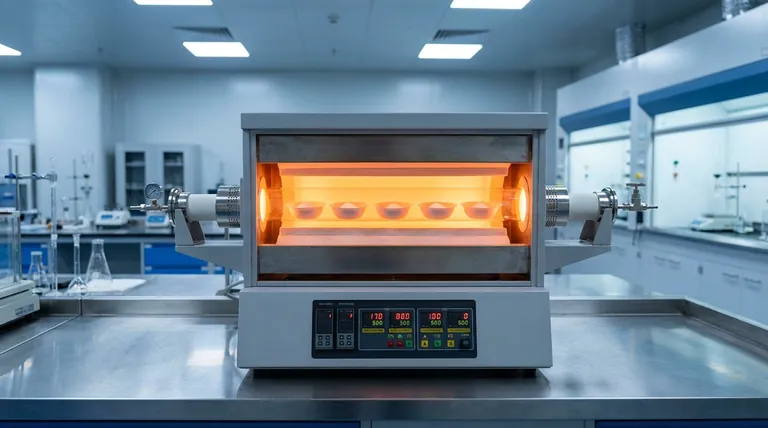
The Architecture of Heat
There is a seductiveness to big numbers. In the laboratory equipment market, the most prominent number on a spec sheet is usually the maximum temperature.
1200°C. 1600°C. 1800°C.
It feels like a measure of power. It signals capability. But in the nuanced world of materials science and chemical synthesis, maximum temperature is often a vanity metric. It tells you what the machine is capable of surviving, not necessarily what it is capable of doing for your specific experiment.
Real engineering romance isn't found in the peak heat; it is found in the control of that heat.
When selecting a tube furnace, the goal is rarely to scorch a sample. The goal is to subject a material to a specific thermodynamic environment with perfect repeatability. To do that, we must look past the "max temp" and understand the system underneath.
The Physical Limits
Temperature is not an arbitrary dial; it is a battle against material degradation.
The upper limit of a furnace is dictated strictly by the chemistry of its heating elements. A standard wire element will oxidize and fail if pushed beyond 1200°C. To breach the 1400°C to 1800°C barrier, engineers must utilize specialized materials like Silicon Carbide (SiC) or Molybdenum Disilicide (MoSi2).
However, configuration matters as much as material.
Consider the Rotary Tube Furnace. Because it is designed to tumble powders and granules continuously, the mechanical motion introduces dynamic variables. Consequently, these are often engineered for a modest 1000°C.
In contrast, static furnaces designed for synthesis are built like fortresses, capable of holding 1800°C because they do not have to contend with moving parts.
The Nervous System: Feedback Loops
Regardless of the maximum capacity, a furnace is only as good as its nervous system—the thermocouple.
This sensor provides the reality check. It tells the controller what is actually happening inside the chamber, allowing the system to modulate power.
But here lies the trap. A thermocouple measures the temperature at a single point, usually the geometric center of the tube. This leads to the most critical, yet overlooked concept in thermal processing: The Uniform Temperature Zone.
The Plateau vs. The Peak
Imagine the temperature profile of a tube furnace as a mountain.
At the very center, you reach the peak (the setpoint). But as you move toward the ends of the tube, heat escapes. The temperature drops. The "mountain" has steep slopes.
For a scientist growing crystals, annealing semiconductors, or testing catalysts, a mountain is useless. You need a plateau.
You need the Uniform Temperature Zone.
This is the specific length within the tube where the temperature does not deviate (e.g., ±5°C over 150mm).
- If your sample is 100mm long: A furnace with a 50mm uniform zone will ruin your data. The edges of your sample will experience a different thermodynamic history than the center.
- The result: Inconsistent grain structures, failed synthesis, and unrepeatable results.
The Psychology of Margins
There is a human tendency to push machines to their limits to get "maximum value." In thermal engineering, this is a mistake.
Just because a car's speedometer goes to 160 mph doesn't mean you should drive it at 160 mph during your daily commute. The engine won't last.
The same applies to furnaces.
- Rated vs. Operational: A furnace rated for 1200°C should not be run at 1200°C continuously.
- The Cost: Operating at the absolute redline drastically shortens the lifespan of heating elements and risks insulation failure.
Smart labs buy a margin of safety. If you need 1100°C daily, buy a 1400°C furnace. The components will be under-stressed, the uniformity will be better, and the equipment will last years longer.
Selecting for Reality, Not Vanity
When choosing your instrument, ignore the marketing urge to buy the highest number for the lowest price. Instead, match the physics of the furnace to the geometry of your sample.
A Quick Decision Framework
- General Purpose (Below 1200°C): Standard single-zone furnaces are the workhorses here. Efficient and cost-effective for ashing or basic heat treatment.
- High-Temperature Synthesis (1400°C - 1800°C): You are paying for advanced insulation and exotic heating elements. Ensure your lab infrastructure (power supply) can handle the load.
- Precision and Repeatability: If your science depends on the entire sample reacting simultaneously, ignore the max temp. Look exclusively at the length of the Uniform Temperature Zone. You may need a multi-zone furnace where the ends are heated independently to flatten the thermal curve.
Summary of Capabilities
| Furnace Type | Operational Reality | The "Why" |
|---|---|---|
| Standard Tube Furnace | Up to 1200°C | Ideal for standard ashing and drying where extreme heat isn't required. |
| High-Temp Furnace | 1400°C - 1800°C | Necessary for ceramics, crystal growth, and advanced materials research. |
| Rotary Tube Furnace | ~1000°C | Sacrifices heat for motion; essential for uniform processing of powders. |
| Multi-Zone Furnace | Variable | Engineered specifically to extend the uniform zone for long samples. |
The KINTEK Solution
At KINTEK, we understand that a furnace is not just a heated box; it is an environment where you attempt to control entropy.
Whether you need the brute force of 1800°C or the delicate precision of a perfectly flat thermal plateau, our equipment is designed to bridge the gap between engineering specs and laboratory reality.
Don't let a temperature gradient compromise your research. Contact Our Experts today to define the exact uniform zone your process requires.
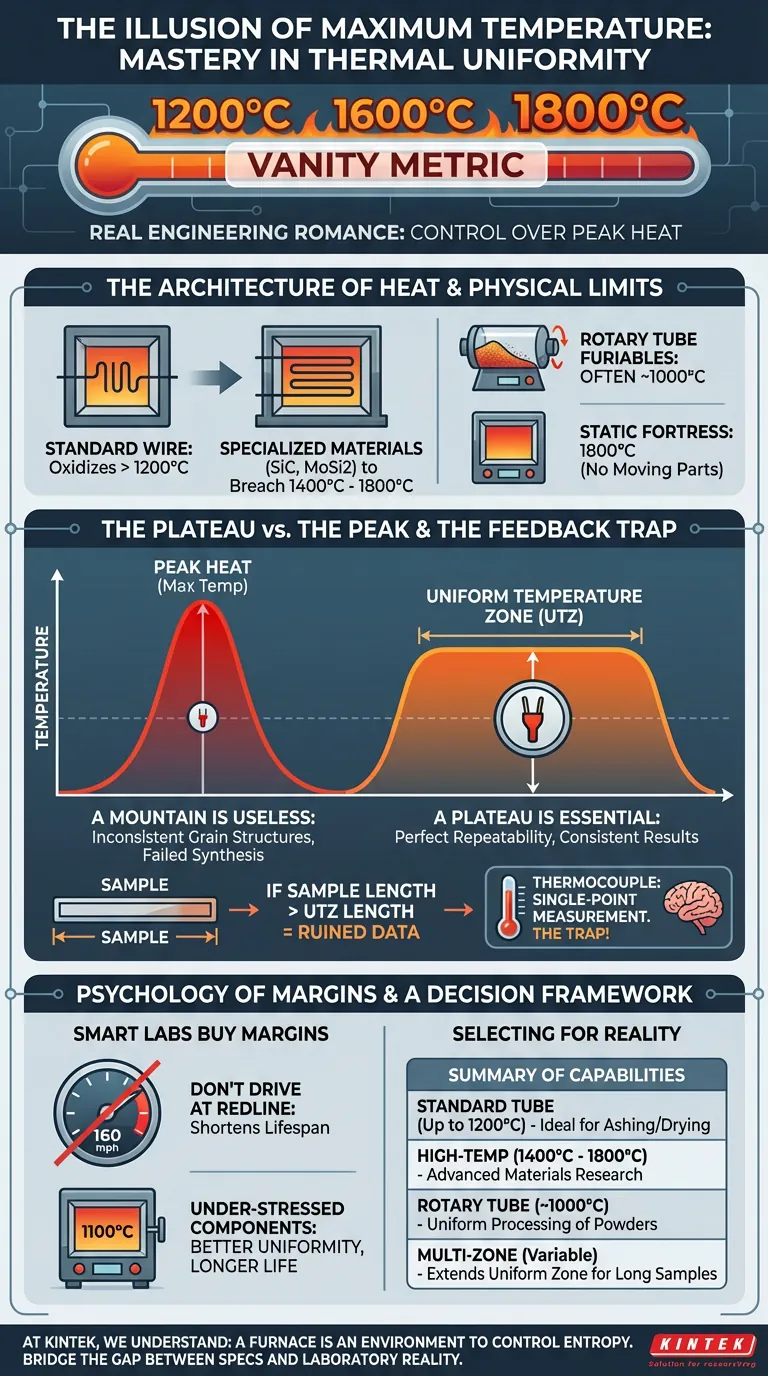
Visual Guide
Related Products
- Rotary Tube Furnace Split Multi Heating Zone Rotating Tube Furnace
- High Temperature Alumina (Al2O3) Furnace Tube for Engineering Advanced Fine Ceramics
- Laboratory Vacuum Tilt Rotary Tube Furnace Rotating Tube Furnace
- 1200℃ Split Tube Furnace with Quartz Tube Laboratory Tubular Furnace
- 1400℃ Laboratory High Temperature Tube Furnace with Alumina Tube
Related Articles
- The Geometry of Heat: Why Motion Matters in Material Synthesis
- The Geometry of Heat: Engineering the Perfect Thermal Environment
- Exploring the Functions and Advantages of Rotary Tube Furnaces
- Exploring Rotary Tube Furnaces: A Comprehensive Guide
- Exploring the Advantages of Rotary Tube Furnaces in Industrial and Laboratory Applications



















