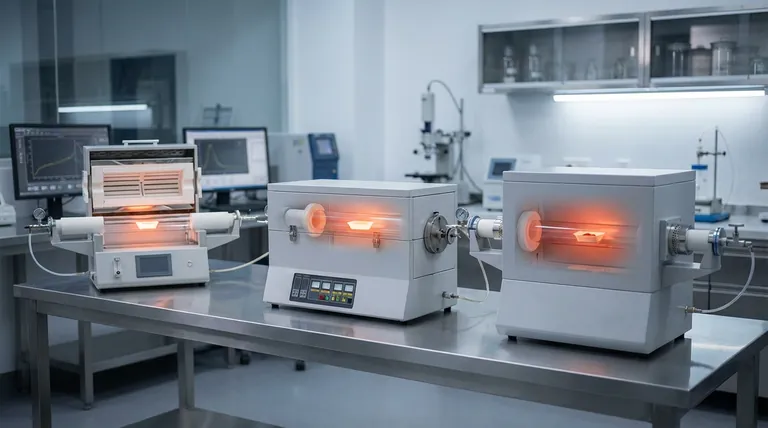
The Researcher's Dilemma: An Enemy Called Variance
Every researcher knows the feeling. An experiment, meticulously planned, fails to produce the expected result. The theory was sound, the materials pure. The culprit is often an invisible variable—a subtle temperature fluctuation, a trace amount of oxygen, an imperceptible inconsistency that renders the outcome useless.
In the world of materials science, chemistry, and engineering, progress is a battle against this randomness. The goal is not just to create something new, but to create it repeatably. This requires more than just heat; it requires an environment of absolute control.
Beyond Brute-Force Heat
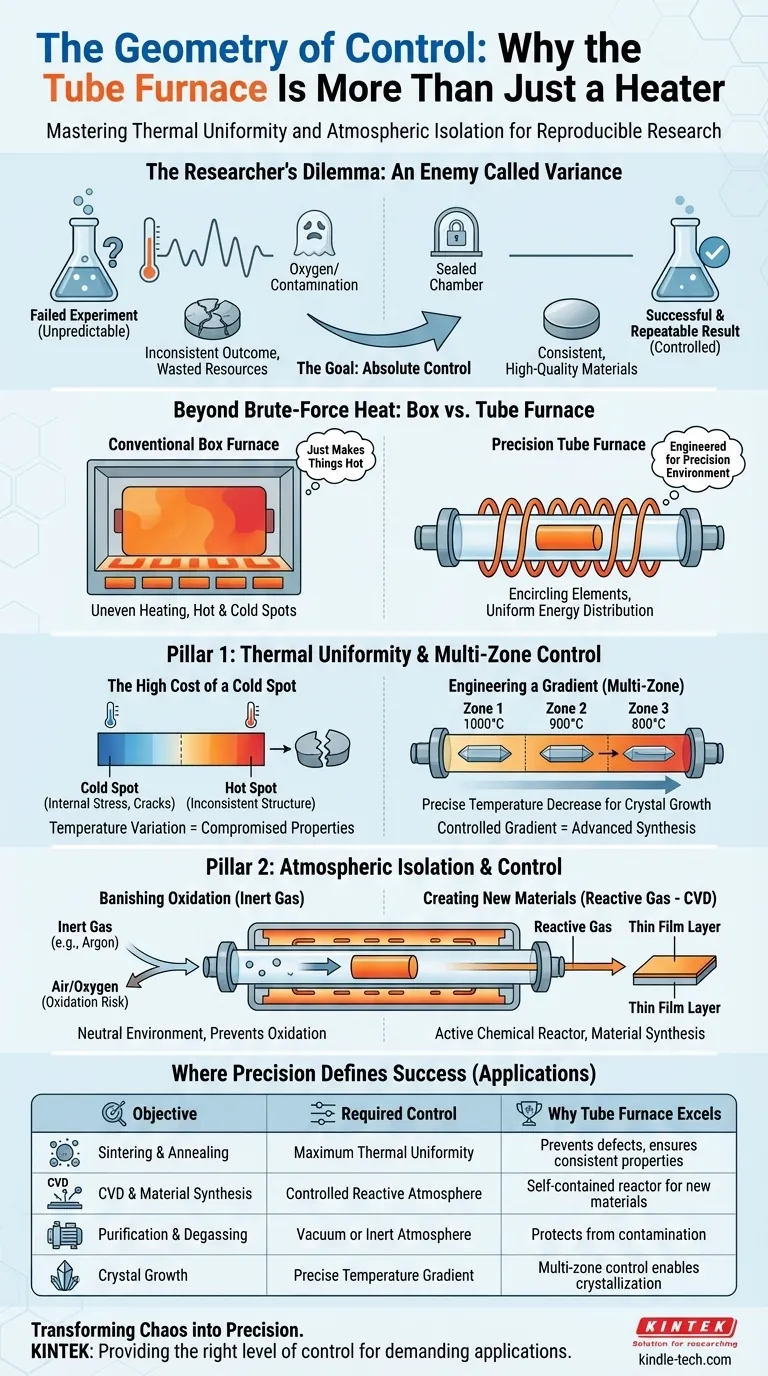
At first glance, a furnace is a simple tool: it makes things hot. A conventional box furnace does this well, heating a chamber much like a kitchen oven. But for advanced processes, "hot" is not enough. The way something is heated becomes more critical than the temperature itself.
This is where the tube furnace distinguishes itself. It is not designed for brute-force heating of large objects. It is a precision instrument designed to create a small, perfectly managed universe for a sample. Its power lies in two fundamental principles: thermal uniformity and atmospheric isolation.
The First Pillar of Control: Thermal Uniformity
The elegance of the tube furnace begins with its geometry. Heating elements encircle a narrow ceramic or quartz tube, creating an exceptionally even distribution of energy.
Imagine trying to toast a marshmallow perfectly over a campfire. Hot spots and cool spots lead to a charred, gooey mess. The tube furnace is the opposite; it's a system engineered to eliminate those hot spots, ensuring every surface of the sample experiences the exact same thermal journey.
The High Cost of a Cold Spot
This uniformity is not an academic detail. In processes like sintering, where fine powders are fused into a solid, a temperature variation of just a few degrees can cause internal stress, leading to cracks. When annealing a metal to soften it, an uneven heat can result in an inconsistent grain structure, compromising its mechanical properties.
Engineering a Gradient
Advanced multi-zone tube furnaces take this a step further. By controlling different heating sections along the tube independently, they can create a stable, predictable temperature gradient. This is essential for sophisticated tasks like growing a single perfect crystal, where temperature must decrease at a precise rate over a specific distance.
The Second Pillar of Control: Atmospheric Isolation
Heat is only half the equation. The air we breathe is a reactive mix of gases, primarily nitrogen and oxygen. For many high-temperature processes, oxygen is the enemy—an unwanted guest that causes oxidation, fundamentally changing the material's chemistry.
The sealed design of a tube furnace allows you to evict this guest. You can remove the air to create a vacuum or replace it with a specific atmosphere.
Banishing Oxidation with Inert Gas
By flooding the tube with an inert gas like argon, you create a neutral environment. This protects sensitive metals and compounds from oxidizing at high temperatures, ensuring the material you put in is the same material you get out, only structurally transformed by the heat.
Creating New Materials with Reactive Gas
This control can also be proactive. In Chemical Vapor Deposition (CVD), a reactive gas is deliberately introduced into the tube. The gas decomposes at high temperature and deposits a thin, ultra-pure film onto a substrate—a process used to create everything from semiconductor layers to wear-resistant coatings. The furnace becomes an active chemical reactor.
Where Precision Defines Success
The combination of these two pillars of control makes the tube furnace indispensable across research and industry. The right tool depends entirely on the objective.
| Process Objective | Required Control | Why the Tube Furnace Excels |
|---|---|---|
| Sintering & Annealing | Maximum Thermal Uniformity | Prevents defects and ensures consistent material properties. |
| CVD & Material Synthesis | Controlled Reactive Atmosphere | Acts as a self-contained reactor for creating new materials. |
| Purification & Degassing | Vacuum or Inert Atmosphere | Protects materials from contamination and unwanted reactions. |
| Crystal Growth | Precise Temperature Gradient | Multi-zone control enables the delicate process of crystallization. |
If your goal is simply to heat a large, non-sensitive part in air, a box furnace is a practical choice. But if your success depends on eliminating variables and achieving a perfect, repeatable result on a smaller scale, the tube furnace is the definitive instrument.
It transforms the chaotic nature of heat into a tool of precision. At KINTEK, we understand that providing the right equipment is about providing the right level of control. Our range of high-performance tube furnaces is engineered to deliver the uniformity and atmospheric integrity your most demanding applications require.
Mastering your thermal process begins with mastering the environment. If your work demands perfection, let's ensure your tools are up to the task. Contact Our Experts
Visual Guide
Related Products
- Rotary Tube Furnace Split Multi Heating Zone Rotating Tube Furnace
- Laboratory Vacuum Tilt Rotary Tube Furnace Rotating Tube Furnace
- 1200℃ Split Tube Furnace with Quartz Tube Laboratory Tubular Furnace
- 1400℃ Laboratory High Temperature Tube Furnace with Alumina Tube
- 1700℃ Laboratory High Temperature Tube Furnace with Alumina Tube
Related Articles
- The Geometry of Heat: Why Motion Matters in Material Synthesis
- Exploring the Advantages of Rotary Tube Furnaces in Industrial and Laboratory Applications
- The Geometry of Heat: Engineering the Perfect Thermal Environment
- Exploring the Functions and Advantages of Rotary Tube Furnaces
- Exploring Rotary Tube Furnaces: A Comprehensive Guide



















