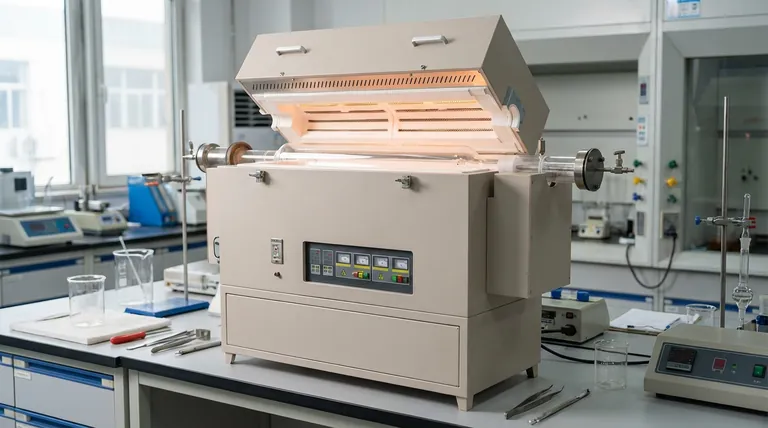
The Illusion of the Single Metric
A researcher prepares a novel catalyst. The synthesis requires holding a precursor powder at 1200°C with absolute uniformity for six hours. They select a furnace with a top-tier temperature controller, run the experiment, and find the resulting material is inconsistent. The particles at the center are perfect, but those near the ends are not.
The controller read 1200°C. The heating elements worked. The failure wasn't in the electronics, but in the physics of the chamber itself.
We have a psychological bias for simple metrics. We look for the highest temperature, the fastest ramp rate, or the most advanced controller. But in thermal processing, the most critical factor is often the physical architecture of the furnace. The geometry of the heat is more important than its peak value.
The First Choice: Access vs. Thermal Integrity
The most fundamental decision in furnace design isn't about temperature; it's about how you get your sample into the heat. This choice creates an immediate and unavoidable trade-off.
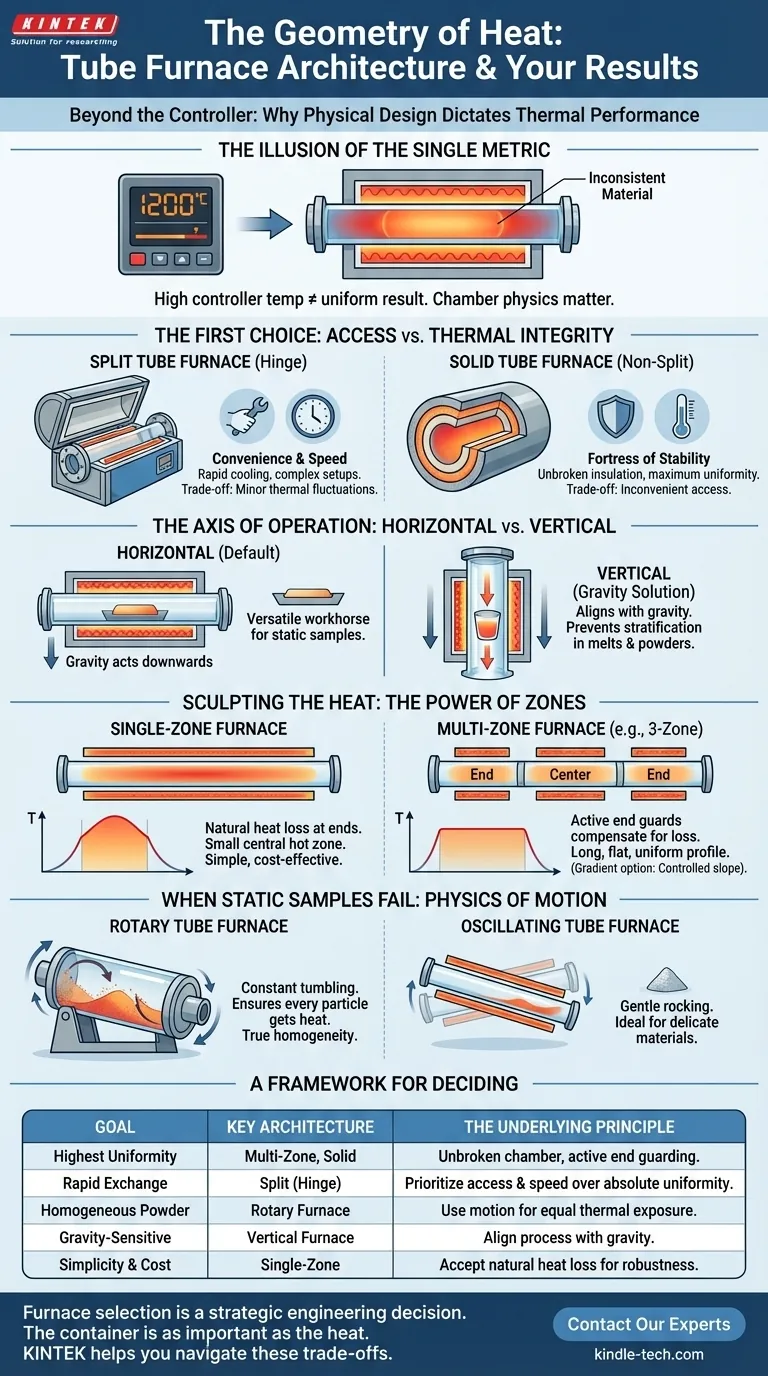
Split Tube Furnaces are marvels of convenience. Built on a hinge, they open like a clamshell, allowing you to place or remove a process tube with complex flanges or connections instantly. This design is also ideal for processes requiring rapid cooling, as you can simply open the chamber to the ambient air.
Solid (Non-Split) Tube Furnaces, in contrast, are fortresses of thermal stability. A solid, unbroken cylinder of insulation and heating elements provides the most uniform and stable environment possible. There are no seams to introduce minor temperature fluctuations. The cost of this integrity is inconvenience; samples must be carefully inserted from an end.
This is the classic engineering dilemma: do you optimize for the process (uniformity) or for the workflow (access)?
The Axis of Operation: Horizontal vs. Vertical
The orientation of the furnace dictates its relationship with gravity, a force that is often overlooked in high-temperature experiments.
Horizontal is the default, the versatile workhorse for most static sample processing.
Vertical orientation is the solution for when gravity becomes a variable. In processes like crystal growth, it prevents stratification in the melt. When treating powders, it can stop finer particles from segregating. By aligning the process with gravity, you remove an unwanted variable, ensuring that the only force at play is the one you are controlling: heat.
Sculpting the Heat: The Power of Zones
A single set of heating elements in a tube furnace will always lose more heat at the ends than in the middle. It's an inescapable law of thermodynamics. The result is a small, truly uniform "hot zone" in the center, with the temperature tapering off at both ends.
Single-Zone Furnaces accept this reality. They are simple, cost-effective, and perfect for small samples placed directly in the center or for applications where absolute uniformity over a long length isn't critical.
Multi-Zone Furnaces refuse to accept it. A three-zone furnace, the most common configuration, adds two smaller, independently controlled "end zones." These act as thermal guardians. Their sole purpose is to inject extra energy at the ends to compensate for natural heat loss, forcing the central zone into a long, exceptionally flat, and uniform temperature profile.
A Gradient Furnace is a specialized use of this technology, where the zones are programmed to create a controlled temperature slope. This transforms the furnace from a simple heater into an analytical tool, allowing researchers to study a material's behavior across a range of temperatures in a single experiment.
When Static Samples Fail: The Physics of Motion
Heating a static pile of powder is inherently inefficient. The particles on the surface are heated directly, while those in the middle are insulated by their neighbors. The result is an unevenly processed batch.
Rotary Tube Furnaces solve this with constant, gentle motion. By slowly rotating the entire process tube, the furnace ensures every particle is continuously folded back to the surface, exposing it to the heat source. This is the key to achieving true homogeneity in processes like calcination or pyrolysis of powders and granules.
Oscillating Tube Furnaces offer a gentler mixing action, rocking the material back and forth. This is ideal for more delicate materials where the tumbling action of a rotary furnace might be too aggressive.
A Framework for Deciding
Choosing the right tube furnace is not about finding the "best" model. It is about understanding the problem you are trying to solve and selecting the architecture designed for that specific challenge. The trade-offs are not flaws; they are features of a purpose-built tool.
| Goal | Key Architecture | The Underlying Principle |
|---|---|---|
| Highest Temperature Uniformity | Multi-Zone, Solid (Non-Split) | Create an unbroken thermal chamber and actively guard the ends. |
| Rapid Sample Exchange / Complex Setup | Split (Hinge) Furnace | Prioritize physical access and workflow speed over absolute uniformity. |
| Homogeneous Powder Processing | Rotary Furnace | Use motion to ensure every particle receives equal thermal energy. |
| Gravity-Sensitive Processes | Vertical Furnace | Align the process with gravity to eliminate it as a variable. |
| Simplicity and Cost-Effectiveness | Single-Zone Furnace | Accept natural heat loss for a simpler, more robust design. |
Understanding these architectural choices transforms furnace selection from a catalog search into a strategic engineering decision. It acknowledges that the container for the heat is just as important as the heat itself. At KINTEK, our expertise lies in helping you navigate these trade-offs, ensuring the furnace you choose is not just a piece of equipment, but the correct solution for your specific challenge.
To ensure your results are defined by your research, not by the limitations of your equipment, let's find the right architecture for your work. Contact Our Experts
Visual Guide
Related Products
- Rotary Tube Furnace Split Multi Heating Zone Rotating Tube Furnace
- Laboratory Vacuum Tilt Rotary Tube Furnace Rotating Tube Furnace
- 1200℃ Split Tube Furnace with Quartz Tube Laboratory Tubular Furnace
- 1400℃ Laboratory High Temperature Tube Furnace with Alumina Tube
- 1700℃ Laboratory High Temperature Tube Furnace with Alumina Tube
Related Articles
- The Geometry of Heat: Why Motion Matters in Material Synthesis
- Exploring the Advantages of Rotary Tube Furnaces in Industrial and Laboratory Applications
- The Geometry of Heat: Engineering the Perfect Thermal Environment
- Exploring the Functions and Advantages of Rotary Tube Furnaces
- Exploring Rotary Tube Furnaces: A Comprehensive Guide



















