The Illusion of Simplicity
In the world of material science, variables are the enemy.
When a researcher places a sample into a furnace, they are not merely asking for heat. They are asking for certainty. They are purchasing the assurance that the only changing factor in their experiment is the one they intended to change.
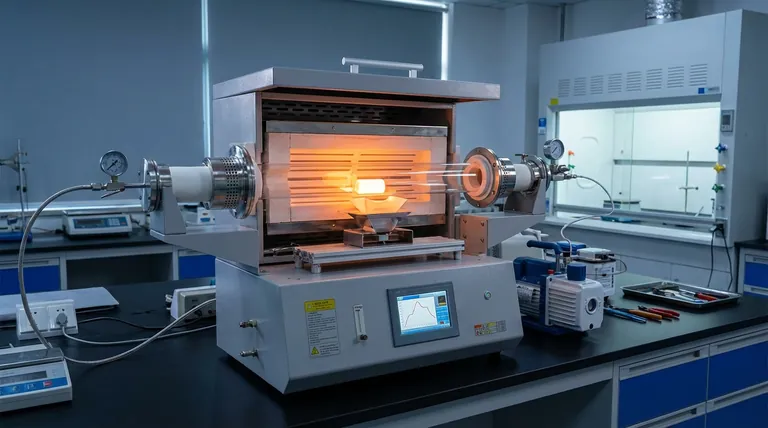
At first glance, the horizontal tube furnace appears deceptively simple. It looks like a tunnel. You put a sample in one end, heat it up, and take it out.
But beneath that simple geometry lies a complex orchestration of thermal dynamics and atmospheric engineering. It is a machine built to impose order on the chaos of high temperatures.
The Logic of the Cylinder
The anatomy of the tube furnace is not accidental. It is a design evolved for a specific kind of control.
The "Horizontal" Advantage
The orientation dictates the workflow. By positioning the cylindrical chamber horizontally, gravity becomes a neutral partner rather than an active participant.
Samples are typically placed in a "combustion boat"—a vessel that slides into the tube. This allows for:
- Effortless Loading: The geometry aligns with human ergonomics.
- Thermal Symmetry: The cylindrical shape ensures that heat radiates equidistantly from the perimeter to the center.
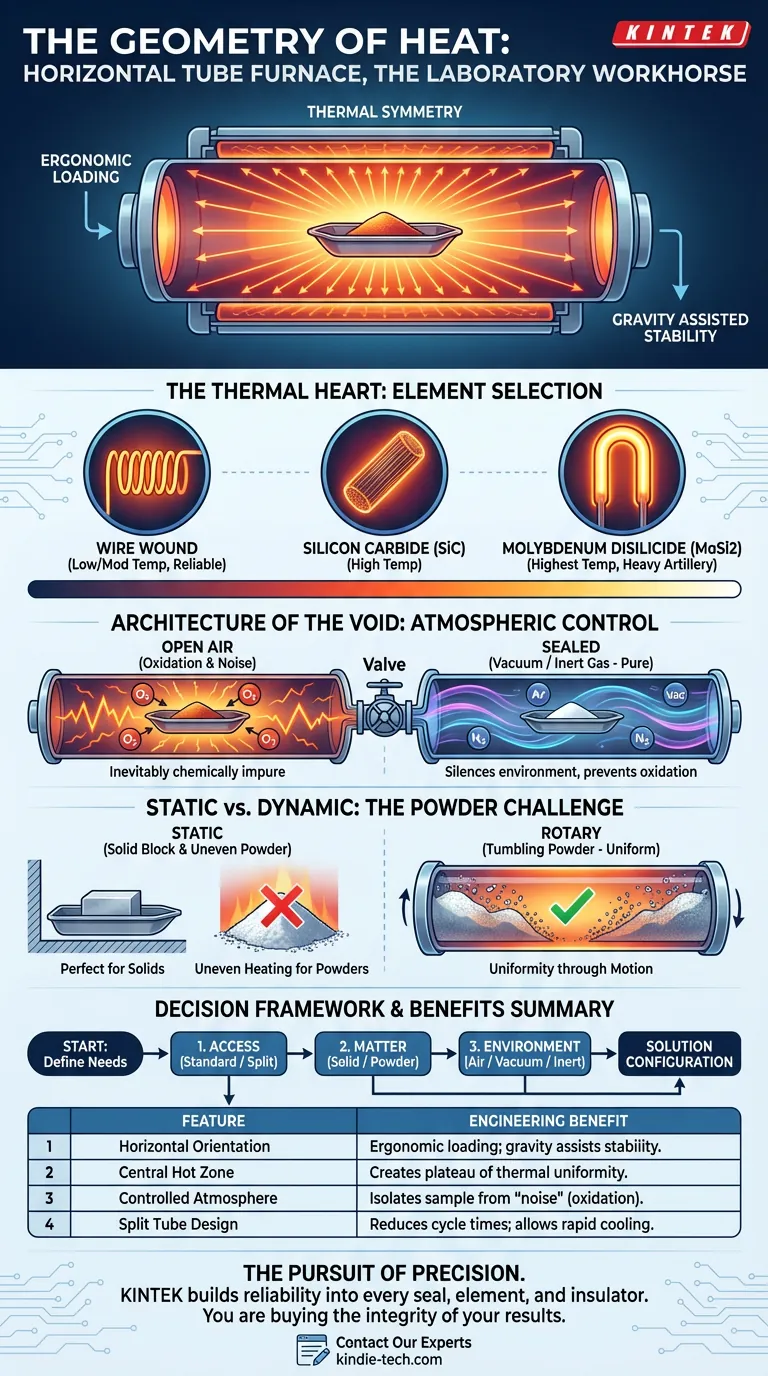
The Thermal Heart: Choosing Your Element
A furnace is defined by its ability to resist failure under stress. The "stress" here is heat.
The heating elements surrounding the process tube are the muscles of the system. Choosing them is not about finding the "hottest" option, but fitting the capability to the requirement.
- Wire Wound Elements: The standard for lower to moderate temperatures. Reliable and consistent.
- Silicon Carbide (SiC): The bridge to high-intensity thermal processing.
- Molybdenum Disilicide (MoSi2): The heavy artillery. Used for the highest temperature ranges where other metals would simply liquefy or oxidize.
The Architecture of The Void
The most romantic aspect of engineering is often what isn't there.
The true power of a KINTEK horizontal tube furnace is not just the heat it adds, but the air it removes.
In open-air furnaces, oxidation is inevitable. It is the chemical equivalent of noise. To hear the signal—the true reaction of the material—you must silence the environment.
By fitting sealed end caps to the tube, the furnace transforms into a vacuum chamber or a vessel for inert gases like argon or nitrogen. This allows for:
- Prevention of Oxidation: Keeping the sample chemically pure.
- Vacuum Processing: Removing volatile components effectively.
- Atmospheric Specificity: Creating a "reducing" environment for specialized metallurgy.
The Limitation of Stillness
However, we must confront the physics of the design.
The horizontal tube furnace is a master of static processing. The sample sits in the combustion boat, immobile.
For a solid block of metal or a ceramic wafer, this is perfect. But for powders? It is a compromise.
When you heat a pile of powder without moving it, the outer layer insulates the inner core. The heat gradient becomes uneven. The experiment loses its integrity.
The Rotary Alternative
If your material requires agitation—like calcining a powder where every particle needs to touch the atmosphere—the solution is the Rotary Tube Furnace. It tumbles the material, trading the simplicity of the static tube for the uniformity of motion.
The Decision Framework
Engineering is the art of trade-offs.
There is no "perfect" furnace. There is only the furnace that matches your specific constraints.
When consulting with laboratory managers, we often map their needs to the following architecture:
1. The Geometry of Access
- Standard Solid Tube: Best for routine, stable processing.
- Split Tube Design: The tube opens longitudinally. Essential if you need rapid cooling or struggle to position awkward samples.
2. The State of Matter
- Solid Objects: Horizontal Tube Furnace (Static).
- Loose Powders/Granules: Rotary Tube Furnace (Dynamic).
3. The Environment
- Air: Standard end caps.
- Vacuum/Inert Gas: Requires precision-engineered sealing systems and gas delivery modules.
Summary: Matching Feature to Benefit
| Feature | The Engineering Benefit |
|---|---|
| Horizontal Orientation | Ergonomic loading; gravity assists in sample stability. |
| Central Hot Zone | Creates a plateau of thermal uniformity essential for repeatable data. |
| Controlled Atmosphere | Isolates the sample from environmental "noise" (oxidation/contamination). |
| Split Tube Design | Reduces cycle times by allowing rapid cooling and easy access. |
The Pursuit of Precision
In the end, a furnace is a tool for discovery.
Whether you are sintering advanced ceramics or annealing semiconductors, the equipment should disappear into the background. It should work with such reliability that you forget it is there.
At KINTEK, we build that reliability into every seal, element, and insulator. We understand that you aren't just buying a machine; you are buying the integrity of your results.
If you are ready to configure a thermal processing system that matches the rigor of your research, we are ready to assist.
Visual Guide
Related Products
- Horizontal High Temperature Graphite Vacuum Graphitization Furnace
- Rotary Tube Furnace Split Multi Heating Zone Rotating Tube Furnace
- Vertical Laboratory Tube Furnace
- Laboratory Vacuum Tilt Rotary Tube Furnace Rotating Tube Furnace
- 1200℃ Split Tube Furnace with Quartz Tube Laboratory Tubular Furnace
Related Articles
- Unveiling Vacuum Graphite Furnaces: Performance, Applications, and Expert Insights
- Maximizing Efficiency and Precision with Vacuum Graphite Furnaces
- Optimizing Performance with Graphite Vacuum Furnaces: A Comprehensive Guide
- High-Temperature Vacuum Furnace: Classification, Applications, and Components
- Classification, Applications, and Components of High-Temperature Vacuum Furnaces



















