The Art of Exclusion
In the laboratory, success is rarely defined by what you add to a sample. It is defined by what you manage to keep out.
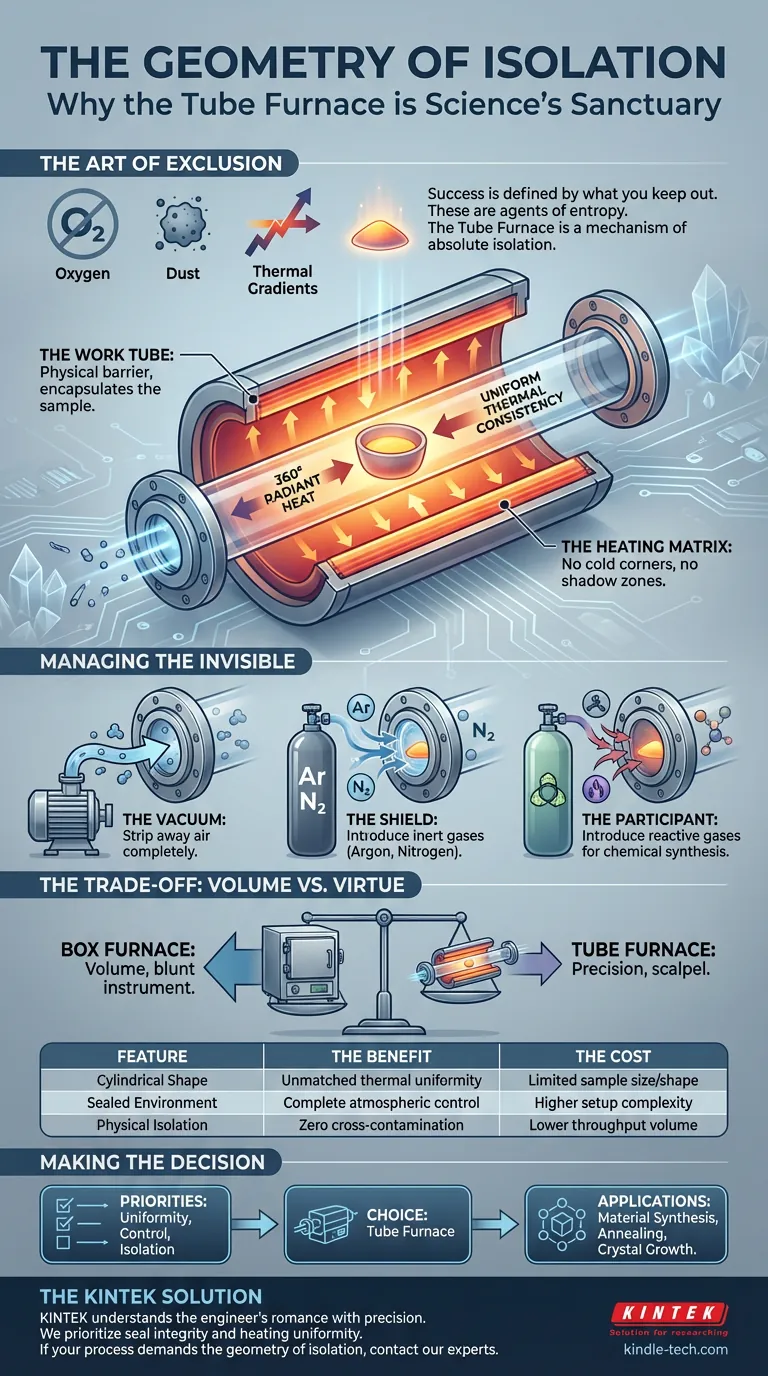
Oxygen. Dust. Thermal gradients. These are the agents of entropy. They are the invisible enemies of material synthesis and crystal growth. When a researcher needs to create something new—whether it is a high-purity semiconductor or a delicate inorganic compound—the open air is not a canvas. It is a contaminant.
This is where the tube furnace becomes more than just a heating device.
It acts as a sanctuary. It is a mechanism of absolute isolation.
By understanding the architecture of a tube furnace, we begin to understand a fundamental truth about advanced engineering: To control the outcome, you must first control the environment.
The Architecture of The Cylinder
The design of a tube furnace is deceptively simple, yet it represents a triumph of function over form.
Most heating devices are boxes. They are designed for volume. The tube furnace, however, is designed for focus.
The Work Tube
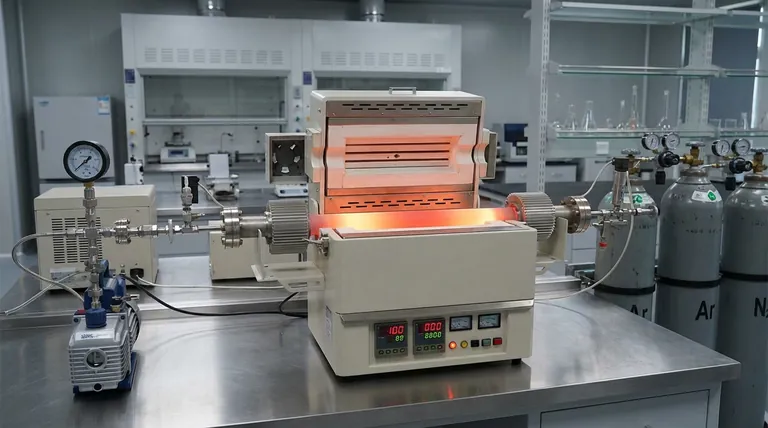
The core is the work tube, typically crafted from ceramic, quartz, or metal. The sample sits here. Unlike a box furnace, where the sample is merely "inside," here the sample is encapsulated. The tube creates a physical barrier between the material and the heating elements.
This separation is critical. It prevents the heating coils themselves from shedding contaminants onto your sample.
The Heating Matrix
Surrounding this tube are heating elements embedded in an insulating matrix. Because of the cylindrical geometry, heat radiates inward from 360 degrees.
There are no cold corners. There are no shadow zones.
This creates a thermal consistency that square geometries struggle to match. The heat distribution is uniform along the length of the tube, ensuring that one end of your sample experiences the exact same reality as the other.
Managing the Invisible
The true value of a tube furnace lies in its flanges.
By sealing the ends of the tube, operators can manipulate the atmosphere inside. This transforms the tube from a heater into a chemical reactor.
- The Vacuum: You can strip away the air completely, removing any molecules that might react with the sample.
- The Shield: You can introduce inert gases like argon or nitrogen, creating a "blanket" that prevents oxidation during annealing.
- The Participant: You can introduce reactive gases, allowing the atmosphere to become part of the chemical synthesis.
This capability makes the tube furnace indispensable. It allows you to pause the chaotic laws of nature—oxidation, corrosion, contamination—and substitute your own rules.
The Trade-off: Volume vs. Virtue
In engineering, there are no solutions, only trade-offs. The tube furnace is no exception.
The very geometry that grants it such precision also limits its utility. A tube has a fixed diameter. It cannot accommodate large, bulky, or irregularly shaped objects.
If you need to heat-treat a large engine part, the tube furnace is useless. You need a box furnace.
But if you need to grow a crystal where a single degree of variance ruins the batch? Or anneal a sample where a single molecule of oxygen corrupts the surface?
Then the box furnace is a blunt instrument, and the tube furnace is a scalpel.
Making the Decision
Choosing the right equipment is about understanding your priorities. It is a psychological sift between the desire for volume and the need for perfection.
Here is how to view the trade-offs:
| Feature | The Benefit | The Cost |
|---|---|---|
| Cylindrical Shape | Unmatched thermal uniformity | Limited sample size/shape |
| Sealed Environment | Complete atmospheric control | Higher setup complexity |
| Physical Isolation | Zero cross-contamination | Lower throughput volume |
Common Applications
- Material Synthesis: Where gas interaction is required.
- Annealing: Where preventing surface oxidation is non-negotiable.
- Crystal Growth: Where stability over long durations is required.
The KINTEK Solution
At KINTEK, we understand the engineer’s romance with precision. We know that for our clients, "good enough" is often a failed experiment.
Our tube furnaces are designed for those who cannot afford variance. We prioritize the integrity of the seal and the uniformity of the heating element, ensuring that the environment inside the tube is exactly what you designed it to be.
Whether you are pushing the boundaries of material science or ensuring standard compliance in quality control, the equipment should never be the variable.
If your process demands the geometry of isolation, Contact Our Experts to discuss how we can help you build the perfect environment for your research.
Visual Guide
Related Products
- Rotary Tube Furnace Split Multi Heating Zone Rotating Tube Furnace
- Laboratory Vacuum Tilt Rotary Tube Furnace Rotating Tube Furnace
- 1200℃ Split Tube Furnace with Quartz Tube Laboratory Tubular Furnace
- 1400℃ Laboratory High Temperature Tube Furnace with Alumina Tube
- 1700℃ Laboratory High Temperature Tube Furnace with Alumina Tube
Related Articles
- The Geometry of Heat: Why Motion Matters in Material Synthesis
- The Geometry of Heat: Engineering the Perfect Thermal Environment
- Exploring the Functions and Advantages of Rotary Tube Furnaces
- Exploring Rotary Tube Furnaces: A Comprehensive Guide
- Exploring the Advantages of Rotary Tube Furnaces in Industrial and Laboratory Applications



















