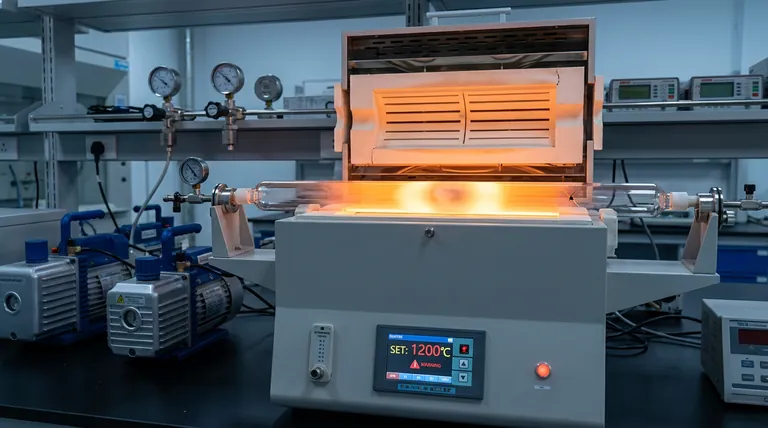
The Allure of a Single Number
In a busy lab, a specification sheet is a source of comfort. It provides clear, hard numbers in a world of complex variables. When the manual for a quartz tube furnace says "Max Temperature: 1200°C," the instinct is to trust it. It becomes the boundary on the map.
But then, a tube that never exceeded 1150°C cracks. An experiment run under vacuum fails when the tube deforms overnight.
This isn't a case of faulty equipment. It's a case of a psychological blind spot: we are drawn to simple numbers, but physics operates on a spectrum of conditions. The true maximum temperature of a quartz tube is not a static figure; it's a dynamic contract you negotiate with the material itself.
Why We Trust Quartz (And Why It Fails)
The material we call "quartz" in a lab setting is almost always high-purity fused silica. It's a marvel of material science, chosen for a triad of remarkable properties.
An Immunity to Shock
Fused silica has an incredibly low coefficient of thermal expansion. While ordinary glass shatters from the stress of rapid heating or cooling, quartz remains stoic. This resilience gives us confidence, sometimes too much.
Stability in the Heat
With a softening point near 1600°C, it remains rigid and structurally sound at temperatures that would melt lesser materials. It provides a clean, stable, and transparent environment for high-temperature processes.
Purity is Paramount
Its high purity prevents contamination, which is non-negotiable in fields like semiconductor manufacturing. It's a seemingly perfect window into extreme environments.
But every material has a breaking point. For quartz, failure isn't always a sudden event. It's often a slow degradation, accelerated by the very conditions we impose on it.
The Invisible Forces That Weaken the Glass
The number printed in the manual assumes ideal conditions. Your lab is the real world. Three invisible forces are constantly working to lower the effective maximum temperature of your quartz tube.
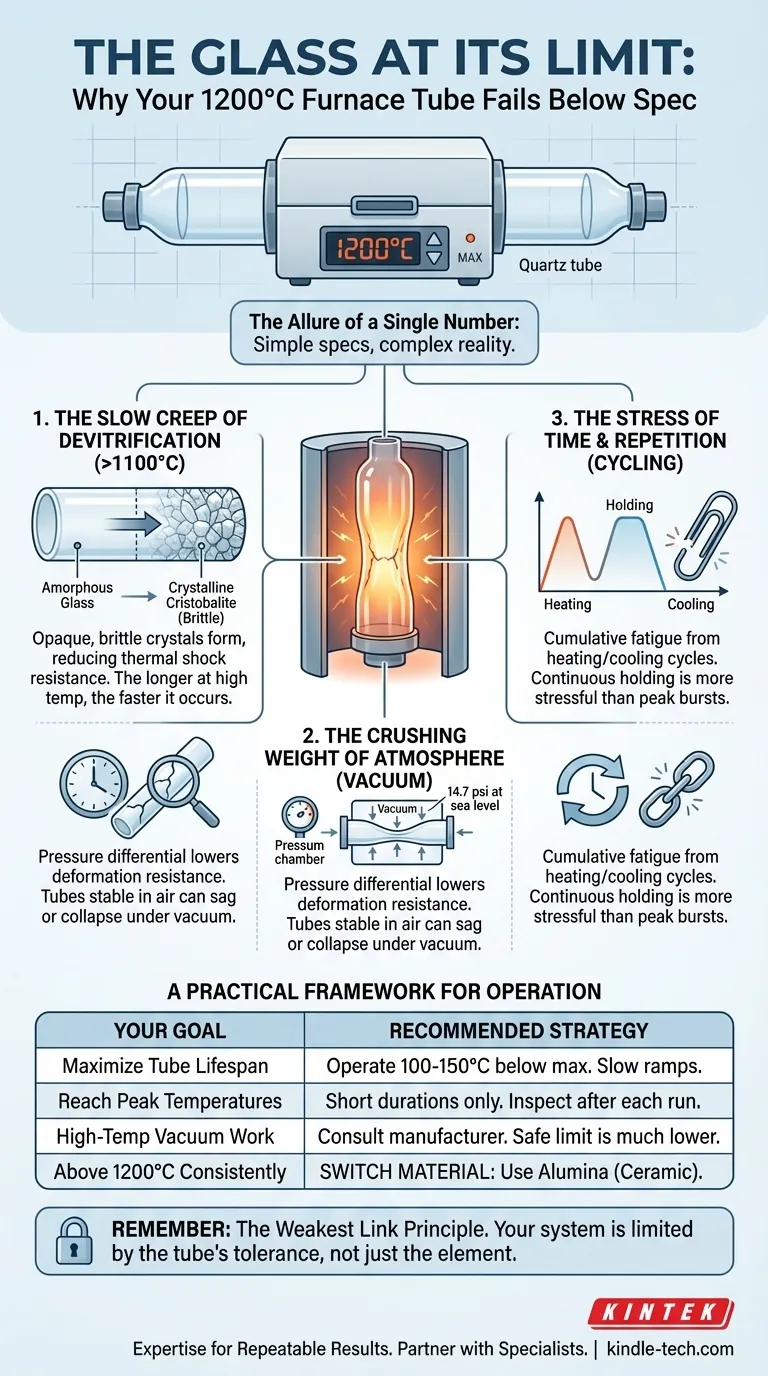
1. The Slow Creep of Devitrification
This is the primary enemy of a quartz tube. Above 1100°C, a subtle process begins. The amorphous, glass-like structure of fused silica starts to revert to a crystalline state called cristobalite.
This transformation, devitrification, is like a slow-motion disease. It turns the transparent glass opaque and, more critically, makes it profoundly brittle. A tube that was once resistant to thermal shock can now fail catastrophically. The longer you hold it at high temperatures, the faster this process occurs.
2. The Crushing Weight of the Atmosphere
Running a process under vacuum creates a significant pressure differential. At sea level, the outside atmosphere pushes on every square inch of the tube with 14.7 pounds of force.
While the tube is strong, this constant external pressure lowers its resistance to deformation at high temperatures. A tube that is perfectly stable at 1180°C in air might begin to sag or deform at a much lower temperature under vacuum.
3. The Stress of Time and Repetition
A maximum temperature rating is often a peak figure, not a continuous-use guarantee. Holding a tube at its limit for hours is far more stressful than reaching it for a few minutes.
Likewise, every heating and cooling cycle, no matter how controlled, imparts thermal stress. These cycles are like bending a paperclip back and forth; each one contributes to cumulative fatigue, eventually leading to failure.
A Practical Framework for Operation
Understanding these limits isn't about being overly cautious; it's about being effective. It's about ensuring your equipment serves your science reliably. Your operational strategy should be dictated by your primary goal.
| Your Goal | Recommended Operational Strategy |
|---|---|
| Maximize Tube Lifespan | Operate at least 100-150°C below the stated maximum continuous-use temperature. Use slow, controlled heating/cooling ramps. |
| Reach Peak Temperatures | Use temperatures near 1200°C for short durations only. Inspect the tube for any cloudiness (devitrification) after each run. |
| High-Temp Vacuum Work | Consult the manufacturer's specific guidance for vacuum use. The safe maximum temperature will be significantly lower than in air. |
| Above 1200°C Consistently | Quartz is the wrong material. You must switch to a ceramic alternative, such as an alumina tube, to ensure safety and success. |
Remember the "weakest link" principle: your furnace's heating element might be rated for 1500°C, but if your process tube is quartz, the entire system is limited by the tube's much lower tolerance.
Navigating these material science nuances is key to achieving repeatable and reliable results. Partnering with specialists who understand the interplay between equipment, materials, and process goals can prevent costly failures and accelerate your research. At KINTEK, we provide not just high-quality quartz tube furnaces, but the expertise to help you define the right operational parameters for your specific application.
To ensure your high-temperature processes are built on a foundation of safety and efficiency, Contact Our Experts.
Visual Guide
Related Products
- 1200℃ Split Tube Furnace with Quartz Tube Laboratory Tubular Furnace
- 1200℃ Controlled Atmosphere Furnace Nitrogen Inert Atmosphere Furnace
- 1200℃ Muffle Furnace Oven for Laboratory
- 1400℃ Laboratory High Temperature Tube Furnace with Alumina Tube
- Laboratory Rapid Thermal Processing (RTP) Quartz Tube Furnace
Related Articles
- The Unsung Hinge: Why Split Tube Furnaces Are a Quiet Revolution in Lab Workflow
- The Geometry of Heat: Why the Split Tube Furnace is an Engineer’s Best Ally
- A Comprehensive Guide to Split Tube Furnaces: Applications, Features
- From Crack to Complete: A Scientist's Guide to Eliminating Catastrophic Tube Furnace Failures
- The Architecture of Heat: Choosing Between Control and Capacity



















