Blog The Unsung Hinge: Why Split Tube Furnaces Are a Quiet Revolution in Lab Workflow
The Unsung Hinge: Why Split Tube Furnaces Are a Quiet Revolution in Lab Workflow

The Unsung Hinge: Why Split Tube Furnaces Are a Quiet Revolution in Lab Workflow

2 hours ago

The Final, Frustrating Barrier

Imagine this scene: A researcher has spent weeks meticulously assembling a complex glass reaction vessel. Sensors are perfectly placed, flanges are sealed, and a delicate sample is secured inside. The final step is thermal processing.

They approach the lab's high-temperature tube furnace, only to face a simple, unyielding reality. The apparatus, with its wide flanges, is physically too large to slide into the furnace's fixed cylindrical opening.

The experiment is stalled. The choice is to either redesign the entire setup—a compromise driven by the tool, not the science—or find a better tool. This is not just a logistical problem; it's a story of how equipment can impose unseen constraints on innovation.

The Tyranny of the Solid Tube

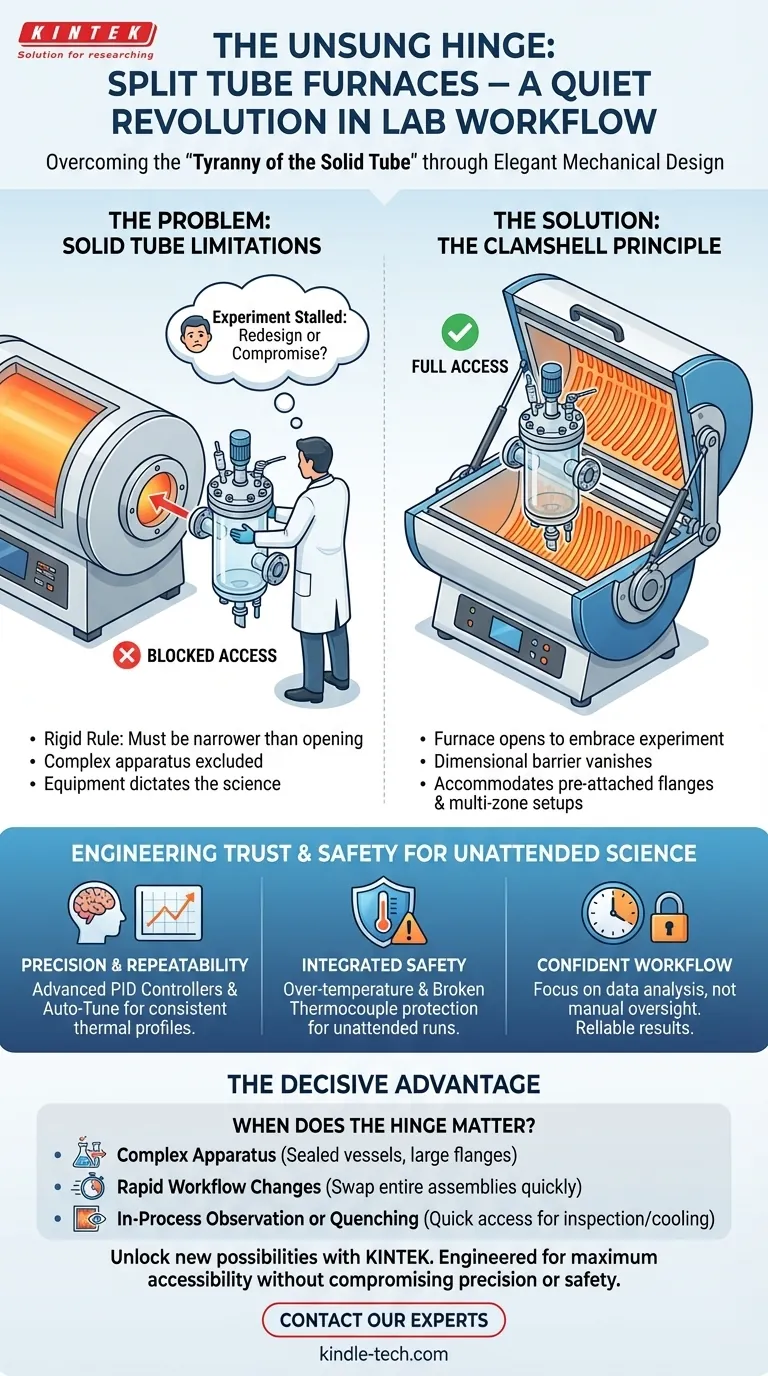
A standard tube furnace is a model of simplicity and efficiency. A heating element array surrounds a solid, continuous tube of insulation. It’s robust and excellent at creating a uniform thermal environment.

But this elegant simplicity creates a rigid rule: whatever goes in must be narrower than the opening.

For decades, this meant researchers designed their experiments around the furnace, not the other way around. Flanges had to be attached after the tube was inserted. Complex vessels were often out of the question. The tool, in its simplicity, dictated the boundaries of the work.

An Elegant Mechanical Answer: The Split

The split tube furnace is the direct, brilliant answer to this fundamental limitation. Its design is rooted in a single, powerful idea: instead of forcing the experiment into the furnace, what if the furnace opened to embrace the experiment?

The Clamshell Principle

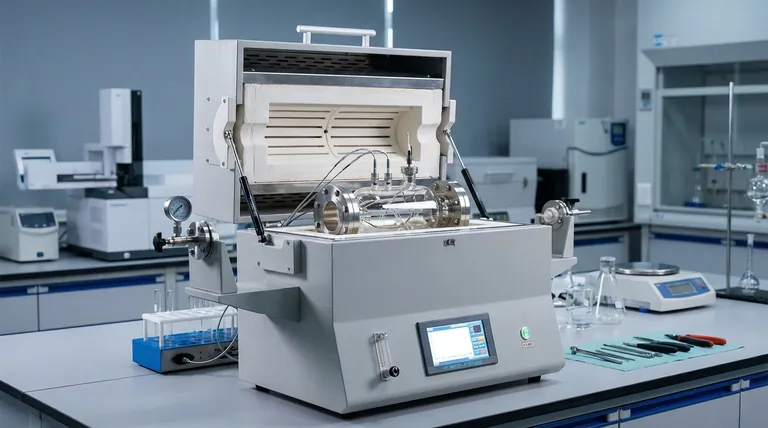
The furnace body is literally built in two halves, connected by a robust hinge. Latches secure it on the opposite side. When opened, often with the smooth assistance of pneumatic struts, the entire heating chamber is exposed from above.

This "clamshell" or "split" design changes everything.

The Barrier It Removes

The dimensional barrier vanishes. The researcher can now lower their entire, fully assembled apparatus directly into the bottom half of the heating chamber. The top half is then closed around it.

Work tubes with pre-attached, sealed flanges, multi-zone reaction chambers, or integrated sensor arrays are no longer a problem. The furnace adapts to the complexity of the experiment, liberating the scientist from a critical design constraint.

Engineering Trust for Unattended Science

Beyond its revolutionary access, the modern split tube furnace is a system designed to earn a researcher's trust. In a world of long-duration experiments that often run overnight, trust isn't a feature; it's the entire product.

The Quest for Repeatability

Precision is paramount. Advanced PID (Proportional-Integral-Derivative) controllers are the brain of the system, managing temperature with exceptional accuracy.

Features like PID Auto-Tune allow the furnace to "learn" the thermal properties of a specific payload, optimizing its heating and cooling cycles. This ensures that the results from Tuesday's experiment are perfectly repeatable on Thursday. It removes the equipment as a variable, which is the cornerstone of good science.

Designing for Inevitable Failure

Great engineering anticipates problems. Integrated safety mechanisms are not afterthoughts; they are core to the design.

  • Over-temperature protection acts as a vigilant supervisor, shutting the system down if a thermal limit is breached.
  • Broken thermocouple protection recognizes a sensor failure, preventing a dangerous thermal runaway that could destroy both the sample and the equipment.

These systems allow a researcher to press "start" and walk away with confidence, focusing on data analysis rather than manual oversight.

The Decisive Question: When Does the Hinge Matter?

While versatile, the split tube furnace is a specialist. Its value is unlocked in specific scenarios where its design provides a non-negotiable advantage.

Choosing a split tube furnace is the right decision if your work involves:

  • Complex Apparatus: You work with sealed reaction vessels, tubes with large end-flanges, or integrated probes that cannot be disassembled.
  • Rapid Workflow Changes: Your R&D or academic lab requires frequent swapping of entire experimental setups, not just samples. The ability to lift out a whole assembly and drop in another is a massive time-saver.
  • In-Process Observation or Quenching: The ability to quickly open the chamber allows for rapid cooling or visual inspection that is impossible with a solid tube furnace.

If your process is high-throughput processing of simple, uniform tubes, a standard furnace may suffice. But if your work prioritizes experimental flexibility and complex setups, the split design is essential.

At KINTEK, we build laboratory equipment that removes barriers. Our split tube furnaces are engineered for researchers who need maximum accessibility without compromising on precision or safety. We understand that the right tool doesn't just perform a task; it unlocks new possibilities.

To find the furnace that fits the demands of your research, Contact Our Experts.

Visual Guide
The Unsung Hinge: Why Split Tube Furnaces Are a Quiet Revolution in Lab Workflow Visual Guide

Related Products

Related Articles

Related Products

1200℃ Split Tube Furnace with Quartz Tube Laboratory Tubular Furnace

1200℃ Split Tube Furnace with Quartz Tube Laboratory Tubular Furnace

KT-TF12 split tube furnace: high-purity insulation, embedded heating wire coils, and max. 1200C. Widely used for new materials and chemical vapour deposition.

Split Chamber CVD Tube Furnace with Vacuum Station Chemical Vapor Deposition System Equipment Machine

Split Chamber CVD Tube Furnace with Vacuum Station Chemical Vapor Deposition System Equipment Machine

Efficient split chamber CVD furnace with vacuum station for intuitive sample checking and quick cooling. Up to 1200℃ max temperature with accurate MFC mass flowmeter control.

Rotary Tube Furnace Split Multi Heating Zone Rotating Tube Furnace

Rotary Tube Furnace Split Multi Heating Zone Rotating Tube Furnace

Multi zone rotary furnace for high-precision temperature control with 2-8 independent heating zones. Ideal for lithium ion battery electrode materials and high-temperature reactions. Can work under vacuum and controlled atmosphere.

Multi-zone Laboratory Tube Furnace

Multi-zone Laboratory Tube Furnace

Experience precise, efficient thermal testing with our Multi Zone Tube Furnace. Independent heating zones and temperature sensors allow for controlled high-temperature gradient heating fields. Order now for advanced thermal analysis!

Laboratory Vacuum Tilt Rotary Tube Furnace Rotating Tube Furnace

Laboratory Vacuum Tilt Rotary Tube Furnace Rotating Tube Furnace

Discover the versatility of Laboratory Rotary Furnace: Ideal for calcination, drying, sintering, and high-temperature reactions. Adjustable rotating and tilting functions for optimal heating. Suitable for vacuum and controlled atmosphere environments. Learn more now!

Vacuum Sealed Continuous Working Rotary Tube Furnace Rotating Tube Furnace

Vacuum Sealed Continuous Working Rotary Tube Furnace Rotating Tube Furnace

Experience efficient material processing with our vacuum-sealed rotary tube furnace. Perfect for experiments or industrial production, equipped with optional features for controlled feeding and optimized results. Order now.

Multi Heating Zones CVD Tube Furnace Machine Chemical Vapor Deposition Chamber System Equipment

Multi Heating Zones CVD Tube Furnace Machine Chemical Vapor Deposition Chamber System Equipment

KT-CTF14 Multi Heating Zones CVD Furnace - Precise Temperature Control and Gas Flow for Advanced Applications. Max temp up to 1200℃, 4 channels MFC mass flow meter, and 7" TFT touch screen controller.

1700℃ Laboratory High Temperature Tube Furnace with Alumina Tube

1700℃ Laboratory High Temperature Tube Furnace with Alumina Tube

Looking for a high-temperature tube furnace? Check out our 1700℃ Tube Furnace with Alumina Tube. Perfect for research and industrial applications up to 1700C.

Customer Made Versatile CVD Tube Furnace Chemical Vapor Deposition Chamber System Equipment

Customer Made Versatile CVD Tube Furnace Chemical Vapor Deposition Chamber System Equipment

Get your exclusive CVD furnace with KT-CTF16 Customer Made Versatile Furnace. Customizable sliding, rotating, and tilting functions for precise reactions. Order now!

Vertical Laboratory Tube Furnace

Vertical Laboratory Tube Furnace

Elevate your experiments with our Vertical Tube Furnace. Versatile design allows for operation under various environments and heat treatment applications. Order now for precise results!

Laboratory High Pressure Vacuum Tube Furnace

Laboratory High Pressure Vacuum Tube Furnace

KT-PTF High Pressure Tube Furnace: Compact split tube furnace with strong positive pressure resistance. Working temp up to 1100°C and pressure up to 15Mpa. Also works under controller atmosphere or high vacuum.

Laboratory Rapid Thermal Processing (RTP) Quartz Tube Furnace

Laboratory Rapid Thermal Processing (RTP) Quartz Tube Furnace

Get lightning-fast heating with our RTP Rapid Heating Tube Furnace. Designed for precise, high-speed heating and cooling with convenient sliding rail and TFT touch screen controller. Order now for ideal thermal processing!

High Temperature Alumina (Al2O3) Furnace Tube for Engineering Advanced Fine Ceramics

High Temperature Alumina (Al2O3) Furnace Tube for Engineering Advanced Fine Ceramics

High temperature alumina furnace tube combines the advantages of high hardness of alumina, good chemical inertness and steel, and has excellent wear resistance, thermal shock resistance and mechanical shock resistance.

1200℃ Controlled Atmosphere Furnace Nitrogen Inert Atmosphere Furnace

1200℃ Controlled Atmosphere Furnace Nitrogen Inert Atmosphere Furnace

Discover our KT-12A Pro Controlled atmosphere furnace - high precision, heavy duty vacuum chamber, versatile smart touch screen controller, and excellent temperature uniformity up to 1200C. Ideal for both laboratory and industrial application.

1700℃ Controlled Atmosphere Furnace Nitrogen Inert Atmosphere Furnace

1700℃ Controlled Atmosphere Furnace Nitrogen Inert Atmosphere Furnace

KT-17A Controlled atmosphere furnace: 1700℃ heating, vacuum sealing technology, PID temperature control, and versatile TFT smart touch screen controller for laboratory and industrial use.

Mesh belt controlled atmosphere furnace

Mesh belt controlled atmosphere furnace

Discover our KT-MB mesh belt sintering furnace - perfect for high-temperature sintering of electronic components & glass insulators. Available for open air or controlled atmosphere environments.

High Temperature Muffle Oven Furnace for Laboratory Debinding and Pre Sintering

High Temperature Muffle Oven Furnace for Laboratory Debinding and Pre Sintering

KT-MD High temperature debinding and pre-sintering furnace for ceramic materials with various molding processes. Ideal for electronic components such as MLCC and NFC.

Graphite Vacuum Furnace Bottom Discharge Graphitization Furnace for Carbon Materials

Graphite Vacuum Furnace Bottom Discharge Graphitization Furnace for Carbon Materials

Bottom-out graphitization furnace for carbon materials, ultra-high temperature furnace up to 3100°C, suitable for graphitization and sintering of carbon rods and carbon blocks. Vertical design, bottom discharging, convenient feeding and discharging, high temperature uniformity, low energy consumption, good stability, hydraulic lifting system, convenient loading and unloading.

Ultra-High Temperature Graphite Vacuum Graphitization Furnace

Ultra-High Temperature Graphite Vacuum Graphitization Furnace

The ultra-high temperature graphitization furnace utilizes medium frequency induction heating in a vacuum or inert gas environment. The induction coil generates an alternating magnetic field, inducing eddy currents in the graphite crucible, which heats up and radiates heat to the workpiece, bringing it to the desired temperature. This furnace is primarily used for graphitization and sintering of carbon materials, carbon fiber materials, and other composite materials.

Vacuum Heat Treat and Molybdenum Wire Sintering Furnace for Vacuum Sintering

Vacuum Heat Treat and Molybdenum Wire Sintering Furnace for Vacuum Sintering

A vacuum molybdenum wire sintering furnace is a vertical or bedroom structure, which is suitable for withdrawal, brazing, sintering and degassing of metal materials under high vacuum and high temperature conditions. It is also suitable for dehydroxylation treatment of quartz materials.


Leave Your Message



















