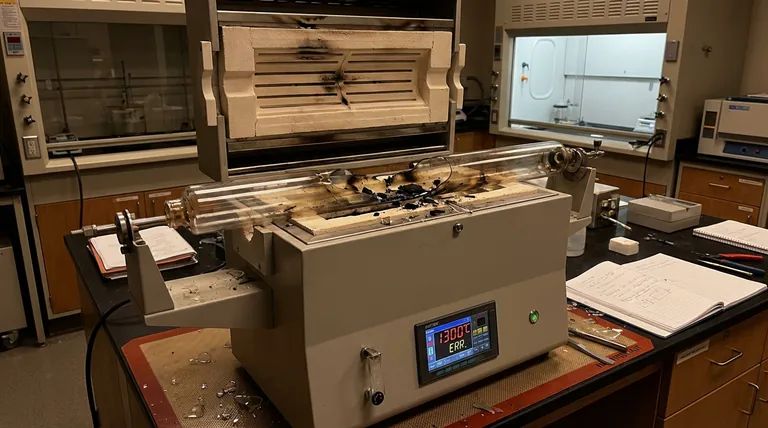
The Anatomy of a Failed Experiment
Imagine this: The experiment is critical. The sample is priceless. You program the tube furnace to 1300°C, confident in the digital display and the spec sheet that boasts of even higher capabilities. You return hours later to a disaster—a cracked, warped quartz tube, a compromised atmosphere, and a completely ruined sample.
This scenario is frustratingly common. The failure isn't in the furnace's heating elements, but in a psychological blind spot. We are biased to trust the machine's maximum power, forgetting that a system is only as strong as its most vulnerable component. In a high-temperature furnace, that component is almost always the quartz tube.
A System, Not Just a Heater
The heating elements in a modern furnace are often marvels of engineering, capable of reaching extreme temperatures. But the furnace isn't just a heater; it's a controlled environment. The centerpiece of that environment—the quartz tube—is what dictates the operational reality.
The furnace's controller is programmed with a temperature limit not because the heaters can't go higher, but to protect the tube from self-destruction. The true operational ceiling is defined by the physics of the glass, not the power of the electronics.
Understanding Quartz: A Material's Point of View
To use a tool effectively, you must respect its nature. For a quartz tube, this means understanding its relationship with heat.
The Deceptive "Melting" Point
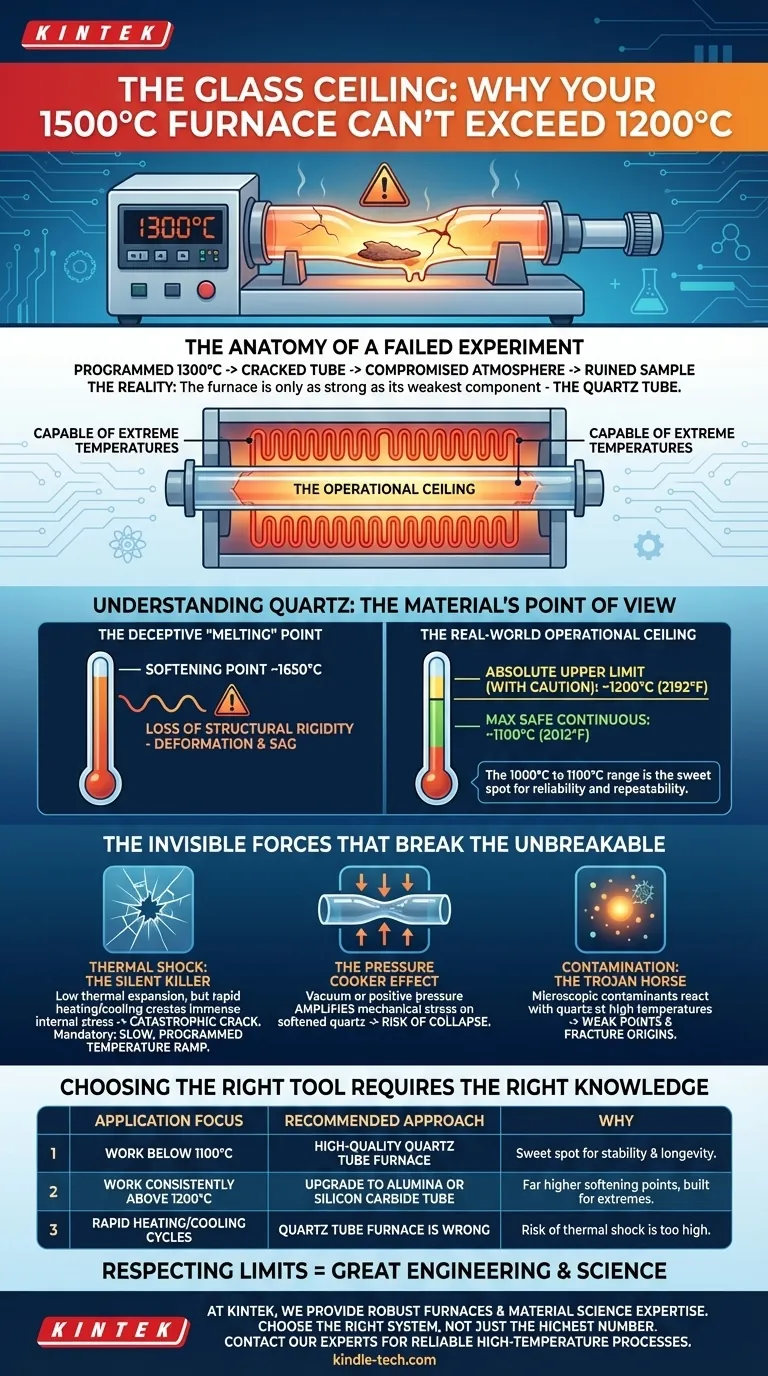
Metals have a clear, sharp melting point. Glass does not. Quartz has a softening point, which for high-purity fused quartz is around 1650°C.
But this number is a siren's call for anyone running an experiment. Long before it "melts," the tube will lose its structural rigidity. It will begin to sag under its own weight or deform under vacuum or pressure, destroying the integrity of your process. Operating anywhere near this theoretical limit is courting failure.
The Real-World Operational Ceiling
To ensure reliability and repeatability, we operate far below the softening point. This creates a safety margin against deformation and failure.
- Maximum Safe Continuous Temperature: ~1100°C (2012°F)
- Absolute Upper Limit (with caution): ~1200°C (2192°F)
The common 1000°C to 1100°C range is the sweet spot for a vast array of applications, from annealing semiconductors to growing novel materials through chemical vapor deposition. It's the temperature at which you get performance without compromising the equipment.
The Invisible Forces That Break the Unbreakable
Pushing past 1200°C is not just about the risk of the tube turning soft. It introduces other, more insidious failure modes.
Thermal Shock: The Silent Killer
Quartz has an extremely low coefficient of thermal expansion, which is why it's so useful. But it is not immune to thermal shock.
Heating or cooling the tube too quickly creates immense internal stress between the hotter surface and the cooler core. This stress finds a microscopic flaw and creates a catastrophic crack. A slow, programmed temperature ramp is not just a best practice; it is a mandatory protocol for the tube's survival.
The Pressure Cooker Effect
Running a process under vacuum or positive pressure adds another layer of stress. As the quartz tube heats up and softens, this mechanical stress is amplified. A tube that is perfectly stable at 1100°C in ambient pressure might be at risk of collapse under a deep vacuum at the same temperature.
Contamination: The Trojan Horse
In materials science, cleanliness is paramount for results. In furnace operation, it's also critical for safety. A microscopic speck of a contaminant can react with the quartz at high temperatures, creating a weak point or a localized hot spot that becomes the origin point for a fracture.
Choosing the Right Tool Requires The Right Knowledge
Success in high-temperature work isn't about having the most powerful furnace; it's about matching the equipment to the scientific need while respecting the material limits.
| Application Focus | Recommended Approach | Why |
|---|---|---|
| Work Below 1100°C | A high-quality quartz tube furnace is the ideal, cost-effective tool. | You are operating in the material's sweet spot for stability and longevity. |
| Work Consistently Above 1200°C | Upgrade to a system with an alumina or silicon carbide tube. | These materials have far higher softening points and are built for extremes. |
| Rapid Heating/Cooling Cycles | A quartz tube furnace is the wrong instrument. | The risk of thermal shock is too high for reliable, repeatable results. |
Ultimately, great engineering—and great science—is the art of respecting limits. By understanding that the fragile quartz tube is the true heart of the furnace, you can design experiments that succeed.
At KINTEK, we provide robust laboratory furnaces and the material science expertise to go with them. We help you choose the right system—not just the one with the highest number on the box—to ensure your work is both ambitious and successful. For laboratories seeking to master high-temperature processes with reliable and perfectly-matched equipment, our team is here to help. Contact Our Experts
Visual Guide
Related Products
- 1400℃ Laboratory High Temperature Tube Furnace with Alumina Tube
- 1200℃ Split Tube Furnace with Quartz Tube Laboratory Tubular Furnace
- Laboratory Rapid Thermal Processing (RTP) Quartz Tube Furnace
- 1700℃ Laboratory High Temperature Tube Furnace with Alumina Tube
- High Temperature Alumina (Al2O3) Furnace Tube for Engineering Advanced Fine Ceramics
Related Articles
- The Clockwork of Cooling: Why Inert Gas is the Unsung Hero of High-Temperature Furnaces
- Why Your High-Temperature Furnace Failed—And How to Prevent It From Happening Again
- Why Your High-Temperature Experiments Fail: The Furnace Flaw Most Labs Overlook
- Why Your High-Temperature Furnace Fails—And How to Choose the Right One
- Why Your High-Temperature Experiments Fail: It's Not the Heat, It's the Furnace



















