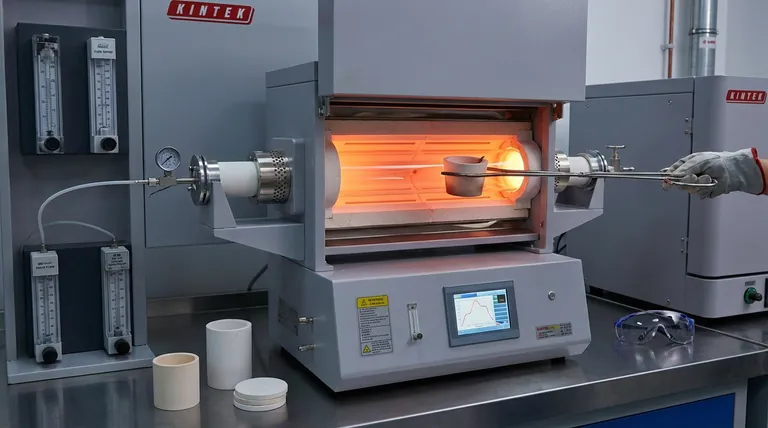
The Illusion of Simple Heat
Fire is primal. For millennia, we've used it to transform materials. But moving from a blacksmith's chaotic forge to the nanometer-scale precision of modern materials science requires a profound shift in thinking.
We don't just need heat; we need a perfectly controlled, contained, and predictable thermal environment.
This is the world of the tube furnace. It's not just a box that gets hot. It is an instrument designed to master the physics of thermal energy transfer. Understanding its principles is less about operating a machine and more about conducting an orchestra of electrons and photons.
Deconstructing the Inferno: A System of Four Parts
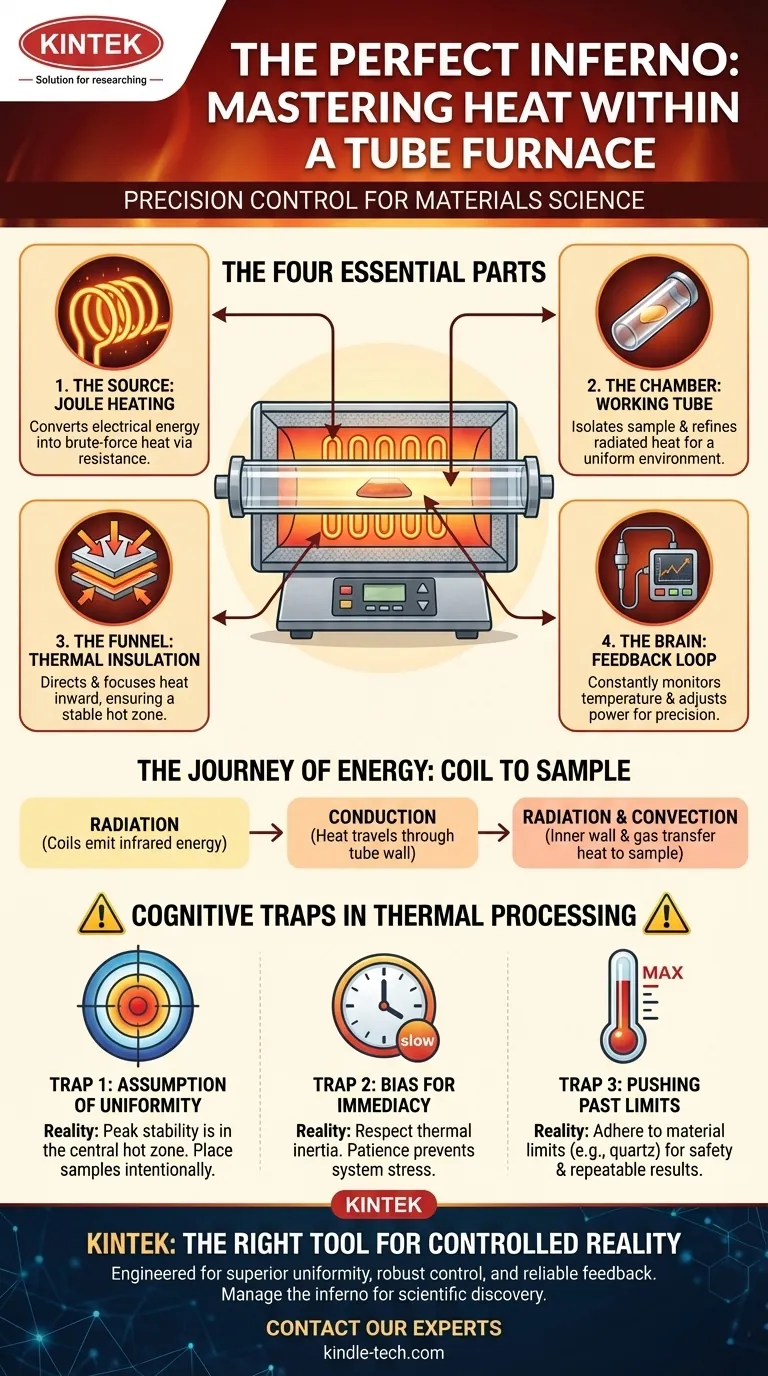
At its heart, a tube furnace is an elegant system that converts electrical energy into a stable thermal field. Its design can be broken down into four critical, interlocking concepts.
1. The Source: Joule Heating
The engine of the furnace is a principle every engineer knows: electrical resistance. Coiled heating elements, often made of robust alloys, encircle the core of the machine.
When current flows through them, their resistance acts like a bottleneck, converting electrical energy into heat. This is Joule heating—the same phenomenon that makes your toaster glow, but engineered for extreme temperatures and endurance. It is the raw, brute-force source of the inferno.
2. The Chamber: The Working Tube
The sample never touches the heating elements. It resides inside a separate cylindrical chamber—the working tube. This tube is the crucible, the stage where the transformation happens.
Crafted from materials like quartz or high-purity alumina, the tube's purpose is twofold. First, it isolates the sample chemically and physically. Second, it receives the raw radiated heat from the elements and refines it, creating a more uniform thermal environment inside. The choice of tube material is the first critical decision in designing an experiment.
3. The Funnel: Thermal Insulation
Surrounding the heating elements is a thick matrix of thermal insulation. Its most obvious job is preventing heat from escaping, which is a matter of efficiency and safety.
But its more subtle, and arguably more important, role is to act as a thermal funnel. The insulation doesn't just block heat; it reflects and directs it inward, focusing the energy onto the working tube. Without this, achieving a stable and uniform hot zone would be impossible.
4. The Brain: The Feedback Loop
Raw power is useless without control. A thermocouple—a sensitive temperature probe—acts as the furnace's nervous system, constantly reporting the temperature back to a digital controller.
This controller is the brain. It compares the real-time temperature to the desired setpoint and constantly adjusts the power flowing to the heating elements. This closed-loop feedback system is what transforms a simple heater into a precision scientific instrument.
The Journey of Energy: From Coil to Sample
Understanding the components is only half the story. The true genius of the design lies in how heat travels from its source to the sample.
Radiation is king. The primary mechanism is thermal radiation. The incandescent heating elements emit infrared energy, which travels through the space and is absorbed by the outer wall of the working tube.
Conduction takes over. Once the tube wall is hot, that energy conducts through the ceramic or quartz material to the inner wall.
Convection and radiation finish the job. Inside the tube, the inner wall radiates heat onto the sample. If a gas atmosphere is present, convection currents will also swirl and circulate, helping to transfer heat uniformly. This multi-stage journey is what smooths out the raw energy from the coils into the stable environment needed for research.
The Psychology of Thermal Processing: Three Cognitive Traps
A tube furnace's operation is governed by physics, but its successful use is often a matter of psychology. The system has inherent traits that can mislead the impatient or unwary researcher.
Trap 1: The Assumption of Uniformity
We see a single temperature on the controller and assume the entire tube is at that exact temperature. This is a cognitive shortcut that doesn't match reality.
Every tube furnace has a central "hot zone" of peak stability. Temperatures fall off near the ends. Success depends on acknowledging this physical reality and placing the sample with intention, not assuming the machine's display tells the whole story.
Trap 2: The Bias for Immediacy
We want things to happen now. But the very insulation that makes a furnace stable also gives it high thermal mass. It cannot heat up or cool down instantly.
Fighting this—by trying to force rapid temperature changes—stresses the system and can ruin experiments. Working with a tube furnace requires a kind of patience, an acceptance of the physical law of thermal inertia. You must work with its rhythm, not against it.
Trap 3: Pushing Past Known Limits
The maximum temperature is not a suggestion; it is a hard limit dictated by the material science of the working tube. A quartz tube, for instance, will begin to soften and deform if pushed beyond its specified range.
The temptation to push for "just a few more degrees" is a classic human error. Respecting the physical boundaries of the equipment is paramount for both safety and repeatable results.
The Right Tool for a Controlled Reality
Ultimately, understanding the principles of a tube furnace is about controlling reality on a microscopic level. Whether you are annealing a new alloy, synthesizing a nanomaterial, or growing a crystal, you are leveraging these fundamentals.
At KINTEK, our tube furnaces are designed with a deep appreciation for this interplay of physics and practical application. We engineer our systems for superior temperature uniformity, robust atmospheric control, and reliable feedback loops, because we know that managing the inferno is the key to discovery. By providing a stable, predictable, and precisely controlled thermal environment, we empower you to focus on the science.
If your work demands unwavering control over heat and atmosphere, let's discuss how the right instrument can eliminate these variables. Contact Our Experts
Visual Guide
Related Products
- Rotary Tube Furnace Split Multi Heating Zone Rotating Tube Furnace
- High Temperature Alumina (Al2O3) Furnace Tube for Engineering Advanced Fine Ceramics
- Laboratory Vacuum Tilt Rotary Tube Furnace Rotating Tube Furnace
- 1200℃ Split Tube Furnace with Quartz Tube Laboratory Tubular Furnace
- 1400℃ Laboratory High Temperature Tube Furnace with Alumina Tube
Related Articles
- The Geometry of Heat: Why Motion Matters in Material Synthesis
- Exploring the Functions and Advantages of Rotary Tube Furnaces
- Exploring the Benefits and Applications of Rotary Furnaces: A Comprehensive Guide
- The Physics of Perfection: How Rotary Furnaces Eliminate Randomness in Material Processing
- The Geometry of Heat: Engineering the Perfect Thermal Environment



















