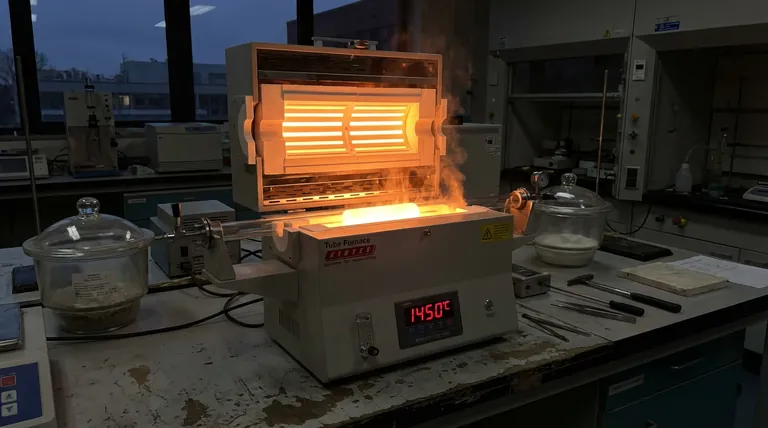
The Allure of the Maximum Specification
An engineer specifies a material that requires sintering at 1450°C. In the lab sits a vacuum tube furnace, its specification sheet proudly stating a maximum operating temperature of precisely 1450°C. On paper, the tool matches the task.
This is a common scenario. It’s also a psychological trap.
We are conditioned to see maximum ratings as an invitation—a capability to be used. In the world of material science and high-temperature equipment, however, a maximum rating is often not a routine operating point. It is a cliff edge. Operating there transforms the nature of the tool, introducing a cascade of compromises that are rarely detailed on the spec sheet.
The Physics of the Edge
At lower temperatures, a ceramic work tube inside a furnace is a stable, durable, and largely permanent component. It defines the controlled atmosphere where the work happens.
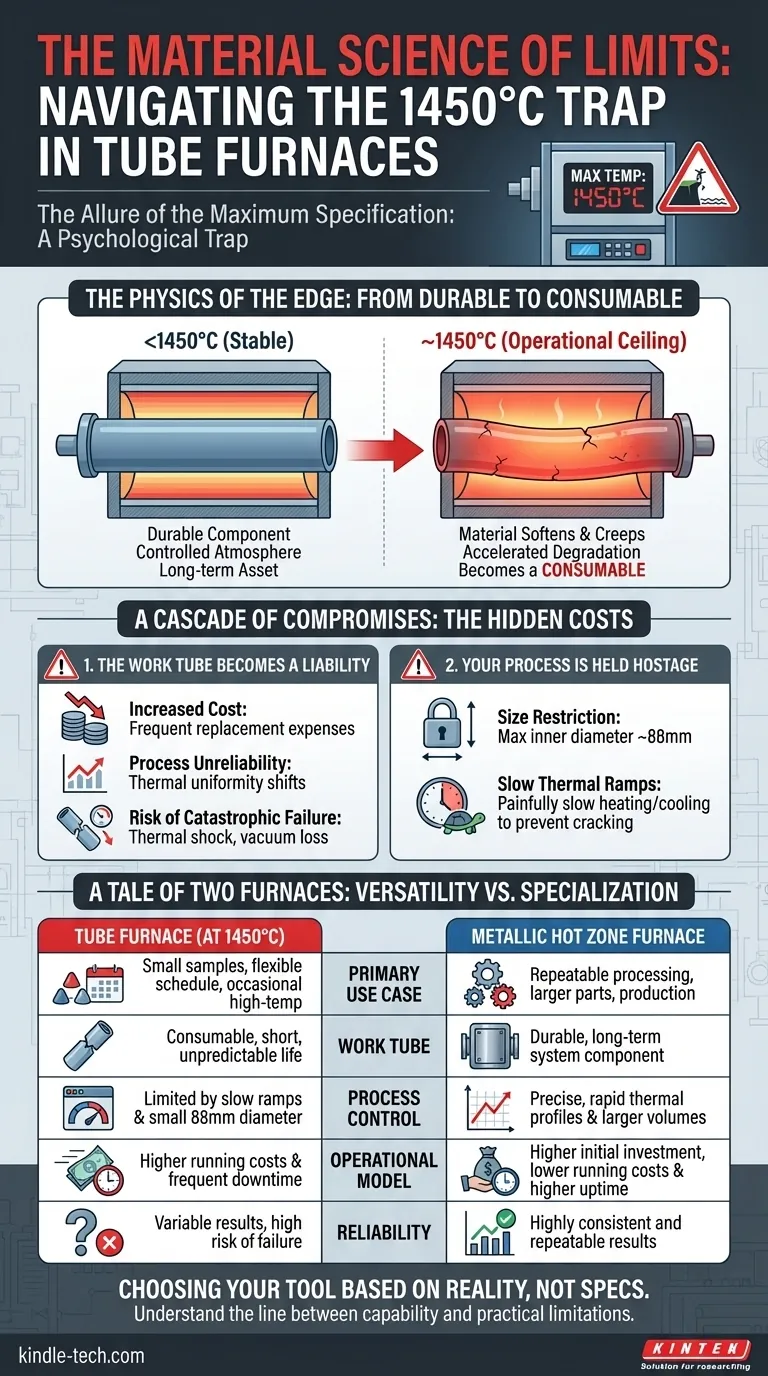
As the temperature climbs towards 1450°C, the tube's material—often high-purity alumina—approaches its operational ceiling. At this point, its physical properties change dramatically. The material begins to soften, creep, and degrade at an accelerated rate.
The furnace undergoes a fundamental identity shift. What was once a durable part of the machine is now a consumable, as fleeting as the samples it processes. This single fact changes everything.
A Cascade of Compromises
Pushing a tube furnace to its thermal limit forces a series of operational trade-offs that constrain your process, increase your costs, and jeopardize your results.
Compromise 1: The Work Tube Becomes a Liability
The most immediate consequence is the tube’s limited lifetime. It is no longer a part of the furnace; it is an ongoing operational expense.
- Increased Cost: You must now budget for frequent tube replacements. An initially lower capital investment can quickly be eclipsed by recurring consumable costs.
- Process Unreliability: As a tube degrades, its thermal uniformity can shift, introducing variability into your process. An experiment run at the beginning of a tube's life may not yield the same result as one run near its end.
- Risk of Catastrophic Failure: A degraded tube can crack from thermal shock or mechanical stress, causing a sudden loss of vacuum. This can ruin your sample and potentially damage the furnace's heating elements.
Compromise 2: Your Process is Held Hostage
To manage the extreme stress on the tube, the furnace's operating parameters must be severely restricted. Your research goals are now dictated by the limitations of the equipment.
- Size Restriction: To maintain structural integrity, the work tube’s inner diameter is strictly limited, often to a maximum of 88 mm. This immediately disqualifies larger parts or higher-volume batch processing.
- Slow Thermal Ramps: To prevent the brittle, stressed tube from cracking, heating and cooling rates must be painfully slow. Processes requiring rapid quenching or specific thermal profiles become impossible, and overall cycle times increase dramatically.
A Tale of Two Furnaces: Versatility vs. Specialization
The limitations of a tube furnace at 1450°C are not a design flaw. They are a reflection of its intended purpose: versatility.
The Laboratory Workhorse: The Tube Furnace
Tube furnaces are the generalists of the thermal processing world. They are designed for periodic operation across a wide range of temperatures, ideal for a research lab exploring many different materials and processes. They offer flexibility, but at the extreme edge of their capability, they demand compromise.
The High-Temperature Specialist: The Metallic Hot Zone Furnace
For sustained, reliable work at 1450°C and above, a different architecture is required. Metallic hot zone furnaces are specialists.
Instead of a ceramic tube and fiber insulation, they use a thermal chamber constructed from high-temperature metals like molybdenum or tungsten. Heat is managed by multiple layers of reflective shielding, not absorbent insulation. This design is inherently more robust, provides a cleaner vacuum environment, and is built for repeatable, demanding industrial and research applications.
Choosing Your Tool Based on Reality, Not Specs
The right choice is not about which furnace is "better," but which furnace aligns with the reality of your application. The decision requires looking past the single data point of maximum temperature.
| Focus Area | Tube Furnace at 1450°C | Metallic Hot Zone Furnace |
|---|---|---|
| Primary Use Case | Small samples, flexible schedule, occasional high-temp runs | Repeatable processing, larger parts, production, sensitive materials |
| Work Tube | A consumable with a short, unpredictable life | A durable, long-term component of the system |
| Process Control | Limited by slow ramps & small 88mm diameter | Allows for precise, rapid thermal profiles and larger volumes |
| Operational Model | Higher running costs (tubes) & frequent downtime | Higher initial investment, lower running costs & higher uptime |
| Reliability | Variable results, high risk of failure | Highly consistent and repeatable results |
Understanding the line between a tool's capability and its limitations is the essence of great engineering. A specification sheet tells you what is possible; deep operational knowledge tells you what is practical. The right furnace is not just about hitting a number; it's about achieving reliable, repeatable results under demanding conditions. At KINTEK, we provide the specialized lab equipment and consumables to ensure your work is built on a foundation of reliability.
If you're facing these high-temperature challenges, Contact Our Experts to align your equipment with your ambition.
Visual Guide
Related Products
- 1400℃ Laboratory High Temperature Tube Furnace with Alumina Tube
- 1700℃ Laboratory High Temperature Tube Furnace with Alumina Tube
- High Temperature Alumina (Al2O3) Furnace Tube for Engineering Advanced Fine Ceramics
- 1400℃ Muffle Oven Furnace for Laboratory
- Laboratory High Pressure Vacuum Tube Furnace
Related Articles
- The Clockwork of Cooling: Why Inert Gas is the Unsung Hero of High-Temperature Furnaces
- Why Your High-Temperature Furnace Failed—And How to Prevent It From Happening Again
- Why Your High-Temperature Experiments Fail: The Furnace Flaw Most Labs Overlook
- Why Your High-Temperature Furnace Fails—And How to Choose the Right One
- Why Your High-Temperature Experiments Fail: It's Not the Heat, It's the Furnace



















