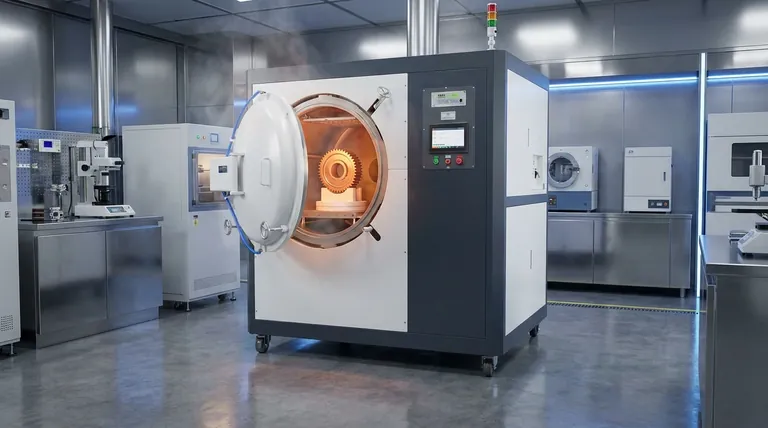
The Unseen Enemy of Strength
In the world of metallurgy, heat is the primary tool for transformation. We use it to harden, soften, and strengthen metals. But the very act of heating a part introduces a formidable adversary: the air around it.
At high temperatures, the oxygen in our atmosphere becomes an aggressive agent of chaos. It attacks the metal's surface, forming a brittle, discolored layer of scale. This oxidation is not just a cosmetic flaw; it's a form of contamination that can compromise the integrity of the final component.
Conventional heat treatment is a constant battle against this chaos. It accepts surface contamination as a necessary evil, often requiring costly and time-consuming secondary steps like sandblasting or machining to clean the part.
It's Not the Heat, It's the Environment
The fundamental breakthrough of vacuum heat treatment lies in a simple, profound shift in thinking. The goal is not just to apply heat, but to achieve absolute control over the part's environment while it is being heated and cooled.
It’s the difference between trying to perform delicate surgery in a dust storm versus in a sterile operating room. By removing the atmosphere, you remove the primary variable of contamination.
The Conventional Approach: An Uncontrolled Reaction
In a traditional furnace, hot metal is at the mercy of its surroundings. Heat is transferred via convection, where currents of hot gas swirl around the part. This can lead to uneven heating, creating hot spots and internal stresses that cause distortion and warping.
Quenching—the rapid cooling phase—is often a violent plunge into oil or water. This thermal shock is effective for hardening but can be brutal on parts with complex geometries, locking in stress that can lead to premature failure.
The Vacuum Approach: The Elegance of Absence
A vacuum furnace begins by creating a near-perfect void. Powerful pumps remove the air, and with it, the oxygen. The battle against oxidation is won before it even begins.
Inside this controlled void, heat is not carried by unpredictable air currents. Instead, it radiates directly from heating elements to the part. This radiant energy is remarkably uniform, ensuring every surface, every corner, and every thin section of the component heats at the precisely the same rate. Cooling is equally precise, often using a backfill of high-pressure inert gas for a controlled, rapid quench that minimizes thermal shock.
The Tangible Results of an Intangible Void
This mastery over the environment translates directly into superior engineering outcomes. The absence of atmosphere creates a presence of quality.
-
Pristine Surfaces, By Design: Parts emerge from a vacuum furnace clean, bright, and free of scale. They look exactly as they did going in, often eliminating the need for post-treatment finishing.
-
Dimensional Stability: Uniform heating and controlled cooling drastically reduce the risk of warping and distortion. For components with tight tolerances, like aerospace gears or medical implants, this is not a luxury; it is a necessity.
-
Digital Certainty: The entire process is managed by a computer. Every parameter—from the vacuum level to the temperature ramp rate and quench speed—is precisely executed and recorded. This replaces analog guesswork with digital repeatability, ensuring the first part and the thousandth part are identical.
-
Enhanced Metallurgical Properties: This level of control allows engineers to fine-tune the metallurgical structure of the material, unlocking its full potential for hardness, durability, and fatigue resistance.
The Deliberate Choice for Critical Components
Vacuum heat treatment is not a universal replacement for all thermal processes. It represents a significant investment in equipment and requires specialized operational knowledge. The cycle times can be longer due to the need to pump down the chamber.
But these are not drawbacks; they are trade-offs. The decision to use a vacuum furnace is a conscious choice for applications where the cost of failure is unacceptably high.
| Feature | Vacuum Furnace | Conventional Furnace |
|---|---|---|
| Environment | Near-perfect vacuum, inert | Air or gas atmosphere |
| Surface Finish | Clean, bright, scale-free | Oxidized, discolored, requires cleaning |
| Heating Uniformity | Excellent (radiant heat) | Variable (convection currents) |
| Distortion Risk | Very low | High, especially with complex geometries |
| Process Control | Precise, computer-controlled, highly repeatable | Less precise, operator-dependent |
| Best For | High-value parts where integrity is non-negotiable | Simple, low-cost parts where finish is secondary |
When you cannot afford contamination, distortion, or inconsistency, the controlled environment of a vacuum furnace is the only logical path. For the most demanding applications in aerospace, medical devices, and high-performance tooling, it is the standard for achieving perfection.
As specialists in advanced laboratory and production equipment, KINTEK provides the state-of-the-art vacuum furnace solutions needed to achieve this level of control and quality. We understand that for your most critical components, excellence is not an accident—it is engineered.
To ensure your parts meet the highest standards of integrity and performance, Contact Our Experts.
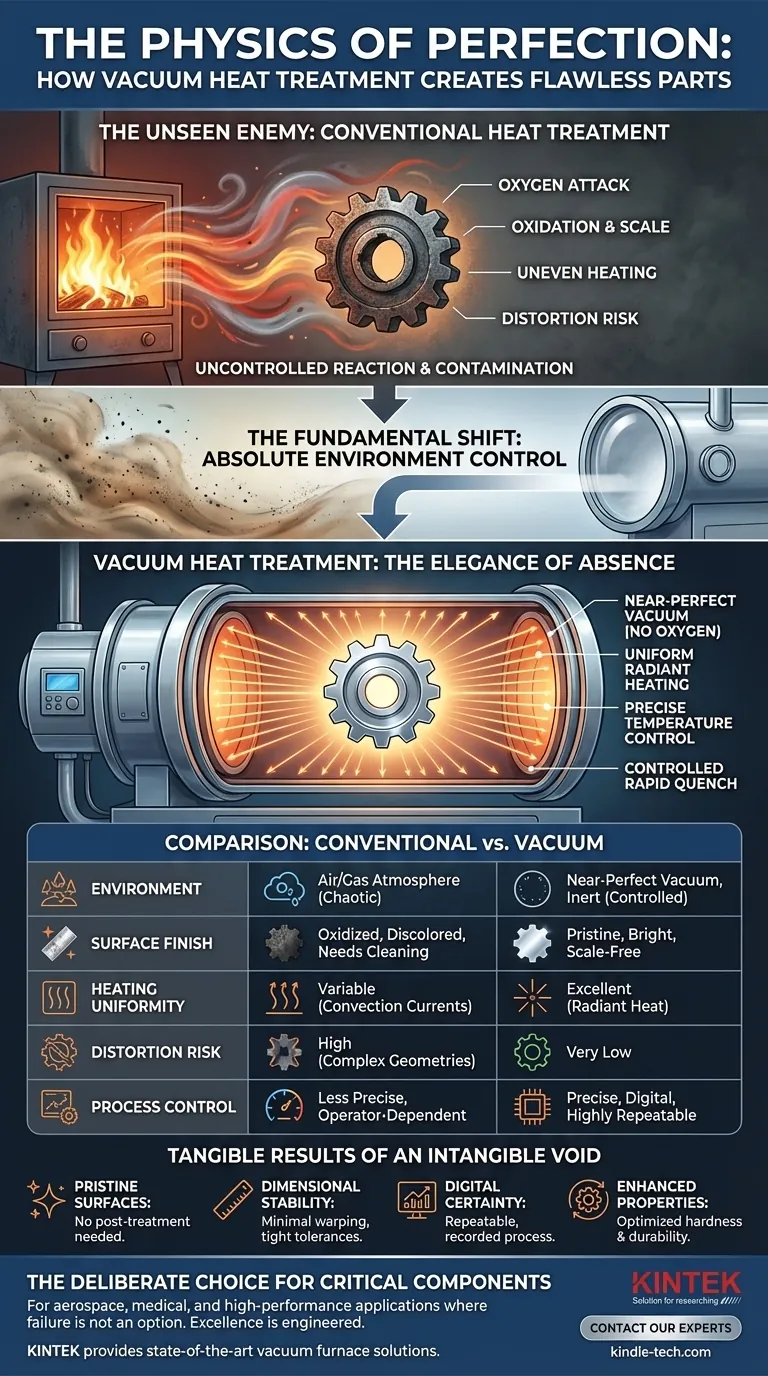
Visual Guide
Related Products
- Vacuum Heat Treat Sintering Brazing Furnace
- Vacuum Heat Treat Furnace with Ceramic Fiber Liner
- 2200 ℃ Graphite Vacuum Heat Treat Furnace
- Vacuum Heat Treat and Pressure Sintering Furnace for High Temperature Applications
- Small Vacuum Heat Treat and Tungsten Wire Sintering Furnace
Related Articles
- The Art of the Void: Why Absence Creates the Strongest Bonds
- Evaluating the Pros and Cons of External Vacuum Heat Treatment Furnaces
- Vacuum Heat Treatment Furnace: Working Principles and Features
- The Architecture of Silence: Mastery Through Total Environmental Control
- Guidelines for Purchasing Vacuum Heat Treatment Furnaces



















