Blog The Art of the Void: Why Absence Creates the Strongest Bonds
The Art of the Void: Why Absence Creates the Strongest Bonds

The Art of the Void: Why Absence Creates the Strongest Bonds

2 hours ago

In engineering, as in life, the presence of contaminants often ruins the bond.

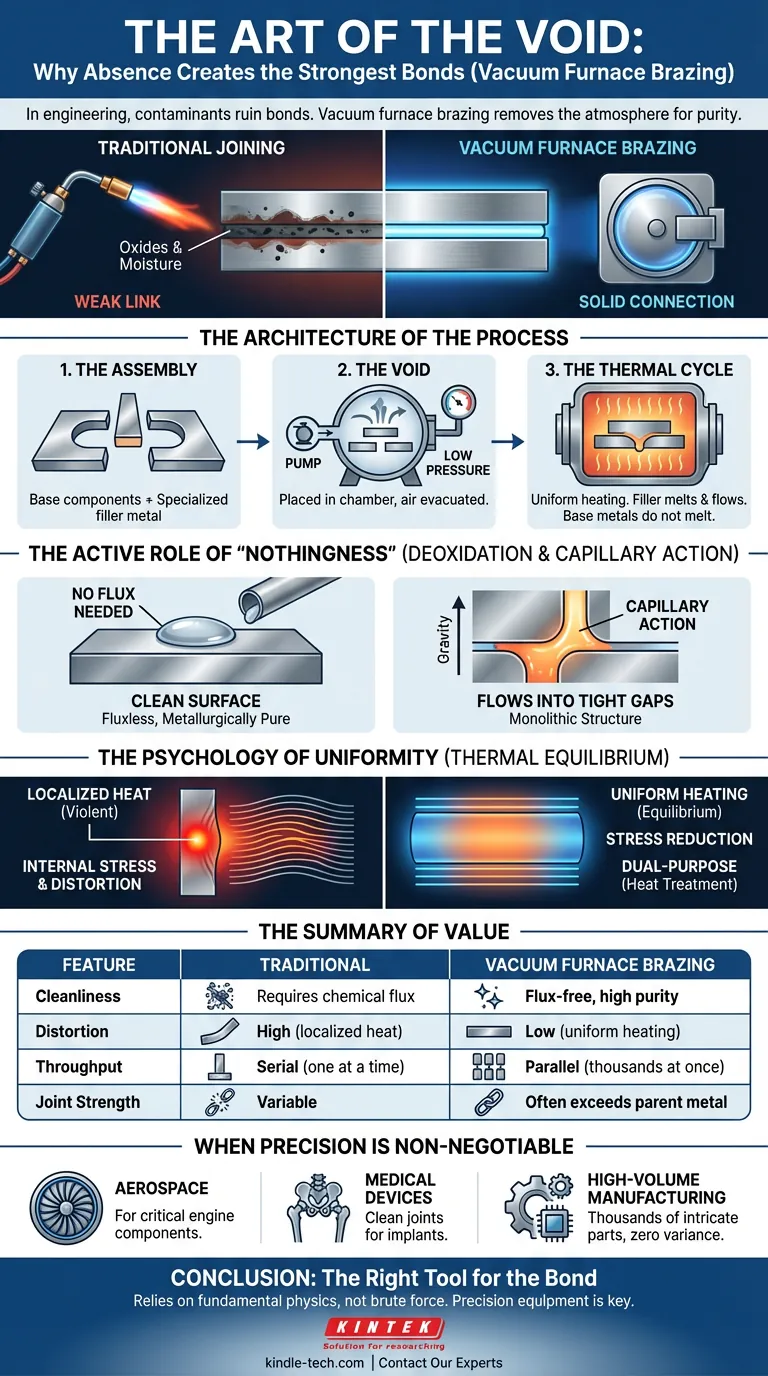
When we try to join two metals using traditional heat, the atmosphere becomes an adversary. Oxygen creates oxides. Moisture introduces hydrogen. These invisible variables turn what should be a solid connection into a weak link.

Vacuum furnace brazing flips this problem on its head.

It does not fight the atmosphere; it removes it entirely. By creating a high-purity environment, it allows physics—specifically capillary action and thermal diffusion—to do the heavy lifting.

Here is why the strongest connections are made in a vacuum.

The Architecture of the Process

Vacuum furnace brazing is deceptively simple in concept but sophisticated in execution. It is a high-purity metal joining process that creates joints often stronger than the parent materials themselves.

The mechanism relies on three distinct phases:

  1. The Assembly: Base metal components are fitted together with a specialized filler metal (an alloy with a lower melting point).
  2. The Void: The assembly is placed in a chamber, and the air is evacuated to extremely low pressures.
  3. The Thermal Cycle: The furnace heats the assembly uniformly. The filler melts, flows, and solidifies.

Unlike welding, the base metals never melt. They merely accept the bond.

The Active Role of "Nothingness"

We tend to think of a vacuum as a passive setting—an empty stage. In brazing, the vacuum is an active participant.

Its primary role is deoxidation.

In standard brazing, you need chemical flux to clean the metal surfaces. Flux is messy. It creates residues. It can corrode the part later if not perfectly removed.

In a vacuum furnace, the low pressure causes surface oxides to dissociate or evaporate. The environment itself cleans the metal. This results in a "fluxless" process, ensuring the joint is metallurgically pure.

The Power of Capillary Action

Once the environment is clean and the temperature rises, the filler metal liquefies.

Because the vacuum has removed the resistance of surface oxides, the liquid alloy is drawn into the tightest gaps between components via capillary action.

It flows against gravity. It penetrates deep into the joint. It diffuses slightly into the atomic structure of the base metal. Upon cooling, it forms a monolithic structure.

The Psychology of Uniformity

Most joining methods, like torch brazing or localized welding, are violent. They blast heat at a single point.

This creates a temperature gradient. Hot spots expand; cold spots resist. The result is internal stress and distortion.

Vacuum furnace brazing offers thermal equilibrium.

  • Uniform Heating: The entire assembly rises in temperature simultaneously.
  • Stress Reduction: Because the part expands and contracts as a unit, distortion is minimized.
  • Dual-Purpose: The heating cycle can often double as a heat treatment (annealing or hardening), saving time and cost.

Strategic Trade-offs

Every engineering choice has a cost. While vacuum brazing offers unmatched quality, it is not a universal solution.

It requires a shift in mindset from "repair" to "production."

The Limitations

  • Capital Intensity: High-vacuum furnaces are complex, expensive systems requiring skilled operation.
  • The Batch Constraint: This is not a quick fix. It involves pumping down, heating, soaking, and cooling. It is designed for planned batches, not one-off emergency repairs.
  • Material Science: The base metals must withstand the brazing temperatures without degrading.

The Summary of Value

Feature Traditional Welding/Brazing Vacuum Furnace Brazing
Cleanliness Requires chemical flux Flux-free, high purity
Distortion High (localized heat) Low (uniform heating)
Throughput Serial (one at a time) Parallel (thousands of joints at once)
Joint Strength Variable Often exceeds parent metal

When Precision is Non-Negotiable

You do not use vacuum brazing to fix a garden gate. You use it when the cost of failure is catastrophic.

  • Aerospace: For turbine blades where oxide inclusions could lead to engine failure.
  • Medical Devices: For implants where flux residue could cause biological rejection.
  • High-Volume Manufacturing: When you need to join thousands of intricate parts simultaneously with zero variance.

Conclusion: The Right Tool for the Bond

The beauty of vacuum furnace brazing lies in its reliance on fundamental physics rather than brute force. By removing the air, we allow the metal to do what it naturally wants to do: bind together.

However, achieving this level of purity requires precise equipment.

KINTEK understands the rigor required for high-performance laboratories and manufacturing environments. We specialize in the lab equipment and consumables that make these advanced thermal processes possible.

Whether you are joining dissimilar metals or scaling up production for aerospace components, precision begins with the right setup.

Contact Our Experts

Visual Guide

The Art of the Void: Why Absence Creates the Strongest Bonds Visual Guide

Related Products

Related Articles

Related Products

Vacuum Heat Treat and Molybdenum Wire Sintering Furnace for Vacuum Sintering

Vacuum Heat Treat and Molybdenum Wire Sintering Furnace for Vacuum Sintering

A vacuum molybdenum wire sintering furnace is a vertical or bedroom structure, which is suitable for withdrawal, brazing, sintering and degassing of metal materials under high vacuum and high temperature conditions. It is also suitable for dehydroxylation treatment of quartz materials.

Laboratory High Pressure Vacuum Tube Furnace

Laboratory High Pressure Vacuum Tube Furnace

KT-PTF High Pressure Tube Furnace: Compact split tube furnace with strong positive pressure resistance. Working temp up to 1100°C and pressure up to 15Mpa. Also works under controller atmosphere or high vacuum.

2200 ℃ Tungsten Vacuum Heat Treat and Sintering Furnace

2200 ℃ Tungsten Vacuum Heat Treat and Sintering Furnace

Experience the ultimate refractory metal furnace with our Tungsten vacuum furnace. Capable of reaching 2200℃, perfect for sintering advanced ceramics and refractory metals. Order now for high-quality results.

1700℃ Controlled Atmosphere Furnace Nitrogen Inert Atmosphere Furnace

1700℃ Controlled Atmosphere Furnace Nitrogen Inert Atmosphere Furnace

KT-17A Controlled atmosphere furnace: 1700℃ heating, vacuum sealing technology, PID temperature control, and versatile TFT smart touch screen controller for laboratory and industrial use.

Horizontal High Temperature Graphite Vacuum Graphitization Furnace

Horizontal High Temperature Graphite Vacuum Graphitization Furnace

Horizontal Graphitization Furnace: This type of furnace is designed with the heating elements placed horizontally, allowing for uniform heating of the sample. It's well-suited for graphitizing large or bulky samples that require precise temperature control and uniformity.

Ultra-High Temperature Graphite Vacuum Graphitization Furnace

Ultra-High Temperature Graphite Vacuum Graphitization Furnace

The ultra-high temperature graphitization furnace utilizes medium frequency induction heating in a vacuum or inert gas environment. The induction coil generates an alternating magnetic field, inducing eddy currents in the graphite crucible, which heats up and radiates heat to the workpiece, bringing it to the desired temperature. This furnace is primarily used for graphitization and sintering of carbon materials, carbon fiber materials, and other composite materials.

1200℃ Controlled Atmosphere Furnace Nitrogen Inert Atmosphere Furnace

1200℃ Controlled Atmosphere Furnace Nitrogen Inert Atmosphere Furnace

Discover our KT-12A Pro Controlled atmosphere furnace - high precision, heavy duty vacuum chamber, versatile smart touch screen controller, and excellent temperature uniformity up to 1200C. Ideal for both laboratory and industrial application.

Vertical High Temperature Graphite Vacuum Graphitization Furnace

Vertical High Temperature Graphite Vacuum Graphitization Furnace

Vertical high temperature graphitization furnace for carbonization and graphitization of carbon materials up to 3100℃.Suitable for shaped graphitization of carbon fiber filaments and other materials sintered in a carbon environment.Applications in metallurgy, electronics, and aerospace for producing high-quality graphite products like electrodes and crucibles.

Vacuum Heat Treat Sintering Brazing Furnace

Vacuum Heat Treat Sintering Brazing Furnace

A vacuum brazing furnace is a type of industrial furnace used for brazing, a metalworking process that joins two pieces of metal using a filler metal that melts at a lower temperature than the base metals. Vacuum brazing furnaces are typically used for high-quality applications where a strong, clean joint is required.

Vacuum Hot Press Furnace Heated Vacuum Press Machine Tube Furnace

Vacuum Hot Press Furnace Heated Vacuum Press Machine Tube Furnace

Reduce forming pressure & shorten sintering time with Vacuum Tube Hot Press Furnace for high-density, fine-grain materials. Ideal for refractory metals.

Graphite Vacuum Furnace High Thermal Conductivity Film Graphitization Furnace

Graphite Vacuum Furnace High Thermal Conductivity Film Graphitization Furnace

The high thermal conductivity film graphitization furnace has uniform temperature, low energy consumption and can operate continuously.

Laboratory Muffle Oven Furnace Bottom Lifting Muffle Furnace

Laboratory Muffle Oven Furnace Bottom Lifting Muffle Furnace

Efficiently produce batches with excellent temperature uniformity using our Bottom Lifting Furnace. Features two electric lifting stages and advanced temperature control up to 1600℃.

1700℃ Laboratory High Temperature Tube Furnace with Alumina Tube

1700℃ Laboratory High Temperature Tube Furnace with Alumina Tube

Looking for a high-temperature tube furnace? Check out our 1700℃ Tube Furnace with Alumina Tube. Perfect for research and industrial applications up to 1700C.

600T Vacuum Induction Hot Press Furnace for Heat Treat and Sintering

600T Vacuum Induction Hot Press Furnace for Heat Treat and Sintering

Discover the 600T Vacuum Induction Hot Press Furnace, designed for high-temperature sintering experiments in vacuum or protected atmospheres. Its precise temperature and pressure control, adjustable working pressure, and advanced safety features make it ideal for nonmetal materials, carbon composites, ceramics, and metal powders.

Vacuum Hot Press Furnace Machine Heated Vacuum Press

Vacuum Hot Press Furnace Machine Heated Vacuum Press

Discover the advantages of Vacuum Hot Press Furnace! Manufacture dense refractory metals & compounds, ceramics, and composites under high temp and pressure.

Laboratory Vacuum Tilt Rotary Tube Furnace Rotating Tube Furnace

Laboratory Vacuum Tilt Rotary Tube Furnace Rotating Tube Furnace

Discover the versatility of Laboratory Rotary Furnace: Ideal for calcination, drying, sintering, and high-temperature reactions. Adjustable rotating and tilting functions for optimal heating. Suitable for vacuum and controlled atmosphere environments. Learn more now!

Controlled Nitrogen Inert Hydrogen Atmosphere Furnace

Controlled Nitrogen Inert Hydrogen Atmosphere Furnace

KT-AH Hydrogen atmosphere furnace - induction gas furnace for sintering/annealing with built-in safety features, dual housing design, and energy-saving efficiency. Ideal for lab and industrial use.

Mesh belt controlled atmosphere furnace

Mesh belt controlled atmosphere furnace

Discover our KT-MB mesh belt sintering furnace - perfect for high-temperature sintering of electronic components & glass insulators. Available for open air or controlled atmosphere environments.

1700℃ Muffle Oven Furnace for Laboratory

1700℃ Muffle Oven Furnace for Laboratory

Get superior heat control with our 1700℃ Muffle Furnace. Equipped with intelligent temperature microprocessor, TFT touch screen controller & advanced insulation materials for precise heating up to 1700C. Order now!

1800℃ Muffle Oven Furnace for Laboratory

1800℃ Muffle Oven Furnace for Laboratory

KT-18 muffle furnace with Japan Al2O3 polycrystalline fibe and Silicon Molybdenum heating element, up to 1900℃, PID temperature control and 7" smart touch screen. Compact design, low heat loss, and high energy efficiency. Safety interlock system and versatile functions.


Leave Your Message