In engineering, a single number rarely tells the whole story.
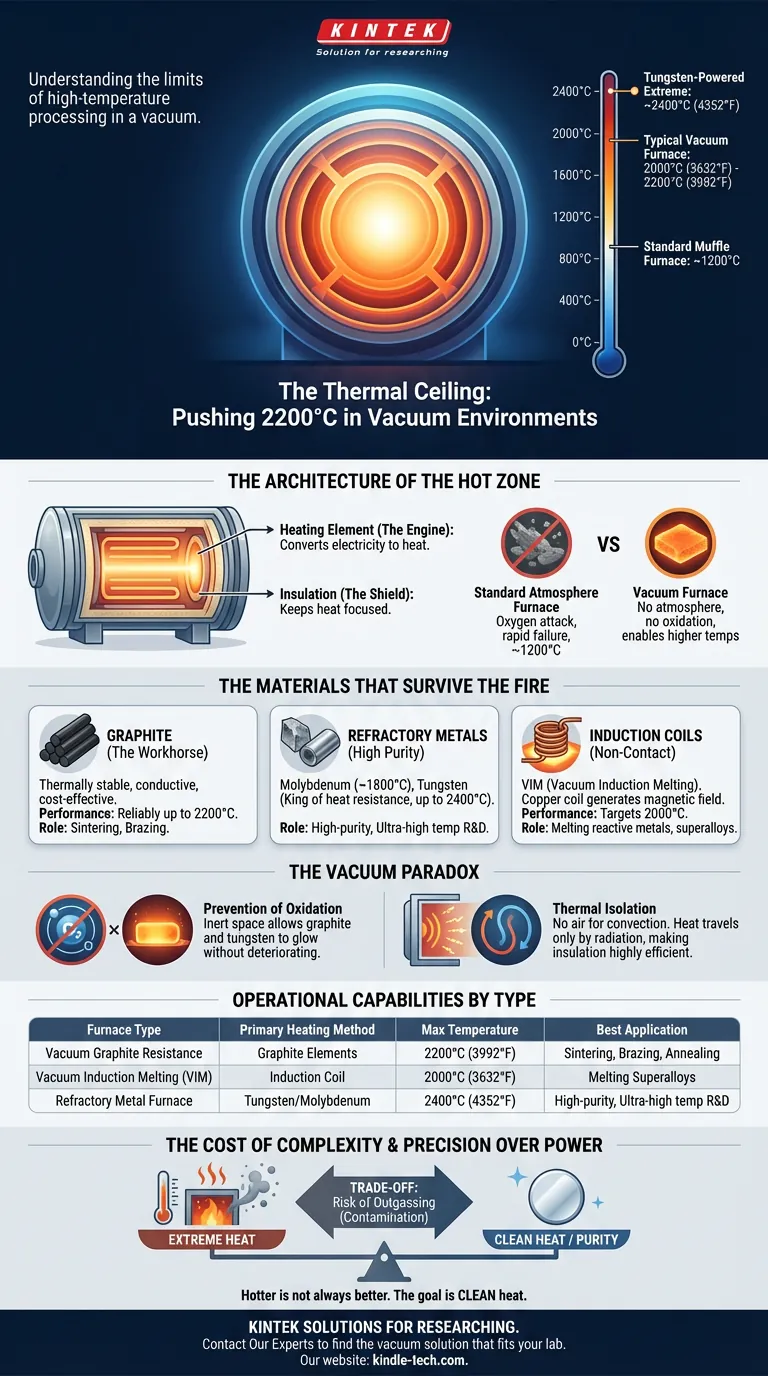
When asked how hot a vacuum furnace can get, the brochure answer is simple: between 2000°C (3632°F) and 2200°C (3992°F). In extreme cases utilizing tungsten, we can push toward 2400°C.
But for the engineer or material scientist, the maximum temperature is not just a limit on a dial. It is a physical negotiation between the energy you input and the structural integrity of the machine holding it.
To understand high-temperature processing, we must look inside the "black box" and appreciate the delicate systems that prevent these infernos from melting themselves.
The Architecture of the Hot Zone
The capability to reach 2200°C is not arbitrary. It is defined by the weakest link in the chain.
In a standard atmosphere furnace, oxygen is the enemy. At high temperatures, oxygen aggressively attacks heating elements, causing rapid oxidation and failure. This is why a standard muffle furnace usually caps out around 1200°C.
A vacuum furnace is different. By removing the atmosphere, we remove the chemistry of destruction. This allows us to use materials that would otherwise burn up in seconds.
The ultimate temperature relies on two internal components:
- The Heating Element: The engine that converts electricity to heat.
- The Insulation: The shield that keeps that heat focused.
The Materials That Survive the Fire
To generate extreme heat, we must use materials that refuse to melt. The engineering choices here are binary and distinct.
1. Graphite
Graphite is the workhorse of high-temperature processing. It is thermally stable, electrically conductive, and remarkably cost-effective.
- Performance: Reliably operates up to 2200°C.
- Role: Used in vacuum resistance furnaces for sintering and brazing.
2. Refractory Metals
When carbon contamination is a concern, or temperatures must go higher, we turn to metals with incredibly high melting points.
- Molybdenum: Effective up to ~1800°C.
- Tungsten: The king of heat resistance, pushing limits to 2400°C.
3. Induction Coils
In Vacuum Induction Melting (VIM), we don't use a resistor. We use a copper coil to generate a magnetic field.
- Performance: Typically targets 2000°C.
- Role: Melting reactive metals and superalloys without direct contact.
The Vacuum Paradox
There is a certain romance to the vacuum furnace. It protects by providing nothingness.
The vacuum serves two critical functions that allow for these extreme temperatures:
- Prevention of Oxidation: It creates a chemically inert space where graphite and tungsten can glow white-hot without deteriorating.
- Thermal Isolation: In a vacuum, there is no air to conduct heat via convection. Heat only travels by radiation. This makes the insulation packs—often rigid graphite felt—incredibly efficient.
Operational Capabilities by Type
Not all furnaces are built for the same "sprint." Different designs are optimized for different finish lines.
| Furnace Type | Primary Heating Method | Max Temperature | Best Application |
|---|---|---|---|
| Vacuum Graphite Resistance | Graphite Elements | 2200°C (3992°F) | Sintering, Brazing, Annealing |
| Vacuum Induction Melting (VIM) | Induction Coil | 2000°C (3632°F) | Melting Superalloys |
| Refractory Metal Furnace | Tungsten/Molybdenum | 2400°C (4352°F) | High-purity, Ultra-high temp R&D |
The Cost of Complexity
In complex systems, trade-offs are inevitable.
Pushing a furnace to its thermal limit introduces the risk of outgassing. As materials heat up, the internal components (insulation, fixtures) release trapped atoms.
At 2000°C, the furnace itself tries to become part of the atmosphere. If not managed correctly, this ruins the vacuum level and contaminates the sample. This is why "hotter" is not always "better."
The goal is not just heat; it is clean heat.
Choosing the right furnace requires balancing the raw temperature needed against the purity required by your specific application. It is the difference between using a sledgehammer and a scalpel.
Precision Over Power
At KINTEK, we understand that reliable data comes from reliable equipment. Whether you are sintering advanced ceramics or melting reactive alloys, the equipment must disappear into the background, leaving only consistent results.
Our engineers can help you navigate the trade-offs between graphite and metal zones, ensuring you have the exact thermal profile your research requires.
Contact Our Experts to discuss your specific temperature requirements and find the vacuum solution that fits your lab.
Visual Guide
Related Products
- Vacuum Hot Press Furnace Heated Vacuum Press Machine Tube Furnace
- 600T Vacuum Induction Hot Press Furnace for Heat Treat and Sintering
- Vacuum Hot Press Furnace Machine Heated Vacuum Press
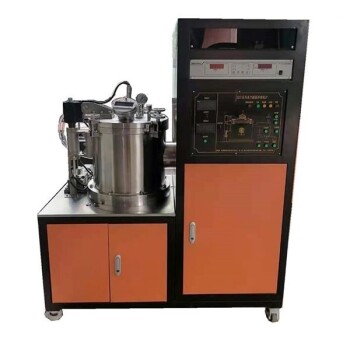
- Vacuum Heat Treat Furnace and Levitation Induction Melting Furnace
- 2200 ℃ Tungsten Vacuum Heat Treat and Sintering Furnace
Related Articles
- The Purity Paradox: Choosing the Heart of Your Vacuum Hot Press Furnace
- Comprehensive Guide to Vacuum Hot Press Furnace Application
- Vacuum Hot Press Furnace: A Comprehensive Guide
- Forging Perfection in a Void: The Physics of Ultra-Dense Materials
- Defeating the Void: The Quiet Power of Vacuum Hot Pressing