The Invisible Cost of "Good Enough"
In engineering and finance, there is a dangerous concept known as "latent failure."
It is the problem that exists but hasn’t caused a disaster yet. It is the worn brake pad, the frayed wire, or the slightly oxidized heat shield.
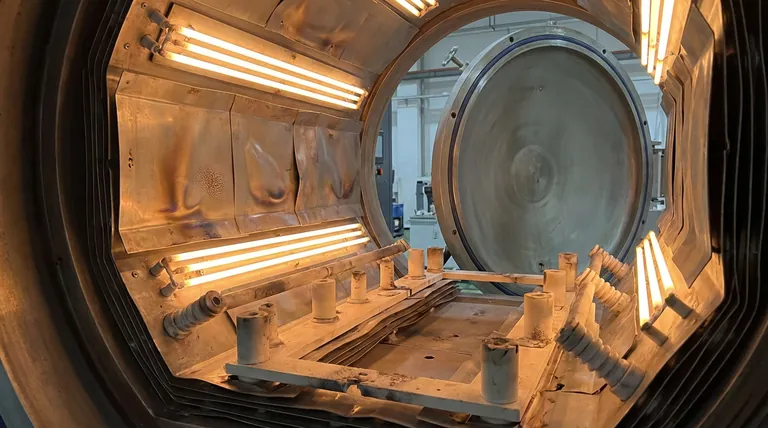
In the world of high-temperature processing, the hot zone of your vacuum furnace is the stage where this drama plays out. It is the functional heart of your system, often operating at temperatures exceeding 1300°C (2372°F).
When it works, it is invisible. When it fails, it becomes the only thing on your balance sheet that matters.
Many lab managers treat maintenance as a chore—a box to be ticked. But the health of your hot zone is not merely a maintenance task. It is a direct predictor of your operational uptime, process quality, and financial performance.
The Anatomy of a Breakdown
The hot zone is a marvel of engineering. Typically constructed from materials like molybdenum, it relies on resistance heating to create a pristine thermal environment.
But this environment is fragile.
A "fix it when it breaks" approach—often called reactive maintenance—is a liability masquerading as frugality. By the time a component fails, the damage is rarely isolated.
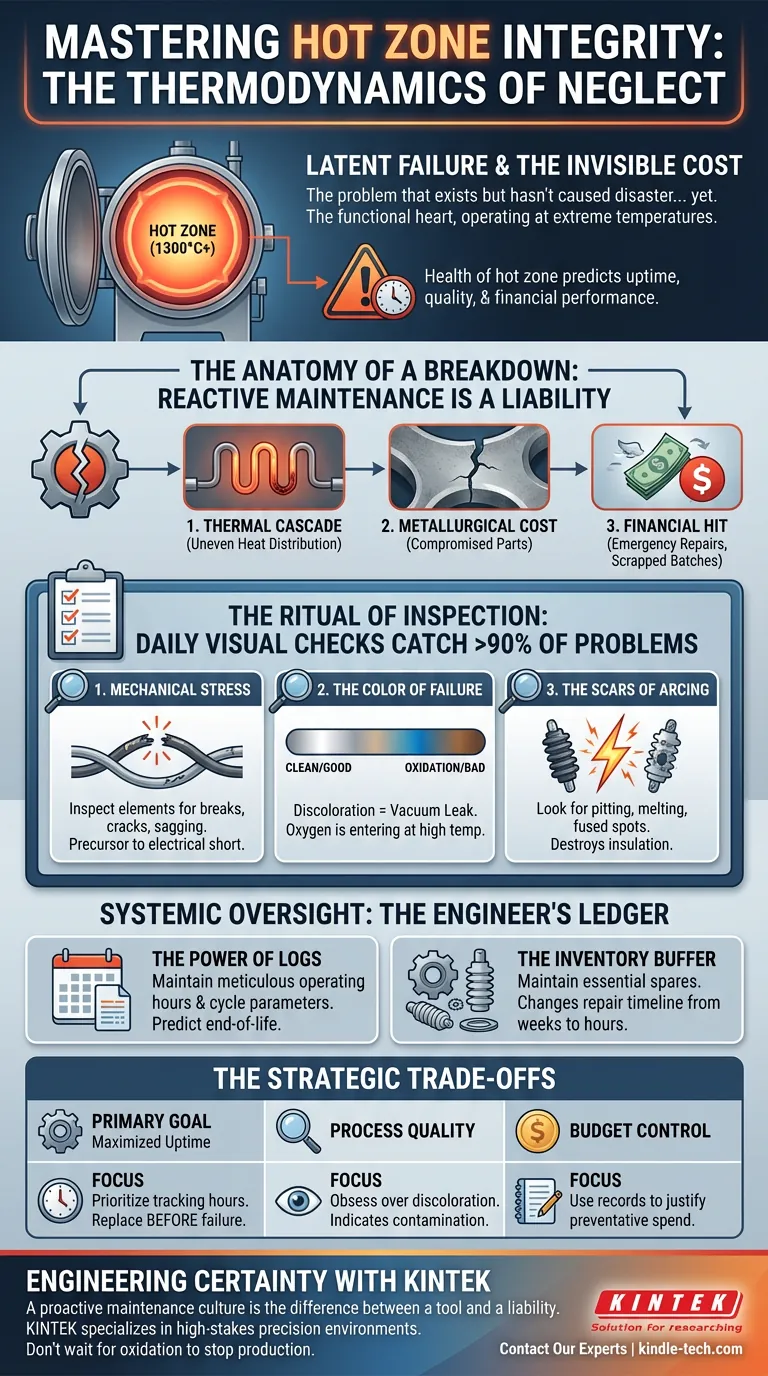
- The Thermal Cascade: A small sag in a heating element creates uneven heat distribution.
- The Metallurgical Cost: Poor temperature uniformity compromises the properties of the parts being treated.
- The Financial Hit: Emergency repairs, scrapped batches, and expedited shipping for parts cost exponentially more than scheduled downtime.
Preventing this requires a shift in mindset: from repairing machines to managing systems.
The Ritual of Inspection
Atul Gawande, in his exploration of systemic failure, noted that the most complex technologies often fail due to simple oversights.
The defense against this is the daily visual inspection. This ritual, performed diligently, catches over 90% of developing problems before they become catastrophic.
You are looking for three specific signals:
1. Mechanical Stress
Inspect the heating elements. You are looking for breaks, cracks, or significant sagging. A sagging element is not just a cosmetic issue; it is a precursor to an electrical short.
2. The Color of Failure
In a vacuum furnace, cleanliness is synonymous with performance. Elements and heat shields should remain metallic and bright.
Discoloration is a diagnostic tool:
- Blueing or Browning: This is not heat tint. It is oxidation.
- The Implication: Your vacuum integrity is compromised. Oxygen is entering the chamber at high temperatures.
- The Risk: If you ignore the color, you ignore the leak. Replacing the shield without fixing the leak is burning money.
3. The Scars of Arcing
Look for pitting, melting, or fused spots on insulators and support hardware. Arcing indicates uncontrolled electrical discharge. It destroys insulation and melts elements.
Systemic Oversight: The Engineer's Ledger
Visual inspection is the tactical side of maintenance. The strategic side happens in the office.
Reliability is a data problem. Without records, you are guessing.
The Power of Logs
You must maintain a meticulous log of operating hours and cycle parameters. If you know a set of heating elements typically lasts 5,000 hours, and you are at hour 4,800, you have a choice.
You can replace them during a planned shutdown, or you can wait for them to fail in the middle of a critical production run.
The Inventory Buffer
Supply chains are unpredictable. Your furnace needs shouldn't be.
Based on your workload and component life data, maintaining an inventory of essential spare parts—elements, insulators, thermocouples—changes a repair timeline from weeks to hours.
The Strategic Trade-Offs
Every maintenance strategy is a choice between three priorities. You cannot maximize all three simultaneously without a robust plan.
| Primary Goal | Strategic Focus |
|---|---|
| Maximized Uptime | Prioritize tracking operating hours. Replace components before end-of-life. |
| Process Quality | Obsess over discoloration. It indicates contamination that ruins metallurgy. |
| Budget Control | Use record-keeping to justify preventative spend and avoid unbudgeted emergency repairs. |
Engineering Certainty
The hot zone is where the physics of your product is defined. Its integrity should not be left to chance.
A proactive maintenance culture is the difference between a furnace that is a tool and a furnace that is a liability. It requires the right habits, the right data, and the right partners.
KINTEK specializes in the precision required for these high-stakes environments. From high-quality lab equipment to the consumables that keep them running, we provide the support structure for a proactive strategy.
Don't wait for the blue tint of oxidation to stop your production. Contact Our Experts to discuss your spare parts inventory and maintenance needs today.
Visual Guide
Related Products
- 2200 ℃ Tungsten Vacuum Heat Treat and Sintering Furnace
- Vacuum Hot Press Furnace Heated Vacuum Press Machine Tube Furnace
- Vacuum Hot Press Furnace Machine Heated Vacuum Press
- 600T Vacuum Induction Hot Press Furnace for Heat Treat and Sintering
- Vacuum Heat Treat and Pressure Sintering Furnace for High Temperature Applications
Related Articles
- The Architecture of Extremes: Mastering the Thermal Ceiling
- Exploring Tungsten Vacuum Furnaces: Operation, Applications, and Advantages
- Your Tungsten Furnace Is Failing. The Culprit Isn't What You Think.
- Classification, Applications, and Components of High-Temperature Vacuum Furnaces
- High-Temperature Vacuum Furnace: Classification, Applications, and Components



















