The Two Enemies of Precision
In high-temperature research, the most expensive experiment is the one you have to repeat. The cause is rarely a catastrophic explosion. More often, it's a silent degradation—a slow, creeping loss of integrity in the heart of the furnace.
The alumina tube, a seemingly simple ceramic component, is where chemistry and physics meet. But it is also where two invisible enemies wage a constant war against your results: thermal shock and contamination.
Understanding them is not just about maintenance. It's about mindset.
Enemy #1: Thermal Shock, The Physics of Haste
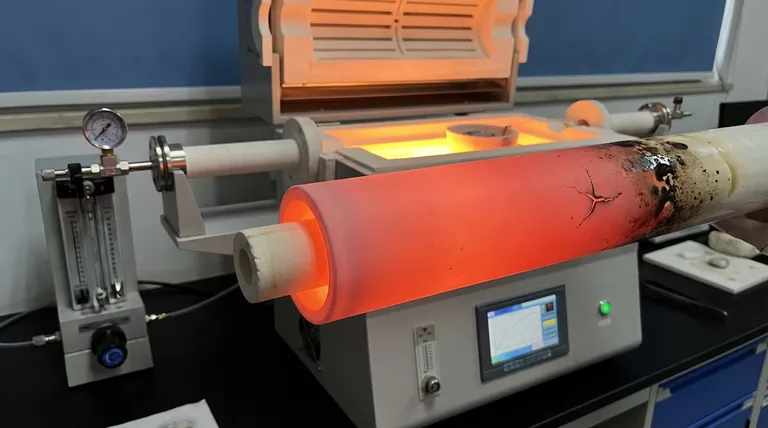
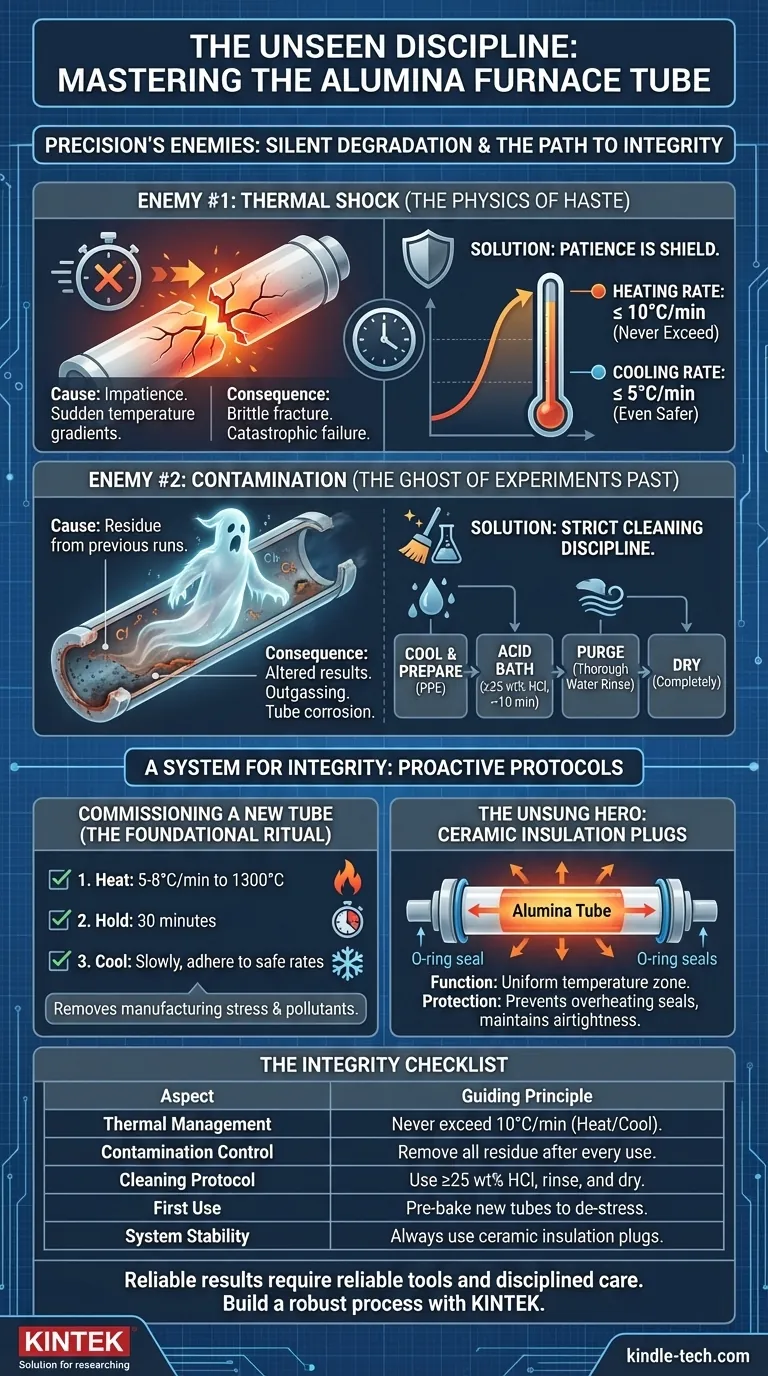
Alumina is strong, but it is brittle. It despises sudden change. When a temperature gradient across its body becomes too steep, it cracks. This is thermal shock.
It's a failure born from impatience.
Rushing a heating cycle, introducing a cold sample holder into a hot tube, or cooling the system too quickly are all invitations for disaster. The ceramic cannot expand or contract fast enough to accommodate the stress, and a fracture is its only recourse.
The defense is simple, yet requires discipline:
- Heating Rate: Never exceed 10°C per minute.
- Cooling Rate: A slower pace of 5°C per minute is even safer.
Patience is the most effective shield against thermal shock. The furnace rewards deliberation, not speed.
Enemy #2: Contamination, The Ghost of Experiments Past
Every material left inside the tube after a run is a potential ghost. At high temperatures, this residue doesn't just sit there; it can fuse to the alumina wall, chemically reacting with it or outgassing during the next experiment.
This ghost will haunt your future work, subtly altering results and casting doubt on every data point. Over time, it can even corrode and weaken the tube itself.
The only way to exorcise this ghost is through a strict, unwavering cleaning discipline. The work isn't finished when the furnace cools down; it's finished when the tube is clean.
A System for Integrity, Not Just a Cleaning List
The best way to defeat these enemies is not through heroic, last-minute efforts but through a systematic, proactive protocol. It's less about cleaning and more about building a culture of care around the instrument.
The Foundational Ritual: Commissioning a New Tube
A new alumina tube is not yet ready for service. It holds residual stresses from manufacturing and invisible pollutants on its surface.
The first use is a commissioning ritual.
- Heat the empty tube at a rate of 5-8°C per minute up to 1300°C.
- Hold at this temperature for 30 minutes. This allows stresses to relax and burns off any organic contaminants.
- Cool it down slowly, adhering to the safe thermal rates.
This one-time process prepares the tube for a long and reliable service life.
The Post-Experiment Protocol: A Rigorous Cleanse
For metallic or oxide residues, an acid wash is the standard procedure. This must be done with care, in a well-ventilated area, and with proper personal protective equipment (PPE).
- Step 1: Preparation. Ensure the tube is completely cool and removed from the furnace. Safety is paramount.
- Step 2: The Acid Bath. Carefully fill the tube with a diluted hydrochloric acid solution (at least 25 wt%). Let it soak for approximately 10 minutes. This is typically enough time to dissolve common contaminants without harming the alumina.
- Step 3: The Purge. Drain the acid into a designated waste container. Rinse the tube thoroughly and repeatedly with deionized water until all acid is neutralized and removed.
- Step 4: The Dry. Let the tube dry completely. Any moisture introduced into a hot furnace will instantly become steam, creating a severe risk of thermal shock.
The Unsung Hero: Insulation Plugs
A stable system depends on small, often-overlooked details. Ceramic insulation plugs, placed at both ends of the tube, are critical.
They don't just keep the heat in. They create a balanced, uniform temperature zone. Without them, the ends of the tube can overheat, damaging the O-ring seals that ensure the system's air tightness and compromising the integrity of your controlled atmosphere.
The Integrity Checklist
| Aspect | Guiding Principle |
|---|---|
| Thermal Management | Never exceed a heating/cooling rate of 10°C per minute. |
| Contamination Control | Remove all sample residue after every single use. No exceptions. |
| Cleaning Protocol | Use ≥25 wt% HCl for ~10 mins, followed by a thorough water rinse. |
| First Use | Always pre-bake a new tube to remove stress and contaminants. |
| System Stability | Always use ceramic insulation plugs to protect seals and the tube. |
Ultimately, the quality of your work depends on the reliability of your tools. A disciplined approach to maintaining your alumina furnace tube is an investment in the accuracy and reproducibility of your results. A robust protocol requires robust equipment, from high-purity furnace tubes to the essential accessories that support them. At KINTEK, we provide the high-quality lab equipment and consumables that form the foundation of a reliable experimental system.
If you are looking to build a more robust and reliable high-temperature process, Contact Our Experts.
Visual Guide
Related Products
- High Temperature Alumina (Al2O3) Furnace Tube for Engineering Advanced Fine Ceramics
- 1400℃ Laboratory High Temperature Tube Furnace with Alumina Tube
- 1700℃ Laboratory High Temperature Tube Furnace with Alumina Tube
- High Temperature Aluminum Oxide (Al2O3) Protective Tube for Engineering Advanced Fine Ceramics
- Engineering Advanced Fine Alumina Al2O3 Ceramic Crucible for Laboratory Muffle Furnace
Related Articles
- Beyond the Acid Wash: A Systems Approach to Alumina Tube Longevity
- Entropy and the Alumina Tube: The Art of Precision Maintenance
- The Ceramic Paradox: Why the Best Way to Clean an Alumina Tube is Not to Clean It
- The Geometry of Heat: Why Your Furnace Tube Material Dictates Your Science
- The Silent Vessel: Why the Material of Your Furnace Tube Defines Your Science