The Allure of the Void
In the world of advanced manufacturing, failure often traces back to a single, microscopic flaw. For an aerospace engineer or a medical device designer, the integrity of a metallic joint isn't just a detail; it's the bedrock of safety and reliability.
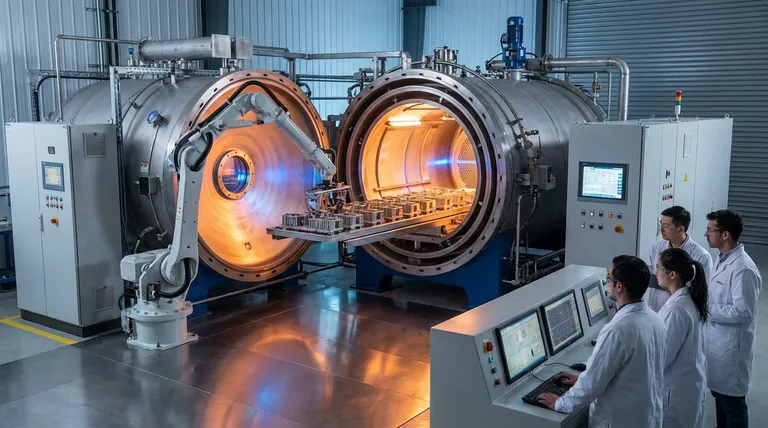
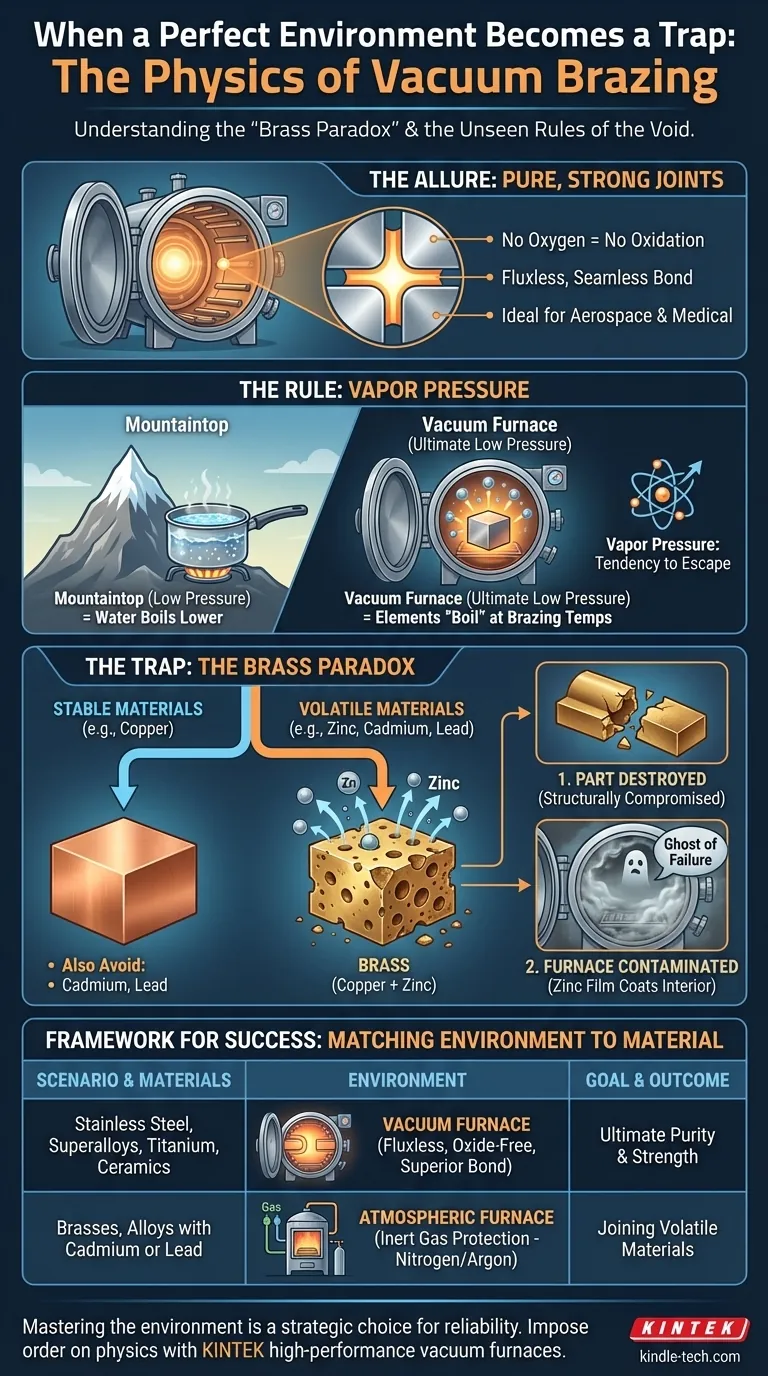
The pursuit of the perfect joint leads many to the vacuum furnace. It represents an ideal world—an environment scrubbed clean of oxygen, the great corruptor of hot metal. By removing the atmosphere, you remove the possibility of oxidation.
This allows a brazing alloy to flow into a joint with unparalleled intimacy, creating a metallurgical bond that is pure, strong, and free of the corrosive residues left by chemical fluxes. The parts emerge from the furnace bright and clean, their union seamless. It's the pinnacle of control.
Or so it seems.
The Unseen Rules of an Empty Room
Here is the crucial mental shift: a vacuum is not an absence of things. It is an active environment with its own unforgiving rules.
The most important rule concerns pressure. We know water boils at a lower temperature on a mountaintop because the air pressure is lower. A vacuum furnace is the ultimate mountaintop; it dramatically lowers the boiling point of everything inside it, including the metals themselves.
This phenomenon is governed by an element’s vapor pressure—its natural tendency to escape into a gaseous state. In a vacuum, at brazing temperatures, elements with high vapor pressure don't just melt; they boil away.
The Brass Paradox: A Flaw in the Logic
This brings us to a common, and often costly, mistake: attempting to braze brass in a vacuum furnace.
Brass is an alloy of copper and zinc. While copper is stable, zinc has a very high vapor pressure. When heated in a vacuum, the zinc atoms literally "boil" out of the alloy.
The consequences are twofold and severe:
- The Part is Destroyed: The brass component no longer has its intended chemical composition. It is structurally compromised, its integrity lost forever.
- The Furnace is Contaminated: The vaporized zinc coats the furnace's interior—its heating elements and insulation—with a fine metallic film. This ghost of a past failure can ruin subsequent, unrelated jobs for entirely different materials.
The same trap applies to any material containing elements with high vapor pressure.
- Zinc (as in brasses)
- Cadmium (used in some brazing alloys and platings)
- Lead (found in some free-machining alloys)
The perfect environment, designed for ultimate purity, becomes a destructive force when used on the wrong material.
A Framework for Choosing Your Environment
Success, then, is not about finding a single "best" method. It's about matching the environment to the material and the goal. The decision is a simple one, but it's critical.
| Scenario | Materials | Environment |
|---|---|---|
| Goal: Ultimate Purity & Strength | Stainless Steel, Superalloys, Titanium, Ceramics | Vacuum Furnace: The only choice for a fluxless, oxide-free, superior bond. |
| Goal: Joining Volatile Materials | Brasses, Alloys with Cadmium or Lead | Atmospheric Furnace: Use an inert gas (like nitrogen or argon) for protection. |
This isn't just a technical choice; it's a strategic one. Understanding how an environment changes the behavior of your materials is the difference between repeatable success and inexplicable failure.
For applications where joint integrity is non-negotiable, mastering the controlled environment of a vacuum is essential. A high-performance vacuum furnace from KINTEK isn't just a piece of equipment; it's a tool for imposing order on physics, ensuring that your most critical components are formed in an environment designed for perfection.
To ensure you have the right controlled environment for your most critical components, Contact Our Experts.
Visual Guide
Related Products
- Vacuum Heat Treat Sintering Brazing Furnace
- Vacuum Induction Melting Spinning System Arc Melting Furnace
- Vacuum Cold Mounting Machine for Sample Preparation
- CF KF Flange Vacuum Electrode Feedthrough Lead Sealing Assembly for Vacuum Systems
- 304 316 Stainless Steel Vacuum Ball Valve Stop Valve for High Vacuum Systems
Related Articles
- The Art of the Void: Why Absence Creates the Strongest Bonds
- Evaluating the Pros and Cons of External Vacuum Heat Treatment Furnaces
- Vacuum Heat Treatment Furnace: Working Principles and Features
- The Architecture of Silence: Mastery Through Total Environmental Control
- Guidelines for Purchasing Vacuum Heat Treatment Furnaces