Imagine the scene: a critical compressive strength test is underway in your lab. You're evaluating a new, super-hard ceramic composite for a next-generation product. The hydraulic press hums, pressure builds, and you watch the monitors, anticipating the exact moment the sample will yield.
Then, a sharp, sickening CRACK echoes through the facility.
But it wasn’t your sample that failed. It was the multi-thousand-dollar steel platen on your press, which now has a permanent, crater-like dent. The test is ruined, the data is useless, and your expensive equipment is damaged. Now what?
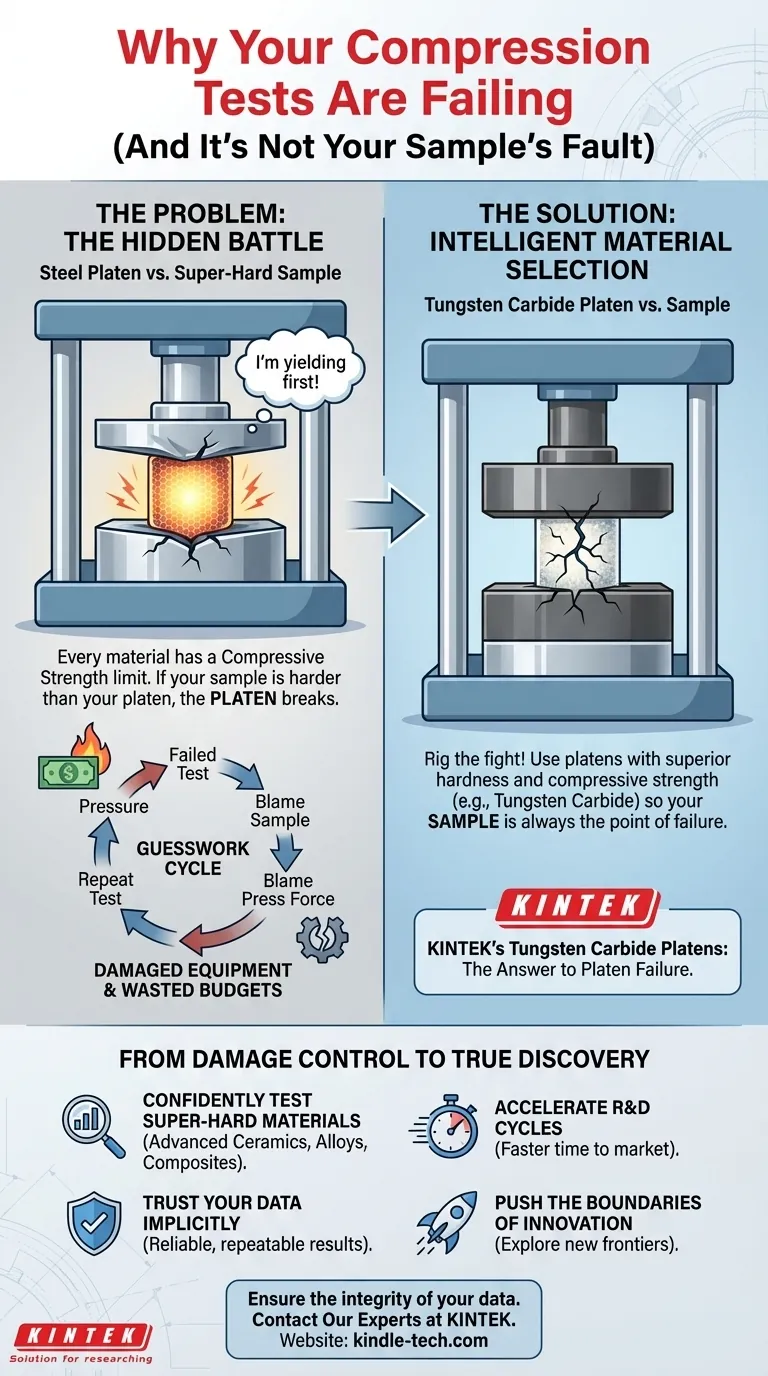
The Cycle of Guesswork and Wasted Budgets
If this scenario sounds familiar, you're not alone. When a material test goes wrong like this, labs often enter a frustrating and expensive cycle of guesswork. The blame is typically placed on one of two things:
- The "Bad" Sample: "This batch must have been faulty or contained an impurity. Let's try another one."
- The "Weak" Press: "We just need more force. Let's crank up the pressure or start budgeting for an even bigger, more powerful press."
So you run the test again. You might even invest in a press with a higher tonnage rating. But soon enough, you're faced with the same result: another damaged platen, another failed test, and more questions than answers.
This isn't just an academic problem; it has serious business consequences. Each failed test means wasted materials, project delays, and mounting costs. More importantly, it erodes confidence in your R&D process. If you can't reliably test your materials, how can you confidently approve them for production or guarantee product quality?
The Battle You Didn't Know You Were Fighting
The reason these common "fixes" fail is that they are based on a fundamental misunderstanding of what happens inside a press. We tend to think of the press as an all-powerful force and the sample as the only variable.
The truth is, every compression test is a battle between two materials: your sample and the press's own platen.
A hydraulic press generates immense force, but it’s pressure—the force concentrated onto a small area—that causes materials to break. Think of how a thumbtack works; your thumb provides the force, but the tiny point creates immense pressure.
Every material, including the hardened steel of your press’s platen, has a limit to the pressure it can withstand. This is its compressive strength.
When you place a sample in the press, you are pitting its compressive strength against the platen's compressive strength. If your sample material is harder and has a higher compressive strength than the steel platen—as is the case with many modern ceramics, industrial diamonds, or tungsten carbide—the platen will lose that battle. It will dent, crack, or shatter first.
Throwing more force at the problem with a bigger press doesn't solve this. You are simply applying more force to break your own machine. You've mistaken the symptom (the test failure) for the disease (a material mismatch).
Winning the Battle: Why Platen Material Matters More Than Tonnage
To get reliable, meaningful data, you must ensure your testing equipment is no longer a variable in the experiment. You need to rig the fight so that your sample is always the designated point of failure.
This means moving beyond the default steel platens that come with most presses. To truly test the limits of ultra-hard materials, you need a contact surface that is significantly stronger than anything you plan to test.
This is where intelligent material selection becomes the solution. The principle is simple: use platens and anvils made from a material with superior hardness and compressive strength, such as tungsten carbide.
At KINTEK, we see this issue constantly. That's why we don't just sell lab equipment; we provide solutions engineered from a deep understanding of these first principles. Our tungsten carbide platens aren't just an "accessory"; they are the direct answer to the problem of platen failure. By equipping your press with a contact surface that is far more robust than your test samples, you transform your press from a potential victim into a truly impartial and reliable testing platform.
From Damage Control to True Discovery
Once you eliminate the risk of equipment failure, the entire dynamic of your lab work changes. You're no longer operating in a state of damage control. You are free to explore.
With a properly configured testing environment, you can now:
- Confidently Test Super-Hard Materials: Finally get reliable data on the advanced ceramics, alloys, and composites that were previously "untestable" or too risky for your equipment.
- Accelerate R&D Cycles: Stop wasting time and money on repeat tests and equipment repairs. Increase your testing throughput and get products to market faster.
- Trust Your Data Implicitly: Make critical design and quality decisions with high confidence, knowing your results reflect the true properties of your material, not the limits of your setup.
- Push the Boundaries of Innovation: Explore the very edge of material science, secure in the knowledge that your laboratory is equipped for the challenge.
Reliable material testing is the bedrock of innovation and quality control. A single failed test due to an equipment mismatch can set back projects and compromise the integrity of your entire product line. This isn't just about avoiding a cracked platen; it's about building unshakeable confidence in every result and accelerating your path to market. Our team of specialists understands the nuances of material science and can help you configure the precise testing environment your projects demand. To move beyond guesswork and ensure the integrity of your data, Contact Our Experts.
Visual Guide
Related Products
- Ball Press Mold for Lab
- Heated Hydraulic Press Machine with Heated Plates for Vacuum Box Laboratory Hot Press
- Automatic High Temperature Heated Hydraulic Press Machine with Heated Plates for Lab
- Manual Heated Hydraulic Press Machine with Heated Plates for Laboratory Hot Press
- 24T 30T 60T Heated Hydraulic Press Machine with Heated Plates for Laboratory Hot Press
Related Articles
- Precision Under Pressure: The Physics and Psychology of the Hydraulic Hot Press
- More Than a Squeeze: The Physics and Psychology of the Hydraulic Hot Press
- Hydraulic Hot Press: Principles, Components, Features, Advantages, and Applications
- Comprehensive Guide to Hydraulic Hot Press: Function, Features and Applications
- The Physics of Flawless Materials: Deconstructing the Hydraulic Hot Press