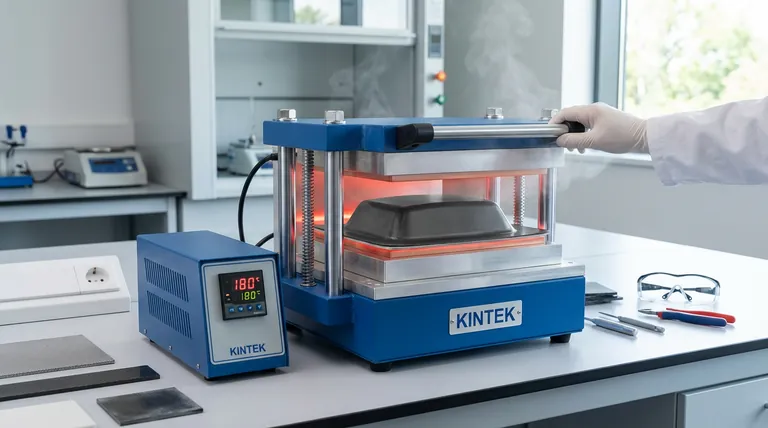
Imagine this: weeks spent developing a new polymer blend or a promising composite layup. You place it in the lab's hydraulic press, apply what should be the perfect amount of pressure, and wait. The result? A warped, brittle part with frustratingly weak spots. You try again, increasing the pressure. Same result. The project deadline is creeping closer, and you're stuck in an expensive cycle of trial, error, and confusion.
The Frustrating Cycle of Press-and-Fail
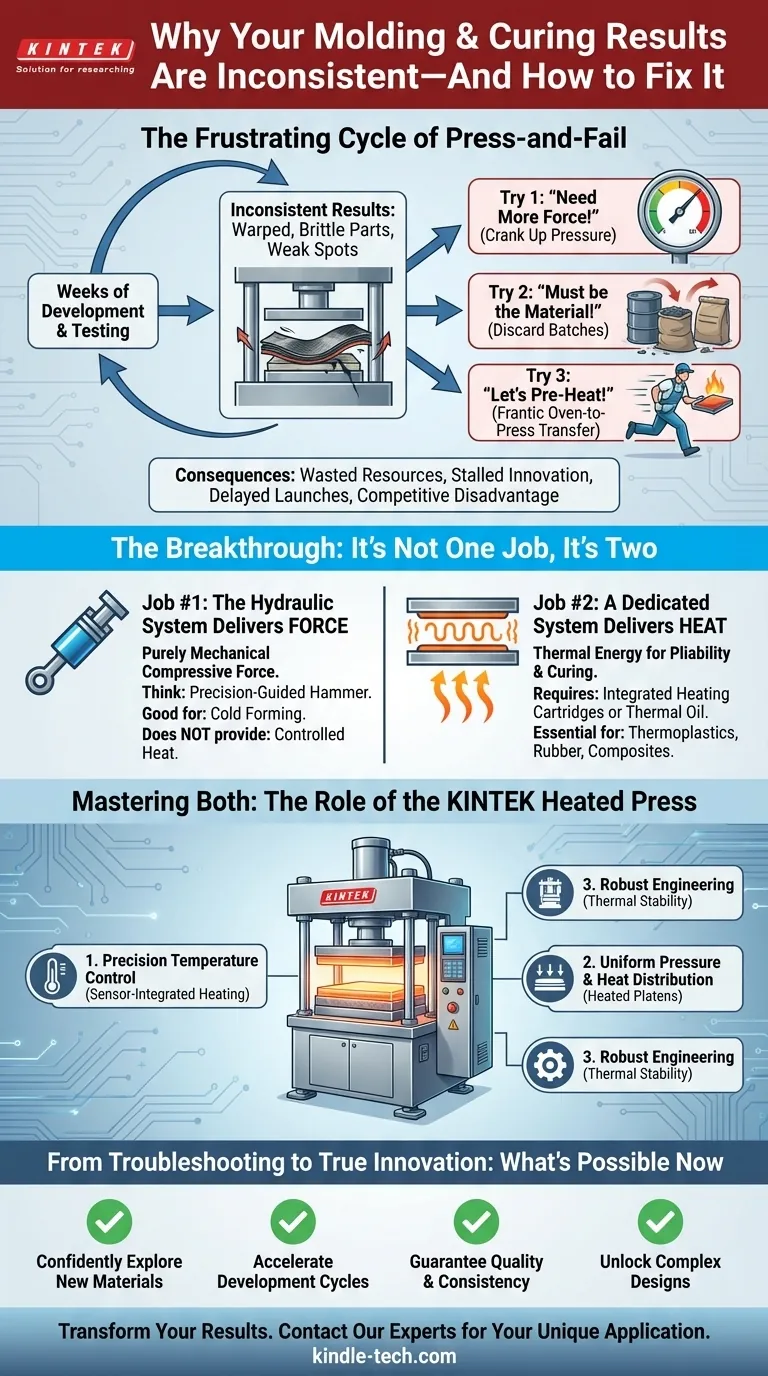
If this scenario sounds familiar, you're not alone. Laboratories and R&D departments everywhere experience this common but misunderstood problem. When faced with inconsistent molding, curing, or lamination results, the typical response is a series of logical but ultimately futile troubleshooting steps:
- "We need more force." The pressure is cranked up, sometimes to the machine's limit, with no improvement.
- "It must be the material." Batches of expensive raw materials are questioned or discarded, suspecting a quality issue.
- "Let's pre-heat it." The material is heated in an oven and quickly transferred to the press, a frantic race against heat loss that produces wildly variable results.
This isn't just a technical headache; it's a direct drain on your resources. Each failed attempt consumes valuable materials, man-hours, and machine time. More importantly, it stalls innovation. Promising new products get stuck in the development phase, and the inability to create reliable, repeatable samples prevents you from scaling up a process with confidence. The commercial consequences are real: delayed product launches, inflated R&D budgets, and a competitive disadvantage.
The Breakthrough: It’s Not One Job, It’s Two
The reason these common fixes fail is that they are based on a fundamental misunderstanding of what a hydraulic press actually does. The breakthrough comes when you realize: applying force and applying heat are two completely separate jobs.
Job #1: The Hydraulic System Delivers Force
The core purpose of a standard hydraulic press is purely mechanical. It uses pressurized fluid to generate immense compressive force. Think of it as a precision-guided hammer. Its one and only job is to push, stamp, or compress materials that can be formed cold. It does not, by its nature, create the controlled, high temperatures needed for many modern materials. The slight warmth from the motor is uncontrolled waste heat, not a usable tool.
Job #2: A Dedicated System Delivers Heat
Processes like curing rubber, molding thermoplastics, or laminating composites require thermal energy to work. This heat makes the material pliable or triggers a chemical reaction (curing) that gives it permanent strength and shape. This heat must be delivered by a completely separate, integrated system—typically electric heating cartridges or circulating thermal oil embedded within the press plates (platens).
Trying to mold a thermoplastic with a standard, unheated press is like trying to bake a cake by just pressing the ingredients together harder. You have the 'form' (pressure), but you're missing the 'transformation' (heat). The common fixes fail because they address the wrong variable. You don't need more force; you need the right kind of energy applied at the same time.
Mastering Both Jobs: The Role of the Purpose-Built Heated Press
To truly solve this, you don't need to try harder; you need a different tool—one engineered from the ground up to master both force and heat simultaneously.
This is where a purpose-built heated hydraulic press from KINTEK becomes the essential solution. It’s not a standard press with a heater added as an afterthought. It is an integrated system designed for the unique challenges of thermal processing.
- Precision Temperature Control: The integrated heating system and sensors ensure your material reaches the exact temperature needed for optimal pliability or curing, and holds it there uniformly. This eliminates the guesswork and inconsistency of external heating.
- Uniform Pressure and Heat Distribution: KINTEK's heated platens are designed to deliver consistent heat across the entire surface while withstanding immense pressure. This combination is what prevents warping and weak spots, guaranteeing a high-quality, uniform part every single time.
- Robust Engineering for Thermal Stability: Our presses are built to manage thermal expansion—the natural tendency of metal to change shape when heated. This ensures the press remains parallel and accurate, cycle after cycle, protecting both your product quality and the longevity of the equipment.
By providing precise, simultaneous control over both pressure and temperature, a KINTEK heated press directly solves the root cause of inconsistency that plagues so many development projects.
From Troubleshooting to True Innovation: What’s Possible Now
Once you stop fighting your equipment and start using the right tool for the job, the entire dynamic of your work changes. The focus shifts from frustrating troubleshooting to genuine innovation.
With a reliable heated press, you can:
- Confidently Explore New Materials: Test and perfect formulations for advanced polymers, rubbers, and composites, knowing your results are repeatable.
- Accelerate Development Cycles: Move from a single successful sample to a reliable process in a fraction of the time, slashing your time-to-market.
- Guarantee Quality and Consistency: Scale your process from lab-scale R&D to pilot production with the assurance that every part will meet specifications.
- Unlock Complex Designs: Manufacture more intricate parts with tighter tolerances that are impossible to achieve without perfect process control.
Your challenge isn't just about curing one part; it's about building a reliable process that accelerates your entire innovation pipeline. A simple conversation with our specialists can help clarify the exact requirements for your project. To discuss your unique application and discover how the right equipment can transform your results, Contact Our Experts.
Visual Guide
Related Products
- Heated Hydraulic Press Machine with Heated Plates for Vacuum Box Laboratory Hot Press
- Automatic High Temperature Heated Hydraulic Press Machine with Heated Plates for Lab
- Manual High Temperature Heated Hydraulic Press Machine with Heated Plates for Lab
- Heated Hydraulic Press Machine with Integrated Manual Heated Plates for Lab Use
- 24T 30T 60T Heated Hydraulic Press Machine with Heated Plates for Laboratory Hot Press
Related Articles
- Why Your Composite and Polymer Parts Keep Failing: The Secret Is Simultaneous Heat and Pressure
- The Physics of Flawless Materials: Deconstructing the Hydraulic Hot Press
- Hydraulic Hot Press: Principles, Components, Features, Advantages, and Applications
- More Than a Squeeze: The Physics and Psychology of the Hydraulic Hot Press
- Comprehensive Guide to Hydraulic Hot Press: Function, Features and Applications



















