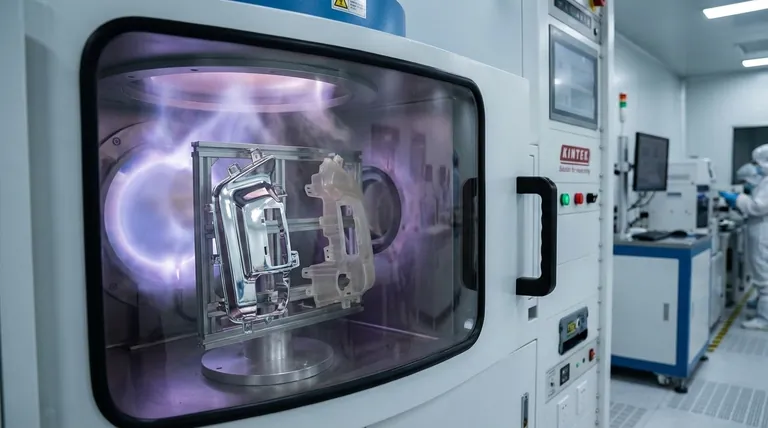
Yes, but with critical considerations. Physical Vapor Deposition (PVD) can be successfully applied to plastic substrates, but it is not as straightforward as coating metals. The process requires special adaptations to overcome plastic's inherent sensitivity to heat and its tendency to release gases under vacuum, which are cornerstone conditions of the PVD process.
While traditional PVD is reserved for materials that can withstand high temperatures, specialized low-temperature PVD processes make it possible to give plastics a durable, premium metallic finish. Success hinges on a multi-layer approach that prepares the plastic surface and protects the final coating.
The Core Challenge: Why Plastic is Difficult to Coat
Unlike metals, which are ideal candidates for PVD, plastics present several fundamental challenges that must be addressed for a successful coating.
Low Thermal Stability
Traditional PVD processes often operate at high temperatures, sometimes exceeding 400°C (750°F). Most commodity and engineering plastics will melt, warp, or degrade long before reaching these temperatures, making standard PVD methods entirely unsuitable.
The Problem of Outgassing
PVD takes place in a high-vacuum environment. When plastics are placed in this vacuum, they tend to release trapped volatile compounds, such as moisture, solvents, and plasticizers. This phenomenon, known as outgassing, contaminates the vacuum chamber and severely compromises the adhesion and quality of the PVD coating.
Poor Surface Adhesion
PVD coatings form a very strong metallurgical bond with metal surfaces. Plastics, however, have a low surface energy, which makes it inherently difficult for the vaporized metal to adhere directly and durably without significant surface preparation.
The Solution: Specialized PVD for Plastics
To overcome these challenges, the industry has developed a proven, multi-step system specifically for coating heat-sensitive substrates like plastic.
Low-Temperature PVD Processes
The first step is using a PVD technology that operates at a much lower temperature, typically below 100°C (212°F). These specialized processes deposit the metallic material without generating enough heat to damage the plastic part.
The Critical Role of a Basecoat
Before the PVD layer is applied, the plastic part is almost always coated with a special UV-cured lacquer or primer. This basecoat is the key to the entire process and serves three functions:
- Seals the Substrate: It creates an impermeable barrier that completely stops the plastic from outgassing in the vacuum chamber.
- Creates an Ideal Surface: It provides a hard, smooth, high-energy surface that is perfect for the PVD layer to adhere to.
- Levels Imperfections: It fills in minor sink marks or flow lines from the plastic molding process, resulting in a flawless, mirror-like finish.
The Protective Topcoat
After the thin PVD layer is deposited, it is often fragile and susceptible to scratching or abrasion. To ensure long-term durability, a final, transparent protective topcoat (typically another UV-cured lacquer) is applied over the PVD film. This creates a durable sandwich: Plastic -> Basecoat -> PVD Layer -> Topcoat.
Understanding the Trade-offs
While PVD on plastic is highly effective, it's important to recognize its limitations.
Durability is Surface-Deep
The resulting coating is highly resistant to scratches, chemicals, and UV degradation. However, it does not change the mechanical properties of the underlying plastic. A hard impact can still dent or break the plastic part, cracking the coating with it.
Process Complexity and Cost
The multi-step nature of the process—requiring a basecoat, PVD, and topcoat—is more complex and often more costly than direct PVD on metal or simpler finishing techniques like painting.
Substrate Compatibility
The process works best on certain plastics. Materials like ABS, Polycarbonate (PC), and ABS/PC blends are common choices. Plastics with very low surface energy, such as Polyethylene (PE) or Polypropylene (PP), are far more challenging and may require additional surface treatments like plasma activation.
Making the Right Choice for Your Application
Use these guidelines to determine if PVD is the right choice for your plastic component.
- If your primary focus is aesthetics: PVD on plastic is an exceptional choice for achieving a premium, durable metallic finish for consumer electronics, automotive interiors, or decorative hardware.
- If your primary focus is functional durability: PVD provides excellent surface protection against wear and abrasion, but ensure the underlying plastic part has the necessary impact strength for its application.
- If your primary focus is EMI/RFI shielding: PVD is a highly effective method for applying a thin, conductive layer to plastic housings for electronic devices.
By understanding these necessary process adaptations, you can successfully leverage PVD to elevate the performance and appearance of your plastic components.
Summary Table:
| Key Consideration | Description |
|---|---|
| Thermal Stability | Requires low-temperature PVD processes (<100°C) to prevent melting/warping. |
| Outgassing | A basecoat is essential to seal the plastic and prevent contamination in the vacuum. |
| Adhesion | A basecoat creates a high-energy surface for the PVD layer to bond to effectively. |
| Durability | A protective topcoat is applied over the PVD layer to resist scratches and abrasion. |
| Ideal Plastics | Works best on ABS, Polycarbonate (PC), and ABS/PC blends. |
Ready to achieve a premium, durable metallic finish on your plastic components?
At KINTEK, we specialize in advanced coating solutions for laboratory and industrial applications. Our expertise in specialized low-temperature PVD processes ensures your plastic parts receive a flawless, high-performance coating that enhances aesthetics and provides superior surface protection.
We provide the equipment and consumables to help you:
- Elevate Product Aesthetics: Achieve a high-end metallic look for consumer electronics, automotive interiors, and more.
- Improve Functional Durability: Protect against wear, chemicals, and UV degradation.
- Enable EMI/RFI Shielding: Apply a thin, conductive layer to plastic housings.
Contact us today to discuss how our lab equipment and consumables can meet your specific plastic coating challenges. Let's perfect your finish together.
Visual Guide

Related Products
- RF PECVD System Radio Frequency Plasma-Enhanced Chemical Vapor Deposition RF PECVD
- Chemical Vapor Deposition CVD Equipment System Chamber Slide PECVD Tube Furnace with Liquid Gasifier PECVD Machine
- Split Chamber CVD Tube Furnace with Vacuum Station Chemical Vapor Deposition System Equipment Machine
- VHP Sterilization Equipment Hydrogen Peroxide H2O2 Space Sterilizer
- Molybdenum Tungsten Tantalum Special Shape Evaporation Boat
People Also Ask
- Why is PECVD environment friendly? Understanding the Eco-Friendly Benefits of Plasma-Enhanced Coating
- How are PECVD and CVD different? A Guide to Choosing the Right Thin-Film Deposition Process
- What is plasma activated chemical vapour deposition method? A Low-Temperature Solution for Advanced Coatings
- Why does PECVD commonly use RF power input? For Precise Low-Temperature Thin Film Deposition
- What is an example of PECVD? RF-PECVD for High-Quality Thin Film Deposition