Knowledge Vacuum Furnace Can you anneal multiple times? Mastering the Cycle for Perfect Metalwork
Author avatar

Tech Team · Kintek Solution

Updated 2 months ago

Can you anneal multiple times? Mastering the Cycle for Perfect Metalwork


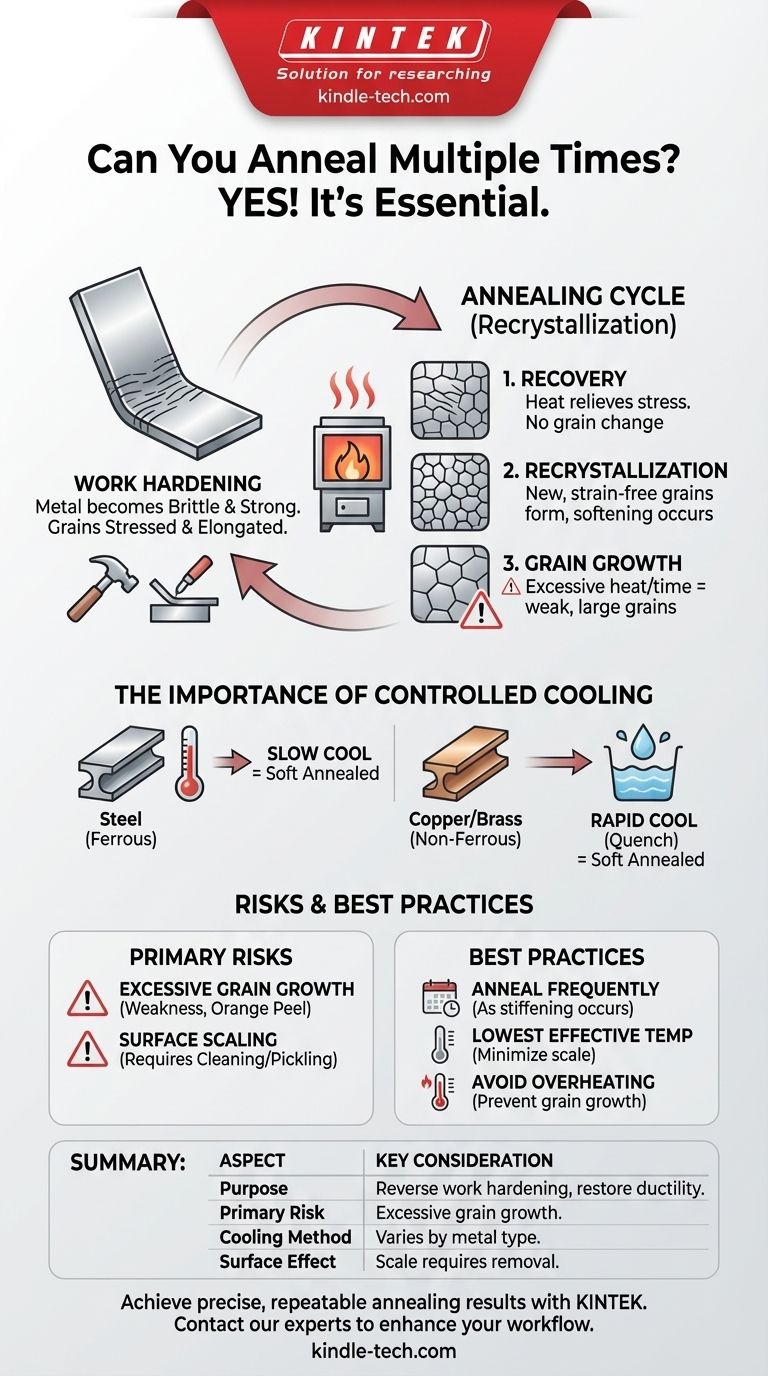
Yes, you can absolutely anneal a metal multiple times. In fact, it is a standard and often necessary practice in many forms of metalworking. Each time a metal is bent, hammered, or stretched—a process known as work hardening—it becomes harder, more brittle, and more resistant to further shaping. Annealing reverses this effect, restoring the metal's ductility and allowing you to continue working with it.

The ability to anneal repeatedly is fundamental to complex metal forming. However, the critical factor is not if you can do it multiple times, but how you control the process each time to avoid degrading the material's structural integrity.
Can you anneal multiple times? Mastering the Cycle for Perfect Metalwork

Why Multiple Annealing Cycles Are Necessary

Understanding Work Hardening

When you mechanically work a metal, you are deforming its internal crystal structure. The microscopic grains that make up the metal become stressed, elongated, and entangled.

This realignment of the grain structure makes the metal stronger but significantly reduces its ability to stretch or bend without cracking. Eventually, the metal will become so brittle that any further work will cause it to fracture.

The Goal: Restoring Ductility

Annealing is the solution to work hardening. By heating the metal to a specific temperature (its recrystallization temperature), you give the atoms enough energy to rearrange themselves into new, strain-free grains.

This process, called recrystallization, effectively resets the metal's internal structure, relieving the built-up stress and making it soft and ductile again. This allows for subsequent rounds of shaping and forming.

A Practical Analogy: Bending a Paperclip

Think of bending a paperclip back and forth. The first few bends are easy. Soon, the bend point becomes stiff and hard. If you continue, it snaps.

That stiff point is the work-hardened zone. If you could anneal the paperclip (without melting it), you could restore its original softness and continue bending it.

The Mechanics of a Proper Annealing Cycle

The Three Key Stages

Every annealing cycle consists of three phases, and understanding them is key to controlling the outcome.

  1. Recovery: As you begin to heat the metal, it first relieves some internal stress without changing the grain structure.
  2. Recrystallization: At the correct temperature, new, stress-free grains begin to form and replace the old, deformed ones. This is the "softening" stage.
  3. Grain Growth: If the metal is held at the annealing temperature for too long, or heated to too high a temperature, the new grains will start to merge and grow larger.

The Importance of Controlled Cooling

The rate at which you cool the metal is just as important as the heating.

For many non-ferrous metals like copper, brass, and sterling silver, you can cool them rapidly by quenching in water. This locks in the soft, annealed state.

For most steels, however, rapid cooling (quenching) will have the opposite effect—it will harden them. Steel must be cooled very slowly to achieve a soft, annealed state.

Understanding the Trade-offs and Risks

The Danger of Excessive Grain Growth

This is the primary risk of improper or excessive annealing. While you want new grains to form, allowing them to grow too large will weaken the material.

Overly large grains can lead to a rough surface texture known as an "orange peel" effect when the metal is bent. More critically, it can reduce the metal's overall strength and toughness.

The Impact of Overheating

Heating a metal far beyond its recrystallization temperature can cause rapid and excessive grain growth. If you heat it too close to its melting point, you risk permanently damaging or destroying the piece.

Surface Oxidation and Scaling

Each time you heat a metal in the presence of oxygen, a layer of oxide, or "scale," will form on the surface.

This scale must typically be removed, often with an acid bath (pickling), before continuing work. Repeated cycles of scaling and pickling can lead to a minor loss of material over time.

How to Apply This to Your Project

Your approach to annealing should be dictated by the material you are using and the demands of your project.

  • If your primary focus is significant shaping (e.g., raising a vessel): Plan to anneal frequently, as soon as you feel the metal begin to stiffen and resist your tools. This prevents the buildup of excessive stress.
  • If your primary focus is preserving fine surface detail: Use the lowest effective temperature and shortest time required for a successful anneal. This will minimize the formation of surface scale.
  • If your primary focus is preventing weakness in the final piece: Avoid overheating and holding the piece at temperature for longer than necessary. Your goal is recrystallization, not excessive grain growth.

Ultimately, viewing annealing not as a single event but as a repeatable and essential step in your workflow is key to achieving complex and successful results in metalwork.

Summary Table:

Aspect Key Consideration
Purpose Reverse work hardening, restore ductility for further shaping.
Primary Risk Excessive grain growth from overheating or holding too long.
Cooling Method Varies by metal (e.g., quench non-ferrous; slow cool steel).
Surface Effect Scale formation requires removal (e.g., pickling).

Achieve precise, repeatable annealing results with KINTEK.

Whether you are shaping complex components or need to restore ductility in precious metals, controlling the annealing cycle is critical to your success. KINTEK specializes in the lab equipment and consumables that laboratories rely on for consistent, high-quality heat treatment processes.

Contact our experts today to discuss how our solutions can enhance your metalworking workflow and ensure material integrity through every cycle.

Visual Guide
Can you anneal multiple times? Mastering the Cycle for Perfect Metalwork Visual Guide

Related Products

People Also Ask

Related Products

Controlled Nitrogen Inert Hydrogen Atmosphere Furnace

Controlled Nitrogen Inert Hydrogen Atmosphere Furnace

KT-AH Hydrogen atmosphere furnace - induction gas furnace for sintering/annealing with built-in safety features, dual housing design, and energy-saving efficiency. Ideal for lab and industrial use.

Vacuum Heat Treat Furnace with Ceramic Fiber Liner

Vacuum Heat Treat Furnace with Ceramic Fiber Liner

Vacuum furnace with polycrystalline ceramic fiber insulation liner for excellent heat insulation and uniform temperature field. Choose from 1200℃ or 1700℃ max. working temperature with high vacuum performance and precise temperature control.

High Temperature Muffle Oven Furnace for Laboratory Debinding and Pre Sintering

High Temperature Muffle Oven Furnace for Laboratory Debinding and Pre Sintering

KT-MD High temperature debinding and pre-sintering furnace for ceramic materials with various molding processes. Ideal for electronic components such as MLCC and NFC.

Laboratory Muffle Oven Furnace Bottom Lifting Muffle Furnace

Laboratory Muffle Oven Furnace Bottom Lifting Muffle Furnace

Efficiently produce batches with excellent temperature uniformity using our Bottom Lifting Furnace. Features two electric lifting stages and advanced temperature control up to 1600℃.

Graphite Vacuum Furnace High Thermal Conductivity Film Graphitization Furnace

Graphite Vacuum Furnace High Thermal Conductivity Film Graphitization Furnace

The high thermal conductivity film graphitization furnace has uniform temperature, low energy consumption and can operate continuously.

Non Consumable Vacuum Arc Induction Melting Furnace

Non Consumable Vacuum Arc Induction Melting Furnace

Explore the benefits of Non-Consumable Vacuum Arc Furnace with high melting point electrodes. Small, easy to operate & eco-friendly. Ideal for laboratory research on refractory metals & carbides.

Vertical High Temperature Graphite Vacuum Graphitization Furnace

Vertical High Temperature Graphite Vacuum Graphitization Furnace

Vertical high temperature graphitization furnace for carbonization and graphitization of carbon materials up to 3100℃.Suitable for shaped graphitization of carbon fiber filaments and other materials sintered in a carbon environment.Applications in metallurgy, electronics, and aerospace for producing high-quality graphite products like electrodes and crucibles.

1200℃ Controlled Atmosphere Furnace Nitrogen Inert Atmosphere Furnace

1200℃ Controlled Atmosphere Furnace Nitrogen Inert Atmosphere Furnace

Discover our KT-12A Pro Controlled atmosphere furnace - high precision, heavy duty vacuum chamber, versatile smart touch screen controller, and excellent temperature uniformity up to 1200C. Ideal for both laboratory and industrial application.

Horizontal High Temperature Graphite Vacuum Graphitization Furnace

Horizontal High Temperature Graphite Vacuum Graphitization Furnace

Horizontal Graphitization Furnace: This type of furnace is designed with the heating elements placed horizontally, allowing for uniform heating of the sample. It's well-suited for graphitizing large or bulky samples that require precise temperature control and uniformity.

1700℃ Controlled Atmosphere Furnace Nitrogen Inert Atmosphere Furnace

1700℃ Controlled Atmosphere Furnace Nitrogen Inert Atmosphere Furnace

KT-17A Controlled atmosphere furnace: 1700℃ heating, vacuum sealing technology, PID temperature control, and versatile TFT smart touch screen controller for laboratory and industrial use.

Dental Porcelain Zirconia Sintering Ceramic Furnace Chairside with Transformer

Dental Porcelain Zirconia Sintering Ceramic Furnace Chairside with Transformer

Experience top-notch sintering with Chairside Sintering Furnace with Transformer. Easy to operate, noise-free pallet, and automatic temperature calibration. Order now!

Ultra-High Temperature Graphite Vacuum Graphitization Furnace

Ultra-High Temperature Graphite Vacuum Graphitization Furnace

The ultra-high temperature graphitization furnace utilizes medium frequency induction heating in a vacuum or inert gas environment. The induction coil generates an alternating magnetic field, inducing eddy currents in the graphite crucible, which heats up and radiates heat to the workpiece, bringing it to the desired temperature. This furnace is primarily used for graphitization and sintering of carbon materials, carbon fiber materials, and other composite materials.

Mesh belt controlled atmosphere furnace

Mesh belt controlled atmosphere furnace

Discover our KT-MB mesh belt sintering furnace - perfect for high-temperature sintering of electronic components & glass insulators. Available for open air or controlled atmosphere environments.

1400℃ Controlled Atmosphere Furnace with Nitrogen and Inert Atmosphere

1400℃ Controlled Atmosphere Furnace with Nitrogen and Inert Atmosphere

Achieve precise heat treatment with KT-14A controlled atmosphere furnace. Vacuum sealed with a smart controller, it's ideal for lab and industrial use up to 1400℃.

Vacuum Heat Treat and Pressure Sintering Furnace for High Temperature Applications

Vacuum Heat Treat and Pressure Sintering Furnace for High Temperature Applications

Vacuum pressure sintering furnaces are designed for high temperature hot pressing applications in metal and ceramic sintering. Its advanced features ensure precise temperature control, reliable pressure maintenance, and a robust design for seamless operation.

Graphite Vacuum Furnace Bottom Discharge Graphitization Furnace for Carbon Materials

Graphite Vacuum Furnace Bottom Discharge Graphitization Furnace for Carbon Materials

Bottom-out graphitization furnace for carbon materials, ultra-high temperature furnace up to 3100°C, suitable for graphitization and sintering of carbon rods and carbon blocks. Vertical design, bottom discharging, convenient feeding and discharging, high temperature uniformity, low energy consumption, good stability, hydraulic lifting system, convenient loading and unloading.

Large Vertical Graphite Vacuum Graphitization Furnace

Large Vertical Graphite Vacuum Graphitization Furnace

A large vertical high-temperature graphitization furnace is a type of industrial furnace used for the graphitization of carbon materials, such as carbon fiber and carbon black. It is a high-temperature furnace that can reach temperatures of up to 3100°C.

Graphite Vacuum Continuous Graphitization Furnace

Graphite Vacuum Continuous Graphitization Furnace

High-temperature graphitization furnace is a professional equipment for graphitization treatment of carbon materials. It is a key equipment for the production of high-quality graphite products. It has high temperature, high efficiency and uniform heating. It is suitable for various high-temperature treatments and graphitization treatments. It is widely used in metallurgy, electronics, aerospace, etc. industry.

Vacuum Arc Induction Melting Furnace

Vacuum Arc Induction Melting Furnace

Discover the power of Vacuum Arc Furnace for melting active & refractory metals. High-speed, remarkable degassing effect, and free of contamination. Learn more now!

Vertical Laboratory Tube Furnace

Vertical Laboratory Tube Furnace

Elevate your experiments with our Vertical Tube Furnace. Versatile design allows for operation under various environments and heat treatment applications. Order now for precise results!


Leave Your Message