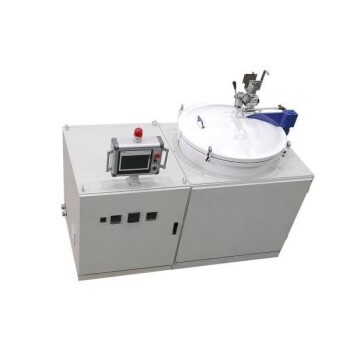
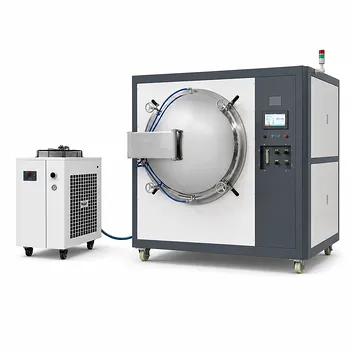
The necessity of a hydrogen atmosphere furnace lies in its ability to actively inhibit and reduce oxide formation on the tungsten surface. By maintaining a reducing environment, the furnace ensures the tungsten remains in a pure metallic state, which is the only state that allows molten copper to effectively wet and infiltrate the skeleton.
The core function of the hydrogen atmosphere is to lower the contact angle between the liquid copper and the tungsten skeleton. Without this reducing environment, surface oxides create a barrier that blocks infiltration and prevents the atomic diffusion required to reach high theoretical densities.
The Science of Wettability and Infiltration
Removing the Oxide Barrier
The primary obstacle in creating Tungsten-Copper (W-Cu) composites is the presence of oxygen. Liquid copper has a large contact angle with oxides, meaning it will bead up rather than spread across an oxidized surface.
Ensuring Metallic Contact
A hydrogen atmosphere furnace solves this by providing a reducing environment. This atmosphere chemically strips away existing oxide layers and inhibits new ones from forming. This leaves the tungsten particles in a pristine metallic state, which is essential for the smooth progression of the infiltration process.
Enhancing Capillary Action
Once the oxides are removed, the wettability of the tungsten significantly increases. This allows the molten copper to flow freely into the pores of the tungsten skeleton, driven by capillary forces rather than blocked by surface tension.
Achieving Structural Integrity through Sintering
Facilitating Atomic Diffusion
Beyond simple wetting, the hydrogen atmosphere plays a critical role in the sintering phase. By removing residual oxygen films, the furnace facilitates atomic diffusion between tungsten particles.
Promoting Grain Boundary Bonding
Clean surfaces allow for strong grain boundary bonding among tungsten atoms. This bonding is the mechanism that transforms loose powder into a cohesive skeleton.
Reaching Theoretical Density
Proper diffusion and bonding allow the final product to achieve 92% to 98% of its theoretical density. This high density is directly responsible for the material’s superior mechanical strength and thermal conductivity.
Operational Parameters and Requirements
The Role of High Temperature
The reduction and sintering process requires extreme heat to be effective. For pure tungsten, temperatures range from 2000°C to 3050°C.
Specialized Alloy Requirements
For specific tungsten alloys or ceramic/metallic compositions, the process generally requires temperatures of 1600°C (2912°F) or higher. At these temperatures, the purity of the hydrogen atmosphere becomes the defining factor in the success of the bond.
Critical Process Sensitivities
The "All or Nothing" Nature of Wetting
The trade-off in this process is its lack of tolerance for impurities. Because the contact angle is so sensitive to oxides, even a partially reducing atmosphere can result in incomplete infiltration.
Temperature vs. Purity Balance
While high temperatures facilitate sintering, they also increase the reactivity of the metals. If the hydrogen atmosphere is not of high purity, the high heat can accelerate defect formation rather than curing it. The process relies on a strict balance where the reducing power of the hydrogen outweighs the oxidation potential of the heat.
Making the Right Choice for Your Goal
To ensure the success of your W-Cu composite preparation, align your process controls with your specific performance targets:
- If your primary focus is Infiltration Efficiency: Prioritize the reducing capability of the furnace to minimize the contact angle between the copper and tungsten.
- If your primary focus is Mechanical Strength: Ensure the furnace can sustain the high temperatures (2000°C+) required to maximize atomic diffusion and grain boundary bonding.
- If your primary focus is Thermal Conductivity: Focus on achieving the highest possible density (aiming for 98%) by maintaining a high-purity hydrogen environment throughout the sintering cycle.
A pure, reducing atmosphere is not merely an optional feature; it is the fundamental enabler of the chemical physics required to bond tungsten and copper.
Summary Table:
| Feature | Role in W-Cu Sintering | Impact on Final Product |
|---|---|---|
| Reducing Environment | Strips oxide layers from tungsten surfaces | Enables molten copper to wet and infiltrate |
| High Temperature | Facilitates atomic diffusion between particles | Maximizes structural integrity and strength |
| Capillary Action | Lowers contact angle of liquid copper | Ensures uniform distribution and 92-98% density |
| Atmosphere Purity | Prevents defect formation at high heat | Optimizes thermal and electrical conductivity |
Elevate Your Advanced Material Processing with KINTEK
Achieving the theoretical density of Tungsten-Copper composites requires absolute control over atmospheric purity and thermal precision. KINTEK specializes in high-performance hydrogen atmosphere and vacuum furnaces, designed to deliver the rigorous reducing environments essential for superior sintering and infiltration.
From high-temperature muffle and tube furnaces to precision crushing, milling, and hydraulic presses, KINTEK provides the end-to-end solutions laboratory researchers and manufacturers need to produce high-density, defect-free materials.
Ready to optimize your sintering cycle? Contact our technical experts today to find the perfect furnace or lab equipment for your specific application.
References
- Jiří Matějíček. Preparation of W-Cu composites by infiltration of W skeletons – review. DOI: 10.37904/metal.2021.4248
This article is also based on technical information from Kintek Solution Knowledge Base .
Related Products
- Controlled Nitrogen Inert Hydrogen Atmosphere Furnace
- 1200℃ Controlled Atmosphere Furnace Nitrogen Inert Atmosphere Furnace
- 1400℃ Controlled Atmosphere Furnace with Nitrogen and Inert Atmosphere
- 1700℃ Controlled Atmosphere Furnace Nitrogen Inert Atmosphere Furnace
- Mesh belt controlled atmosphere furnace
People Also Ask
- Why is hydrogen used in furnaces? Achieve Superior Purity and Bright Finishes
- What is the role of a hydrogen atmosphere furnace in diamond/copper composites? Enhance Your Material Purity
- What are the characteristics and risks of a hydrogen atmosphere in a furnace? Master the Balance of Power and Control
- What is the use of hydrogen in furnace? A Key to Oxygen-Free High-Temperature Processing
- What role does an atmosphere furnace utilizing hydrogen gas play in Cu-Cr-Nb alloy powder pretreatment? (Key Insights)