Knowledge Vacuum Furnace Can you braze copper to brass without flux? Yes, but only under these specific conditions.
Author avatar

Tech Team · Kintek Solution

Updated 2 months ago

Can you braze copper to brass without flux? Yes, but only under these specific conditions.


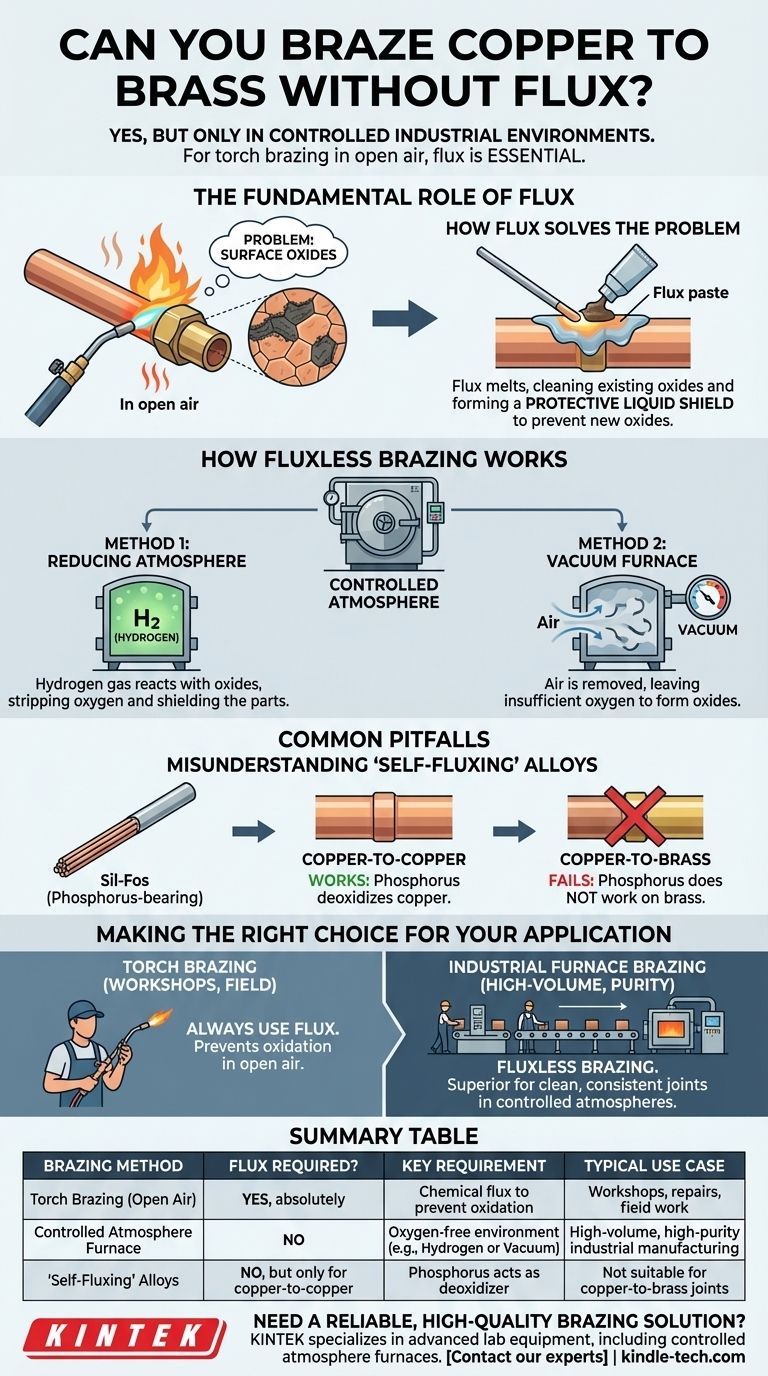
Yes, it is technically possible to braze copper to brass without flux, but only under highly specific industrial conditions. For any standard brazing operation using a torch in open air, flux is absolutely essential. The absence of flux in a normal environment will result in a failed joint due to the rapid formation of surface oxides when the metals are heated.

The core principle of brazing is that the filler metal must bond directly with a pure, clean base metal. The primary role of flux is to prevent oxygen from contaminating the joint area during heating. If you can remove the oxygen from the environment itself, you can eliminate the need for flux.
Can you braze copper to brass without flux? Yes, but only under these specific conditions.

The Fundamental Role of Flux in Brazing

To understand when you can omit flux, you must first understand why it's required in the first place. The entire process hinges on preventing one chemical reaction: oxidation.

The Problem: Surface Oxides

When you heat metals like copper and brass in the presence of air, the metal surfaces react with oxygen to form a thin, hard layer of metal oxides.

This oxide layer acts as a barrier. Molten brazing alloy cannot wet or flow over an oxidized surface, and it cannot form a strong metallurgical bond with the base metals underneath.

How Flux Solves the Problem

Brazing flux is a chemical compound that performs two critical jobs when heated.

First, it cleans and dissolves any minor surface oxides that are already present. Second, and more importantly, it melts to form a protective liquid shield over the joint area, preventing oxygen from reaching the hot base metals and creating new oxides.

Why This is Critical for Copper-to-Brass

Both copper and the zinc within brass oxidize very quickly at brazing temperatures. Without a protective layer of flux, the joint area would become heavily oxidized long before the brazing alloy could melt and flow, guaranteeing a weak or nonexistent bond.

How Fluxless Brazing Works

Fluxless brazing is possible only when you replace the protective function of flux with another method of oxygen control.

The Core Principle: A Controlled Atmosphere

The only way to braze without flux is to perform the heating process inside a sealed environment where oxygen has been removed and replaced with a specific gas or a vacuum.

This is known as controlled atmosphere brazing and is typically done in an industrial furnace.

Method 1: Reducing Atmosphere Furnace

As noted in specialized processes, a furnace can be filled with a reducing gas like hydrogen.

At brazing temperatures, the hydrogen actively reacts with any metal oxides on the parts, stripping the oxygen away and converting the oxides back into pure metal. The hydrogen gas itself acts as the flux, both cleaning the parts and shielding them from any trace oxygen.

Method 2: Vacuum Furnace

Another common industrial method is brazing in a vacuum furnace. By pumping nearly all the air out of the heating chamber, there is simply not enough oxygen present to form detrimental oxide layers on the parts.

Common Pitfalls to Avoid

It is crucial to distinguish industrial furnace brazing from common torch brazing. A frequent point of confusion arises with certain filler metals.

Misunderstanding "Self-Fluxing" Alloys

Some phosphorus-bearing brazing alloys (like Sil-Fos) are described as "self-fluxing" when joining copper to copper.

In this specific case, the phosphorus in the alloy acts as a deoxidizing agent, performing the function of flux. However, this effect only works on pure copper. It is not effective on brass, bronze, or steel. Attempting to braze copper to brass with a self-fluxing alloy and no separate flux will result in a failed joint.

Making the Right Choice for Your Application

Your need for flux is determined entirely by your brazing environment, not just the metals you are joining.

  • If your primary focus is brazing with a torch in a workshop or field setting: You must always use a suitable brazing flux designed for copper and brass.
  • If your primary focus is designing a high-volume, high-purity industrial manufacturing process: Fluxless furnace brazing in a controlled atmosphere is often the superior method for creating clean, consistent, and residue-free joints.

Ultimately, mastering the brazing process comes down to controlling oxidation.

Summary Table:

Brazing Method Flux Required? Key Requirement Typical Use Case
Torch Brazing (Open Air) Yes, absolutely Chemical flux to prevent oxidation Workshops, repairs, field work
Controlled Atmosphere Furnace No Oxygen-free environment (e.g., Hydrogen or Vacuum) High-volume, high-purity industrial manufacturing
"Self-Fluxing" Alloys No, but only for copper-to-copper Phosphorus content acts as a deoxidizer Not suitable for copper-to-brass joints

Need a reliable, high-quality brazing solution for your laboratory or production line?

At KINTEK, we specialize in advanced lab equipment, including the controlled atmosphere furnaces that make fluxless brazing possible. Our expertise ensures clean, strong, and consistent joints for your copper, brass, and other metal assemblies.

Let us help you select the right equipment for your specific brazing application. Contact our experts today to discuss your project requirements and discover the KINTEK difference.

Visual Guide
Can you braze copper to brass without flux? Yes, but only under these specific conditions. Visual Guide

Related Products

People Also Ask

Related Products

1200℃ Controlled Atmosphere Furnace Nitrogen Inert Atmosphere Furnace

1200℃ Controlled Atmosphere Furnace Nitrogen Inert Atmosphere Furnace

Discover our KT-12A Pro Controlled atmosphere furnace - high precision, heavy duty vacuum chamber, versatile smart touch screen controller, and excellent temperature uniformity up to 1200C. Ideal for both laboratory and industrial application.

1700℃ Controlled Atmosphere Furnace Nitrogen Inert Atmosphere Furnace

1700℃ Controlled Atmosphere Furnace Nitrogen Inert Atmosphere Furnace

KT-17A Controlled atmosphere furnace: 1700℃ heating, vacuum sealing technology, PID temperature control, and versatile TFT smart touch screen controller for laboratory and industrial use.

1400℃ Controlled Atmosphere Furnace with Nitrogen and Inert Atmosphere

1400℃ Controlled Atmosphere Furnace with Nitrogen and Inert Atmosphere

Achieve precise heat treatment with KT-14A controlled atmosphere furnace. Vacuum sealed with a smart controller, it's ideal for lab and industrial use up to 1400℃.

Controlled Nitrogen Inert Hydrogen Atmosphere Furnace

Controlled Nitrogen Inert Hydrogen Atmosphere Furnace

KT-AH Hydrogen atmosphere furnace - induction gas furnace for sintering/annealing with built-in safety features, dual housing design, and energy-saving efficiency. Ideal for lab and industrial use.

Mesh belt controlled atmosphere furnace

Mesh belt controlled atmosphere furnace

Discover our KT-MB mesh belt sintering furnace - perfect for high-temperature sintering of electronic components & glass insulators. Available for open air or controlled atmosphere environments.

Multi Heating Zones CVD Tube Furnace Machine Chemical Vapor Deposition Chamber System Equipment

Multi Heating Zones CVD Tube Furnace Machine Chemical Vapor Deposition Chamber System Equipment

KT-CTF14 Multi Heating Zones CVD Furnace - Precise Temperature Control and Gas Flow for Advanced Applications. Max temp up to 1200℃, 4 channels MFC mass flow meter, and 7" TFT touch screen controller.

Customer Made Versatile CVD Tube Furnace Chemical Vapor Deposition Chamber System Equipment

Customer Made Versatile CVD Tube Furnace Chemical Vapor Deposition Chamber System Equipment

Get your exclusive CVD furnace with KT-CTF16 Customer Made Versatile Furnace. Customizable sliding, rotating, and tilting functions for precise reactions. Order now!

High Temperature Muffle Oven Furnace for Laboratory Debinding and Pre Sintering

High Temperature Muffle Oven Furnace for Laboratory Debinding and Pre Sintering

KT-MD High temperature debinding and pre-sintering furnace for ceramic materials with various molding processes. Ideal for electronic components such as MLCC and NFC.

Vacuum Arc Induction Melting Furnace

Vacuum Arc Induction Melting Furnace

Discover the power of Vacuum Arc Furnace for melting active & refractory metals. High-speed, remarkable degassing effect, and free of contamination. Learn more now!

Laboratory Muffle Oven Furnace Bottom Lifting Muffle Furnace

Laboratory Muffle Oven Furnace Bottom Lifting Muffle Furnace

Efficiently produce batches with excellent temperature uniformity using our Bottom Lifting Furnace. Features two electric lifting stages and advanced temperature control up to 1600℃.

Ultra-High Temperature Graphite Vacuum Graphitization Furnace

Ultra-High Temperature Graphite Vacuum Graphitization Furnace

The ultra-high temperature graphitization furnace utilizes medium frequency induction heating in a vacuum or inert gas environment. The induction coil generates an alternating magnetic field, inducing eddy currents in the graphite crucible, which heats up and radiates heat to the workpiece, bringing it to the desired temperature. This furnace is primarily used for graphitization and sintering of carbon materials, carbon fiber materials, and other composite materials.

Vacuum Heat Treat and Pressure Sintering Furnace for High Temperature Applications

Vacuum Heat Treat and Pressure Sintering Furnace for High Temperature Applications

Vacuum pressure sintering furnaces are designed for high temperature hot pressing applications in metal and ceramic sintering. Its advanced features ensure precise temperature control, reliable pressure maintenance, and a robust design for seamless operation.

Horizontal High Temperature Graphite Vacuum Graphitization Furnace

Horizontal High Temperature Graphite Vacuum Graphitization Furnace

Horizontal Graphitization Furnace: This type of furnace is designed with the heating elements placed horizontally, allowing for uniform heating of the sample. It's well-suited for graphitizing large or bulky samples that require precise temperature control and uniformity.

1700℃ Muffle Oven Furnace for Laboratory

1700℃ Muffle Oven Furnace for Laboratory

Get superior heat control with our 1700℃ Muffle Furnace. Equipped with intelligent temperature microprocessor, TFT touch screen controller & advanced insulation materials for precise heating up to 1700C. Order now!

Lab-Scale Vacuum Induction Melting Furnace

Lab-Scale Vacuum Induction Melting Furnace

Get precise alloy composition with our Vacuum Induction Melting Furnace. Ideal for aerospace, nuclear energy, and electronic industries. Order now for effective smelting and casting of metals and alloys.

Graphite Vacuum Furnace Bottom Discharge Graphitization Furnace for Carbon Materials

Graphite Vacuum Furnace Bottom Discharge Graphitization Furnace for Carbon Materials

Bottom-out graphitization furnace for carbon materials, ultra-high temperature furnace up to 3100°C, suitable for graphitization and sintering of carbon rods and carbon blocks. Vertical design, bottom discharging, convenient feeding and discharging, high temperature uniformity, low energy consumption, good stability, hydraulic lifting system, convenient loading and unloading.

Multi-zone Laboratory Tube Furnace

Multi-zone Laboratory Tube Furnace

Experience precise, efficient thermal testing with our Multi Zone Tube Furnace. Independent heating zones and temperature sensors allow for controlled high-temperature gradient heating fields. Order now for advanced thermal analysis!

600T Vacuum Induction Hot Press Furnace for Heat Treat and Sintering

600T Vacuum Induction Hot Press Furnace for Heat Treat and Sintering

Discover the 600T Vacuum Induction Hot Press Furnace, designed for high-temperature sintering experiments in vacuum or protected atmospheres. Its precise temperature and pressure control, adjustable working pressure, and advanced safety features make it ideal for nonmetal materials, carbon composites, ceramics, and metal powders.

1400℃ Muffle Oven Furnace for Laboratory

1400℃ Muffle Oven Furnace for Laboratory

Get precise high-temperature control up to 1500℃ with KT-14M Muffle furnace. Equipped with a smart touch screen controller and advanced insulation materials.

Vacuum Heat Treat Furnace with Ceramic Fiber Liner

Vacuum Heat Treat Furnace with Ceramic Fiber Liner

Vacuum furnace with polycrystalline ceramic fiber insulation liner for excellent heat insulation and uniform temperature field. Choose from 1200℃ or 1700℃ max. working temperature with high vacuum performance and precise temperature control.


Leave Your Message



















